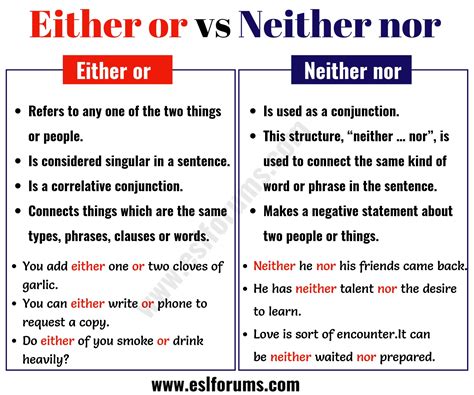
The English language is replete with grammatical rules that can often seem bewildering, even to native speakers. One such rule that frequently poses challenges is the correct usage of "neither" and "nor" in sentences. Understanding the nuances of these conjunctions is crucial for effective communication and to avoid grammatical errors. In this article, we will delve into the world of "neither" and "nor," exploring their meanings, usage, and the grammatical rules that govern their application in sentences.
Introduction to Neither and Nor
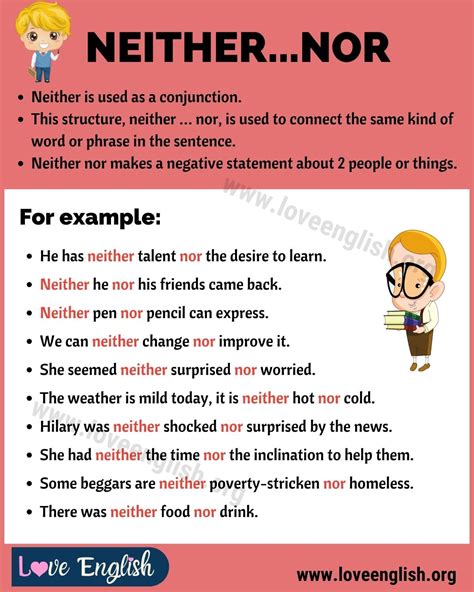
Both “neither” and “nor” are used in English to indicate a negative choice between two options. However, they are not interchangeable and have distinct grammatical functions. “Neither” is used to present the first option in a negative choice, while “nor” follows to present the second or subsequent options. For instance, “I like neither coffee nor tea” demonstrates how “neither” introduces the first negative option, and “nor” introduces the second. This understanding is foundational to using these words correctly in sentences.
Basic Grammar Rules for Neither and Nor
A key rule when using “neither” and “nor” is that they should be used with a negative verb phrase. For example, “He doesn’t like reading books, nor does he enjoy watching movies.” Here, “nor” is correctly used after a negative statement to introduce another negative option. Another important rule is that when using “neither” or “nor” in a sentence, the verb often agrees with the subject that immediately precedes it. This can sometimes lead to sentences that sound a bit awkward but are grammatically correct, such as “Neither the students nor the teacher was prepared for the test.” In this case, “was” agrees with “teacher,” which is the subject closer to the verb.
| Conjunction | Usage Example |
|---|---|
| Neither | I like neither coffee nor tea. |
| Nor | He doesn't like reading, nor does he enjoy writing. |

Advanced Usage and Common Mistakes
One common mistake in using “neither” and “nor” is the incorrect application of verb agreement. For instance, in the sentence “Neither the manager nor the employees are responsible,” the verb “are” agrees with “employees,” which is a plural subject and the one closer to the verb. However, in cases where “neither” is part of the subject, and the other subject is singular, the verb should agree with the nearer subject, leading to sentences like “Neither the boys nor the girl was there.” This rule can sometimes make sentences sound unnatural, but they are grammatically correct.
Negative Correlates and Parallel Structure
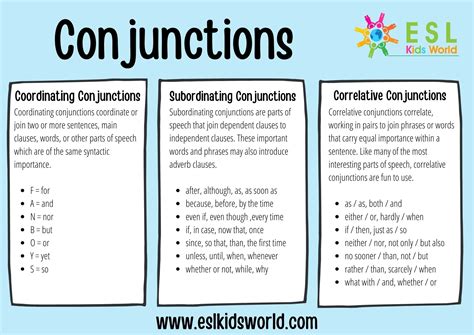
When using “neither” and “nor,” maintaining parallel structure in sentences is crucial for clarity and grammatical correctness. For example, “I don’t like coffee, nor do I like tea” maintains a parallel structure by using “do” after “nor” to match the verb form before “nor.” This parallel structure makes the sentence clear and easier to understand. Additionally, using negative correlates like “not only… but also” or “either… or” can sometimes be confused with “neither… nor” constructions. However, these are used in different contexts and convey different meanings.
Key Points
- Correct Usage: "Neither" introduces the first negative option, and "nor" introduces subsequent options.
- Verb Agreement: The verb often agrees with the subject that immediately precedes it in "neither... nor" constructions.
- Parallel Structure: Maintaining parallel structure is crucial for clarity and grammatical correctness.
- Determiner Usage: "Neither" can be used as a determiner to indicate that two or more things are not true.
- Negative Correlates: Understand the difference between "neither... nor" and other negative correlates like "not only... but also" or "either... or."
In conclusion, mastering the use of "neither" and "nor" in English grammar requires understanding their distinct roles, the rules governing their usage, and how to maintain grammatical correctness in various sentence structures. By recognizing the nuances of these conjunctions and applying the rules outlined above, individuals can enhance their command of the English language and communicate more effectively.
What is the primary difference between “neither” and “nor”?
+“Neither” is used to introduce the first negative option, while “nor” is used to introduce subsequent negative options.
How does verb agreement work with “neither… nor” constructions?
+The verb often agrees with the subject that immediately precedes it. If the subjects are of different numbers (singular or plural), the verb agrees with the nearer subject.
Can “neither” be used as a determiner?
+Yes, “neither” can be used as a determiner to indicate that two or more things are not true, as in “Neither of the solutions worked.”