Converting miles per hour (mph) to feet per second (ft/s) is a fundamental process in physics and engineering, particularly when dealing with velocity and speed calculations. This conversion is crucial for understanding and comparing different rates of movement, whether it's the speed of a vehicle, the velocity of an object in motion, or the flow rate of fluids. In this article, we will explore the ways to convert mph to feet per second, emphasizing the importance of accuracy and the practical applications of such conversions.
Key Points
- The conversion factor from miles per hour to feet per second involves multiplying by 1.46667.
- Understanding the conversion process is essential for various applications in physics, engineering, and everyday life.
- Accurate conversions require attention to the units involved and the context of the problem.
- Practical applications include calculating the speed of vehicles, the velocity of moving objects, and the flow rates of fluids.
- Using conversion factors helps in comparing different rates of movement and ensures consistency across various measurement systems.
Method 1: Direct Conversion
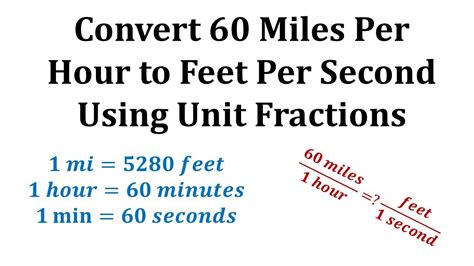
To convert mph to feet per second directly, we use the conversion factor where 1 mph equals 1.46667 feet per second. This method involves a straightforward multiplication. For example, if you want to convert 60 mph to feet per second, you multiply 60 by 1.46667, which equals approximately 88 feet per second.
Formula and Calculation
The formula for this conversion is: feet per second = mph * 1.46667. This calculation is simple and provides a quick way to convert between these two units of speed.
Method 2: Using Conversion Factors
An alternative method involves breaking down the conversion into steps using basic units. Since 1 mile equals 5280 feet and 1 hour equals 3600 seconds, we can convert mph to feet per second by first converting miles to feet and then hours to seconds. This involves multiplying mph by 5280⁄3600, which simplifies to 1.46667, the same conversion factor used in the direct method.
Step-by-Step Calculation
1. Convert miles to feet: 1 mile = 5280 feet.
2. Convert hours to seconds: 1 hour = 3600 seconds.
3. Calculate the conversion factor: 5280 feet / 3600 seconds = 1.46667 feet per second per mph.
Method 3: Online Conversion Tools
In today’s digital age, numerous online tools and calculators can perform the mph to feet per second conversion instantly. These tools are convenient for quick conversions and often provide additional features such as converting between other units of speed or performing complex calculations.
Benefits and Limitations
The benefits of using online conversion tools include speed and convenience. However, reliance on these tools without understanding the underlying conversion process can limit one’s ability to perform calculations manually or understand the principles behind the conversions.
Method 4: Spreadsheet or Software Calculations
For those who need to perform multiple conversions or integrate the conversion into a larger calculation, using a spreadsheet program like Excel or a specialized software can be highly efficient. By setting up a formula once, you can easily convert mph to feet per second for any number of values.
Setting Up the Formula
In a spreadsheet, you can set up a column for mph values and another for the converted feet per second values. The formula for converting mph to feet per second in each cell would be “=A1*1.46667”, where A1 is the cell containing the mph value.
Method 5: Manual Estimation

For quick estimations or when precise calculations are not required, one can use a simplified version of the conversion factor. Knowing that 1 mph is approximately 1.5 feet per second can provide a rapid, though less accurate, conversion method.
Application and Limitation
This method is useful for rough estimates or when the exact conversion is not critical. However, for precise calculations or in applications where accuracy is paramount, using the exact conversion factor of 1.46667 is recommended.
| Conversion Method | Description | Accuracy |
|---|---|---|
| Direct Conversion | Using the conversion factor 1.46667 | High |
| Conversion Factors | Breaking down units for conversion | High |
| Online Tools | Utilizing digital calculators | High |
| Spreadsheet Calculations | Using software for multiple conversions | High |
| Manual Estimation | Approximating with 1.5 feet per second | Low |
What is the most accurate method for converting mph to feet per second?
+The most accurate method involves using the direct conversion factor of 1.46667, as it provides a precise calculation without the need for intermediate steps that might introduce errors.
How do I choose the best method for my conversion needs?
+The choice of method depends on the context and the required level of accuracy. For precise calculations, the direct conversion method or using conversion factors is recommended. For quick estimates, manual estimation or online tools might suffice.
Can I use these conversion methods for other units of speed?
+Yes, understanding the principles behind converting mph to feet per second can be applied to converting other units of speed by using appropriate conversion factors and understanding the relationship between different units of measurement.
Converting miles per hour to feet per second is a straightforward process once the conversion factor is understood. Whether using direct conversion, breaking down units, online tools, spreadsheet calculations, or manual estimation, the key to accurate conversions lies in understanding the underlying principles and applying them correctly. By mastering these methods, individuals can enhance their ability to work with different units of speed, facilitating more accurate calculations and comparisons in various fields.