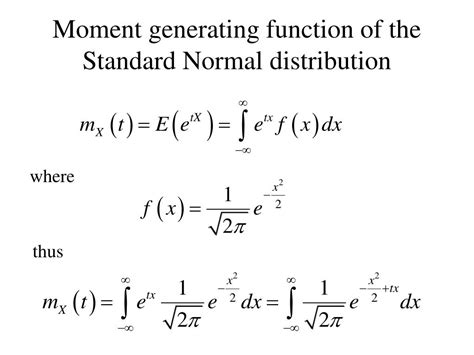
The moment generating function (MGF) is a fundamental concept in probability theory and statistics, playing a crucial role in understanding and analyzing the properties of random variables. It is a powerful tool that helps in characterizing the distribution of a random variable, providing valuable insights into its behavior and properties. In this article, we will delve into the concept of the moment generating function, its definition, properties, and applications, with the aim of providing a comprehensive understanding of this essential topic.
Key Points
- The moment generating function is a function that generates the moments of a random variable.
- It is defined as the expected value of $e^{tX}$, where $X$ is the random variable and $t$ is a parameter.
- The MGF is used to characterize the distribution of a random variable and to derive its properties.
- It is a powerful tool for solving problems in probability theory and statistics.
- The MGF has a wide range of applications in fields such as engineering, economics, and finance.
Definition and Properties of the Moment Generating Function
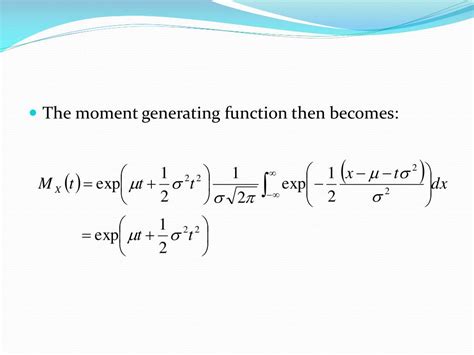
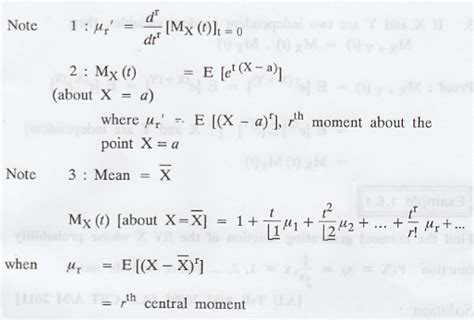
The moment generating function of a random variable X is defined as M_X(t) = E[e^{tX}], where E denotes the expected value and t is a parameter. The MGF is a function of t and is defined for all values of t for which the expected value exists. One of the key properties of the MGF is that it generates the moments of the random variable. The nth moment of X can be obtained by differentiating the MGF n times with respect to t and evaluating the result at t=0. This property makes the MGF a powerful tool for deriving the moments of a random variable.
Derivation of Moments from the MGF
The MGF can be used to derive the moments of a random variable by differentiating it with respect to t. The first moment, or mean, of X can be obtained by differentiating the MGF with respect to t and evaluating the result at t=0. Similarly, the second moment, or variance, can be obtained by differentiating the MGF twice with respect to t and evaluating the result at t=0. This process can be continued to obtain higher-order moments. The ability to derive moments from the MGF makes it a valuable tool in probability theory and statistics.
| Moment | Derivation from MGF |
|---|---|
| Mean | $\frac{d}{dt}M_X(t)|_{t=0}$ |
| Variance | $\frac{d^2}{dt^2}M_X(t)|_{t=0} - \left(\frac{d}{dt}M_X(t)|_{t=0}\right)^2$ |
| Skewness | $\frac{d^3}{dt^3}M_X(t)|_{t=0} - 3\frac{d^2}{dt^2}M_X(t)|_{t=0}\frac{d}{dt}M_X(t)|_{t=0} + 2\left(\frac{d}{dt}M_X(t)|_{t=0}\right)^3$ |
Applications of the Moment Generating Function
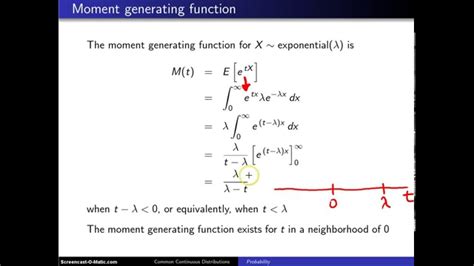
The moment generating function has a wide range of applications in fields such as engineering, economics, and finance. It is used to analyze and understand the properties of random variables, which is essential in many real-world applications. For example, in finance, the MGF is used to model and analyze the behavior of stock prices and to derive the moments of the returns on investment. In engineering, the MGF is used to analyze and understand the properties of signals and systems. The ability to derive the moments of a random variable makes the MGF a valuable tool in many fields.
MGF in Finance
In finance, the MGF is used to model and analyze the behavior of stock prices and to derive the moments of the returns on investment. The MGF is used to calculate the expected return and volatility of a portfolio, which is essential in investment decisions. The ability to derive the moments of the returns on investment makes the MGF a valuable tool in finance.
The moment generating function is a fundamental concept in probability theory and statistics, providing valuable insights into the properties of random variables. Its ability to derive the moments of a random variable makes it a powerful tool in many fields, including engineering, economics, and finance. By understanding the concept of the MGF and its applications, we can gain a deeper understanding of the behavior and properties of random variables, which is essential in many real-world applications.
What is the moment generating function?
+The moment generating function is a function that generates the moments of a random variable. It is defined as the expected value of $e^{tX}$, where $X$ is the random variable and $t$ is a parameter.
What are the properties of the moment generating function?
+The moment generating function has several properties, including the ability to derive the moments of a random variable by differentiating it with respect to $t$. The MGF is also used to characterize the distribution of a random variable and to derive its properties.
What are the applications of the moment generating function?
+The moment generating function has a wide range of applications in fields such as engineering, economics, and finance. It is used to analyze and understand the properties of random variables, which is essential in many real-world applications.
Meta Description: Learn about the moment generating function, its definition, properties, and applications in probability theory and statistics. Discover how the MGF is used to derive the moments of a random variable and its role in characterizing the distribution of a random variable.