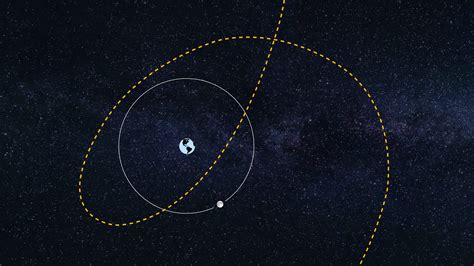
The discovery of a mini moon asteroid orbiting Earth has garnered significant attention in the scientific community, sparking a flurry of research and speculation about the origins and implications of this phenomenon. The asteroid, designated as 2020 CD3, is a small, temporary satellite that has been gravitationally bound to our planet since 2017. With a diameter of approximately 1-2 meters, this tiny asteroid is one of several known objects to have orbited Earth, albeit for a relatively short period.
Key Points
- The mini moon asteroid 2020 CD3 has been orbiting Earth since 2017, with a diameter of approximately 1-2 meters.
- The asteroid's orbit is highly elliptical, taking it as close as 20,000 kilometers from Earth and as far as 1.2 million kilometers away.
- Researchers estimate that 2020 CD3 is a fragment of a larger asteroid that was perturbed into Earth's gravitational sphere of influence.
- The discovery of mini moon asteroids like 2020 CD3 provides valuable insights into the formation and evolution of our solar system.
- Further study of these objects can help scientists better understand the dynamics of small-body orbits and the potential risks associated with near-Earth asteroids.
Orbital Characteristics and Implications
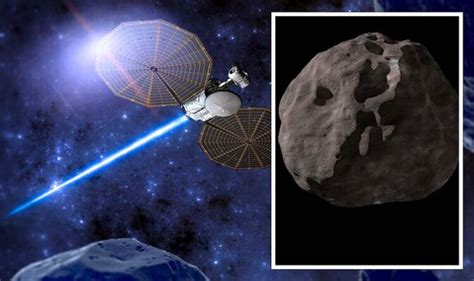
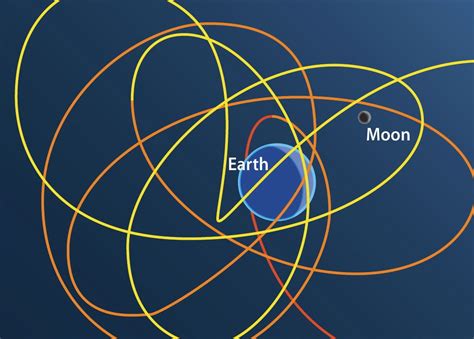
The orbital characteristics of 2020 CD3 are quite remarkable, with a highly elliptical path that takes it as close as 20,000 kilometers from Earth and as far as 1.2 million kilometers away. This unusual orbit is a result of the asteroid’s small size and the gravitational influence of other celestial bodies, such as the Moon and the Sun. Researchers estimate that 2020 CD3 is a fragment of a larger asteroid that was perturbed into Earth’s gravitational sphere of influence, possibly due to a collision or gravitational interaction with another object.
Formation and Evolution of Mini Moon Asteroids
The formation and evolution of mini moon asteroids like 2020 CD3 are complex processes that involve a combination of factors, including the gravitational influence of nearby celestial bodies, the Yarkovsky effect, and the perturbing effects of other asteroids and comets. The Yarkovsky effect, which is caused by the uneven heating of an asteroid’s surface by the Sun, can lead to a gradual change in the asteroid’s orbit over time. This, in turn, can cause the asteroid to be perturbed into a more stable or unstable orbit, depending on the specific circumstances.
| Asteroid Characteristic | Value |
|---|---|
| Diameter | 1-2 meters |
| Orbital Period | 47.4 days |
| Periapsis | 20,000 kilometers |
| Apoapsis | 1.2 million kilometers |

Research and Observation Efforts
Researchers have employed a range of observational and analytical techniques to study 2020 CD3, including optical and spectroscopic observations, as well as orbital simulations and modeling. The Catalina Sky Survey, a NASA-funded project that uses a combination of telescopes and software to detect near-Earth asteroids, was instrumental in the discovery of 2020 CD3. Further study of this asteroid and others like it will require continued observation and monitoring, as well as the development of new technologies and methodologies for detecting and tracking small, faint objects in the night sky.
Conclusion and Future Directions
In conclusion, the discovery of the mini moon asteroid 2020 CD3 has significant implications for our understanding of the formation and evolution of our solar system, as well as the dynamics of small-body orbits. Further research and observation efforts are needed to fully characterize the orbital characteristics and physical properties of this asteroid, as well as to identify and track other objects like it. By continuing to explore and study these enigmatic objects, scientists can gain a deeper understanding of the complex processes that shape our solar system and the potential risks associated with near-Earth asteroids.
What is a mini moon asteroid?
+A mini moon asteroid is a small, temporary satellite that orbits Earth, typically with a diameter of less than 10 meters. These objects are often fragments of larger asteroids that have been perturbed into Earth’s gravitational sphere of influence.
How was 2020 CD3 discovered?
+2020 CD3 was discovered by the Catalina Sky Survey, a NASA-funded project that uses a combination of telescopes and software to detect near-Earth asteroids.
What are the implications of the discovery of 2020 CD3?
+The discovery of 2020 CD3 has significant implications for our understanding of the formation and evolution of our solar system, as well as the dynamics of small-body orbits. Further study of this asteroid and others like it can help scientists better understand the potential risks associated with near-Earth asteroids.