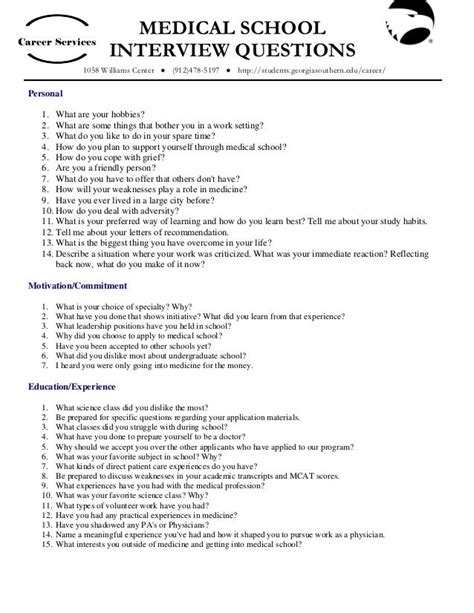
Medical school interviews are a crucial step in the application process, allowing applicants to demonstrate their knowledge, skills, and personal qualities to admissions committees. The questions posed during these interviews can be challenging, but preparing for common queries can help applicants feel more confident and articulate. In this article, we will explore five med school interview questions, providing insights into what interviewers are looking for and offering tips on how to respond effectively.
Key Points
- Understanding the interviewer's perspective is crucial for effective responses.
- Showing empathy and compassion is essential in medical school interviews.
- Highlighting unique experiences and strengths can make an applicant stand out.
- Discussing current healthcare issues demonstrates awareness and engagement.
- Personal and professional goals should align with the values of the medical profession.
Why Do You Want to Be a Doctor?

This question is often used as an icebreaker, but it also provides valuable insight into an applicant’s motivations and understanding of the medical profession. When responding, it’s essential to be sincere and specific, avoiding clichés and generic answers. Interviewers are looking for evidence of a deep commitment to the field, often demonstrated through personal experiences, volunteer work, or research endeavors. For instance, an applicant might discuss how volunteering at a local hospital inspired them to pursue a career in medicine, highlighting the impact they hope to make in patients’ lives.
What Are Some Challenges Facing the Healthcare System Today?
This question assesses an applicant’s awareness of current healthcare issues and their ability to think critically about potential solutions. It’s crucial to demonstrate knowledge of topics such as healthcare disparities, access to care, and the impact of policy changes on patient outcomes. When discussing these challenges, applicants should also offer thoughtful suggestions for improvement, showcasing their problem-solving skills and commitment to addressing complex issues. For example, an applicant might discuss the role of telemedicine in expanding access to care, especially in rural areas, and how it could be further developed to meet the evolving needs of diverse patient populations.
| Healthcare Challenge | Potential Solution |
|---|---|
| Healthcare Disparities | Culturally competent care, community outreach programs |
| Access to Care | Telemedicine, mobile health clinics, policy advocacy |
| Mental Health Stigma | Public awareness campaigns, integrated mental health services |
Tell Me About a Time When You Overcame a Difficult Situation.
This behavioral question is designed to evaluate an applicant’s resilience, problem-solving skills, and ability to work under pressure. The STAR method ( Situation, Task, Action, Result) can be a helpful framework for structuring a response. By describing a specific situation, the task they faced, the actions they took, and the results of those actions, applicants can provide a clear, concise narrative that highlights their capabilities. For instance, an applicant might recount a challenging experience during a clinical rotation, where they had to navigate a difficult patient interaction, and explain how they resolved the situation through effective communication and empathy.
How Do You Handle Stress and Maintain a Work-Life Balance?
Given the high-stress nature of medical education and practice, interviewers want to know that applicants have strategies for managing their well-being. Discussing personal hobbies, exercise routines, or mindfulness practices can demonstrate an awareness of the importance of self-care. It’s also essential to show that you understand the value of seeking help when needed and prioritize your mental health. An applicant might talk about their experience with meditation, highlighting how it helps them stay focused and resilient during challenging times.
Where Do You See Yourself in Ten Years?
This question looks at an applicant’s long-term goals and whether they align with the values and expectations of the medical profession. When responding, it’s crucial to be honest about your aspirations, whether they involve clinical practice, research, public health, or medical education. Interviewers are interested in applicants who have thoughtfully considered their career paths and can articulate how their goals will contribute to the broader healthcare landscape. For example, an applicant might express their desire to work in underserved communities, combining clinical practice with advocacy to address healthcare disparities and improve outcomes for vulnerable populations.
What is the most important quality for a medical student to possess?
+Empathy and compassion are often cited as essential qualities, as they enable medical professionals to provide patient-centered care and build strong, supportive relationships with their patients.
How can I prepare for medical school interviews?
+Preparation involves researching common interview questions, practicing responses with friends or mentors, and staying updated on current healthcare issues to demonstrate awareness and engagement.
What should I wear to a medical school interview?
+Dressing professionally is key, opting for attire that is conservative, clean, and well-fitted. For men, a suit and tie are often recommended, while for women, a professional dress or pantsuit is appropriate.
In conclusion, medical school interviews are not just about answering questions but about telling a story of passion, dedication, and commitment to the field of medicine. By preparing thoughtful responses to common interview questions and demonstrating a deep understanding of the challenges and opportunities in healthcare, applicants can make a lasting impression on admissions committees and take a significant step towards realizing their dream of becoming a doctor.