The age-old debate between "lead" and "led" has sparked confusion among writers and linguists alike. The distinction between these two words lies in their grammatical functions and pronunciation. In this article, we will delve into the nuances of "lead" and "led," providing 5 essential tips to help you master their usage.
Key Points
- Understanding the difference between "lead" as a noun and a verb
- Recognizing the past tense of the verb "lead" as "led"
- Identifying the correct pronunciation of "lead" and "led"
- Applying the correct usage of "lead" and "led" in sentences
- Avoiding common mistakes when using "lead" and "led"
Tip 1: Noun vs. Verb - Understanding the Basics
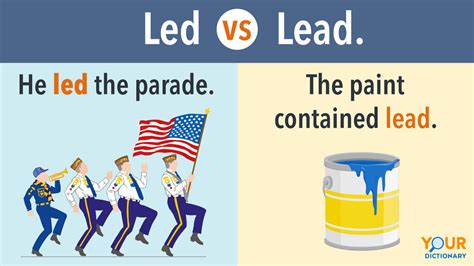
The word “lead” can function as both a noun and a verb. As a noun, “lead” refers to a heavy, bluish-white metal, or a position of guidance or direction. For example: “The company’s lead in the market was due to its innovative products.” On the other hand, the verb “lead” means to guide or direct someone or something. For instance: “The tour guide will lead the group through the museum.”
Past Tense Conundrum - Led vs. Lead
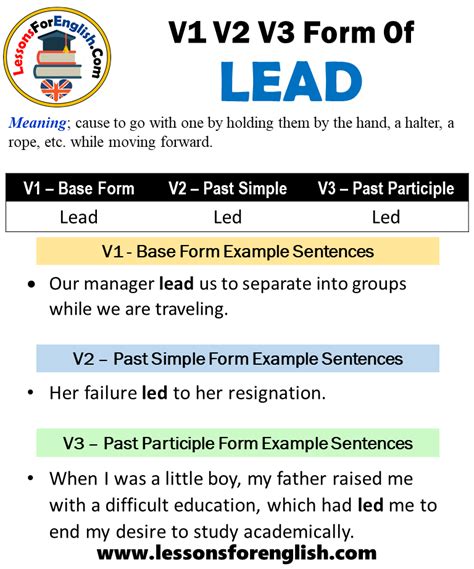
The verb “lead” has a distinct past tense, which is “led.” This is where many writers stumble. To clarify, “led” is the correct past tense of the verb “lead,” whereas “lead” is the present tense. So, if you’re describing a situation where someone guided or directed something in the past, you should use “led.” For example: “The CEO led the company to success during her tenure.” However, if you’re referring to the present or future, use “lead”: “The CEO will lead the company’s expansion into new markets.”
Tip 2: Pronunciation Matters - Lead vs. Led

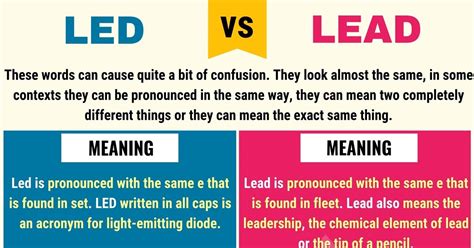
The pronunciation of “lead” and “led” differs significantly. The noun “lead” (the metal) is pronounced as /lɛd/ (LED), whereas the verb “lead” (to guide) is pronounced as /liːd/ (LEED). The past tense “led” is pronounced as /lɛd/ (LED), similar to the noun. Being mindful of these pronunciation differences can help you use the words correctly in context.
Practical Applications - Real-World Examples
To solidify your understanding of “lead” and “led,” consider the following examples:
| Verb Form | Example Sentence |
|---|---|
| Present tense: lead | The manager will lead the team to victory. |
| Past tense: led | The manager led the team to victory last season. |
| Noun: lead | The lead singer of the band performed exceptionally well. |

Tip 3: Sentence Structure - Using Lead and Led Correctly
When constructing sentences, it’s essential to choose the correct form of the word based on the context. If you’re describing a situation where someone is guiding or directing something, use the verb “lead” (present tense) or “led” (past tense). For instance: “The experienced teacher led the class discussion.” However, if you’re referring to the metal or a position of guidance, use the noun “lead”: “The lead actor in the play received a standing ovation.”
Avoiding Common Mistakes - A Word of Caution
One common mistake is using “lead” instead of “led” in the past tense. This can lead to confusion and undermine the credibility of your writing. To avoid this, take a moment to review your sentences and ensure you’re using the correct form of the word. For example, the incorrect sentence “The manager lead the team to victory” should be revised to “The manager led the team to victory.”
Tip 4: Contextual Clues - Identifying the Correct Usage
Context plays a significant role in determining whether to use “lead” or “led.” Pay attention to the surrounding words and the intended meaning of the sentence. If the sentence is describing a past action, “led” is likely the correct choice. However, if the sentence is referring to a present or future action, “lead” is the way to go. Additionally, if the sentence is discussing the metal or a position of guidance, “lead” is the appropriate noun to use.
Subtle Nuances - A Deeper Dive
It’s also important to consider the subtle nuances of language. In some cases, the word “lead” can be used as an adjective, as in “lead singer” or “lead actor.” In these instances, “lead” is used to describe a person or thing that is primary or foremost. However, when using “lead” as a verb, the past tense “led” is still the correct choice: “The lead singer led the band in a rousing performance.”
Tip 5: Practice Makes Perfect - Mastering Lead and Led
As with any aspect of language, practice is key to mastering the usage of “lead” and “led.” The more you write and read, the more comfortable you’ll become with the nuances of these words. Try incorporating “lead” and “led” into your writing and speaking, paying close attention to the context and intended meaning. With time and practice, you’ll develop a keen sense of when to use each word, and your writing will become more precise and effective.
What is the main difference between "lead" and "led"?
+The main difference between "lead" and "led" lies in their grammatical functions and pronunciation. "Lead" can be both a noun and a verb, while "led" is the past tense of the verb "lead."
How do I know when to use "lead" and when to use "led"?
+Use "lead" as a noun to refer to the metal or a position of guidance, and use "lead" as a verb to describe a present or future action. Use "led" as the past tense of the verb "lead" to describe a past action.
What are some common mistakes to avoid when using "lead" and "led"?
+Common mistakes include using "lead" instead of "led" in the past tense, and using "led" instead of "lead" in the present tense. Be mindful of the context and intended meaning to avoid these mistakes.
In conclusion, mastering the usage of “lead” and “led” requires a deep understanding of their grammatical functions, pronunciation, and contextual clues. By following these 5 tips and practicing regularly, you’ll become more confident in your ability to use these words correctly, and your writing will become more precise and effective.