Converting kilograms to gallons can be a bit tricky, as it involves understanding the relationship between weight and volume. However, with the right approach, it's a straightforward process. In this article, we'll explore five ways to convert kilograms to gallons, ensuring that you have a comprehensive understanding of the conversion process.
Key Points
- Understanding the density of the substance is crucial for accurate conversion.
- The formula for conversion is weight in kilograms divided by the density of the substance in kilograms per liter, then multiplied by 0.2642 to get gallons.
- Different substances have different densities, affecting the conversion rate.
- Using online conversion tools can simplify the process but understanding the underlying principle is essential for accuracy.
- Practical applications of this conversion are found in various industries, including petroleum, water treatment, and food processing.
Understanding the Basics of Conversion

To convert kilograms to gallons, it’s essential to understand that 1 kilogram of a substance does not directly translate to a specific volume in gallons due to differences in density among substances. For example, 1 kilogram of water and 1 kilogram of oil will occupy different volumes because they have different densities. The density of water is approximately 1 gram per milliliter (g/mL) or 1 kilogram per liter (kg/L), while the density of oil can vary but is typically around 0.8-0.9 g/mL or kg/L.
Method 1: Using Density for Conversion
The most straightforward method to convert kilograms to gallons involves knowing the density of the substance. The formula is: volume in gallons = weight in kilograms / density in kg/L * 0.2642. For water, with a density of 1 kg/L, 1 kilogram of water is equal to 1 liter, which is approximately 0.2642 gallons.
| Substance | Density (kg/L) | Conversion Rate (kg to gallons) |
|---|---|---|
| Water | 1 | 0.2642 gallons/kg |
| Oil (average) | 0.85 | 0.2642 / 0.85 gallons/kg |
Practical Applications and Considerations
In practical scenarios, such as in the petroleum industry, knowing how to convert kilograms to gallons is crucial for inventory management, transportation logistics, and sales. For instance, if a tanker truck is carrying 10,000 kilograms of gasoline with a density of approximately 0.75 kg/L, the volume in gallons would be calculated as follows: 10,000 kg / 0.75 kg/L * 0.2642 gallons/L = approximately 3,523 gallons.
Method 2: Utilizing Online Conversion Tools
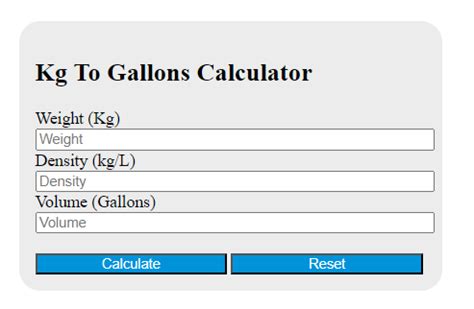
For those who prefer a more straightforward approach without needing to remember formulas, online conversion tools can be incredibly useful. These tools often allow you to input the weight in kilograms and select the substance (or input its density) to get the volume in gallons directly. This method is quick and easy but relies on having access to the internet and the specific tool.
Addressing Common Misconceptions
A common misconception is that kilograms can be directly converted to gallons without considering the substance’s density. This oversight can lead to significant errors in calculations, especially when dealing with large quantities or substances with densities far from that of water. Always ensure that the density of the substance is accounted for to achieve accurate conversions.
Method 3: Using Conversion Factors
Another approach involves memorizing or using conversion factors directly. For example, knowing that 1 liter of water is approximately equal to 0.2642 gallons and that 1 kilogram of water is equal to 1 liter, one can directly convert kilograms of water to gallons. For other substances, the conversion factor would need to be adjusted based on their density relative to water.
Advanced Considerations and Applications
In advanced scenarios, such as in chemical engineering or food processing, the conversion between kilograms and gallons may involve additional considerations, such as the temperature and pressure of the substance, which can affect its density. Understanding these advanced principles is crucial for precise calculations in industrial settings.
Method 4: Accounting for Temperature and Pressure
In some cases, especially with gases or substances whose density changes significantly with temperature or pressure, these factors must be considered. The formula would then involve adjusting the density based on the specific conditions, which can be complex and requires detailed knowledge of the substance’s physical properties.
Method 5: Utilizing Professional Software
For industries that frequently deal with conversions, such as in the chemical or petroleum sectors, professional software designed for these calculations can be invaluable. These programs often include databases of densities for various substances under different conditions, allowing for highly accurate conversions with minimal manual calculation.
What is the primary factor affecting the conversion of kilograms to gallons?
+The primary factor is the density of the substance being converted.
How do I convert kilograms of a substance to gallons if I don't know its density?
+You would need to look up the density of the substance or use a conversion tool that allows you to select the substance or input its density.
Are there any substances for which the conversion from kilograms to gallons is not dependent on density?
+No, all conversions from weight (kilograms) to volume (gallons) depend on the density of the substance, as density is what relates weight to volume.
In conclusion, converting kilograms to gallons requires a clear understanding of the substance’s density and how it affects the conversion process. By mastering the different methods of conversion, individuals can accurately calculate volumes in gallons from weights in kilograms, facilitating operations in various industries and applications.