
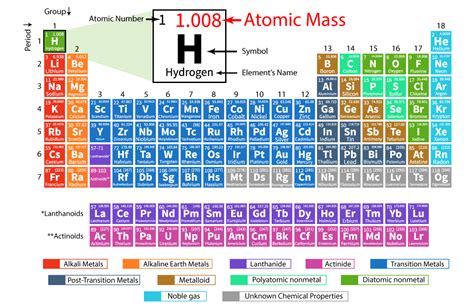
The concept of atomic mass is fundamental in chemistry, representing the total mass of an atom, including its protons, neutrons, and electrons. Although the mass of electrons is negligible, the protons and neutrons, found in the nucleus, contribute the most to the atomic mass. Calculating atomic mass can be approached in several ways, depending on the information available and the specific isotopes of an element. Here, we explore five methods to calculate atomic mass, highlighting their relevance and application in chemical and physical sciences.
Key Points
- The atomic mass of an element is the weighted average of the masses of its naturally occurring isotopes.
- Isotopic masses can be used to calculate atomic mass when the abundance of each isotope is known.
- Nuclear reactions can provide insight into the masses of isotopes and, consequently, the atomic mass of an element.
- Mass spectrometry is a precise method for determining the masses of atoms and molecules.
- Theoretical models, such as the semi-empirical mass formula, can estimate atomic masses based on the number of protons and neutrons in an atom.
Understanding Atomic Mass and Its Calculation
Atomic mass is a critical property of elements, essential for understanding chemical reactions and the structure of matter. The calculation of atomic mass involves considering the masses of the protons and neutrons in the nucleus, as these particles contribute significantly to the overall mass of an atom. The method of calculation can vary, from using the masses of naturally occurring isotopes and their abundances to employing theoretical models that predict atomic mass based on nuclear composition.
Method 1: Using Isotopic Masses and Abundances
This method involves calculating the atomic mass as the weighted average of the masses of the naturally occurring isotopes of an element. The formula for this calculation is: Atomic Mass = (Mass of Isotope 1 * Abundance of Isotope 1) + (Mass of Isotope 2 * Abundance of Isotope 2) +…. For example, chlorine has two main isotopes, Cl-35 and Cl-37, with masses of approximately 34.9689 u and 36.9659 u, respectively, and abundances of about 75.78% and 24.22%. The atomic mass of chlorine can be calculated as (34.9689 * 0.7578) + (36.9659 * 0.2422), resulting in an atomic mass of approximately 35.453 u.
| Isotope | Mass (u) | Abundance (%) |
|---|---|---|
| Cl-35 | 34.9689 | 75.78 |
| Cl-37 | 36.9659 | 24.22 |
Method 2: Mass Spectrometry
Mass spectrometry is a highly accurate method for determining the masses of atoms and molecules. This technique involves ionizing the atoms or molecules of the substance, separating them based on their mass-to-charge ratio, and detecting them to determine their masses. By analyzing the spectrum produced, one can identify the masses of the different isotopes of an element and calculate the atomic mass based on their relative abundances.
Method 3: Nuclear Reactions
Nuclear reactions can provide valuable information about the masses of isotopes. By studying the products and reactants of nuclear reactions, scientists can deduce the masses of the nuclei involved. This method is particularly useful for elements with few or no stable isotopes, where direct measurement might be challenging. The precise masses obtained from these reactions can be used to calculate the atomic mass of an element.
Method 4: Theoretical Models
Theoretical models, such as the semi-empirical mass formula, offer a way to estimate atomic masses based on the number of protons (atomic number) and neutrons (neutron number) in an atom. This formula considers several terms, including the volume, surface, Coulomb, and asymmetry terms, to predict the mass of a nucleus. While not as precise as experimental methods, theoretical models can provide useful estimates, especially for nuclei that are difficult to study experimentally.
Method 5: Average Atomic Mass from Periodic Table
For many purposes, the average atomic mass listed on the periodic table is sufficient for calculations. This value is already a weighted average of the naturally occurring isotopes of an element and can be used directly in chemical calculations, such as determining the mass of a substance in a reaction or the yield of a product.
What is the significance of calculating atomic mass?
+Calculating atomic mass is crucial for understanding the properties of elements, predicting the outcomes of chemical reactions, and determining the composition of substances.
How does the presence of isotopes affect the calculation of atomic mass?
+The presence of isotopes means that the atomic mass of an element is not a fixed value but rather a weighted average of the masses of its naturally occurring isotopes, taking into account their relative abundances.
What are the limitations of theoretical models in predicting atomic masses?
+Theoretical models, while useful for estimating atomic masses, have limitations in terms of accuracy, especially for certain nuclei. They are based on simplifications and do not fully capture the complexities of nuclear interactions.
In conclusion, the calculation of atomic mass is a multifaceted process that can be approached through various methods, each with its own advantages and limitations. From the practical application of isotopic masses and abundances to the theoretical estimation using nuclear models, understanding atomic mass is fundamental to advancing our knowledge of chemistry and physics.

