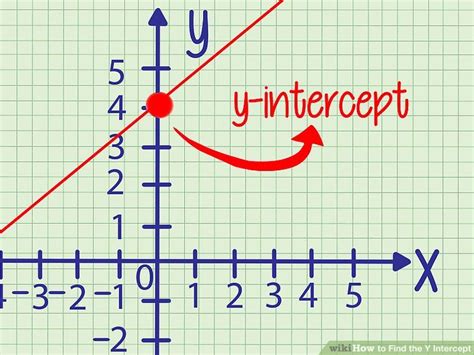
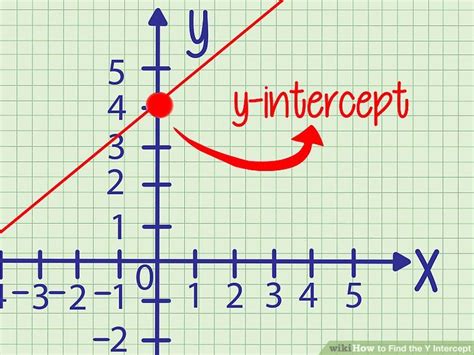
To find the y-intercept of a line, which is the point at which the line crosses the y-axis, you can use several methods depending on the information given. The y-intercept is a crucial concept in algebra and graphing, as it helps in understanding the behavior of lines and their equations. Here are five ways to find the y-intercept, each tailored to different scenarios and types of equations.
Understanding the Concept of Y-Intercept
The y-intercept of a line is the y-coordinate of the point where the line intersects the y-axis. It’s an essential element in linear equations, often represented in the slope-intercept form of a line (y = mx + b), where ’m’ is the slope of the line, and ‘b’ is the y-intercept. Knowing how to find the y-intercept is vital for graphing lines, solving equations, and analyzing linear relationships in various fields, including physics, engineering, and economics.
Method 1: Using the Slope-Intercept Form (y = mx + b)
This is the most straightforward method when the equation of the line is given in slope-intercept form. In this form, ‘b’ directly represents the y-intercept. For example, if the equation of the line is y = 2x + 3, then the y-intercept is 3. This method involves simply identifying the value of ‘b’ in the equation.
| Equation Form | Y-Intercept |
|---|---|
| y = 2x + 3 | 3 |
| y = -x - 2 | -2 |
Method 2: Converting to Slope-Intercept Form
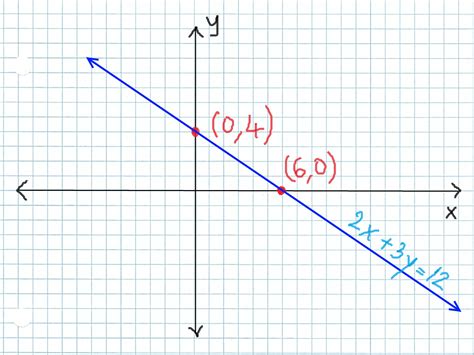
When the equation of the line is not given in slope-intercept form, you may need to convert it. For instance, if the equation is in the standard form (Ax + By = C), you can solve for ‘y’ to find the slope-intercept form. Let’s consider the equation 2x + 3y = 6. To find the y-intercept, we rearrange the equation to solve for ‘y’: 3y = -2x + 6, then y = (-2⁄3)x + 2. The y-intercept in this case is 2.
Method 3: Graphing the Line
Another approach is to graph the line using any two points and then find where it crosses the y-axis. This method is more visual and can be useful when working with equations that are not easily convertible to slope-intercept form or when a graphical representation is preferred. For example, if you have two points (x1, y1) and (x2, y2), you can plot these points on a coordinate plane and draw a line through them. The point where this line crosses the y-axis is the y-intercept.
Method 4: Using the Point-Slope Form
The point-slope form of a line’s equation is y - y1 = m(x - x1), where ’m’ is the slope of the line, and (x1, y1) is a point on the line. If you have the slope and a point, you can use this form to find the y-intercept. First, substitute the known values into the equation, then solve for ‘y’ when x = 0. For example, if the slope (m) is 2 and the point (x1, y1) is (1, 3), the equation becomes y - 3 = 2(x - 1). Simplifying this equation gives y = 2x + 1, meaning the y-intercept is 1.
Method 5: Using a Table of Values or Substitution
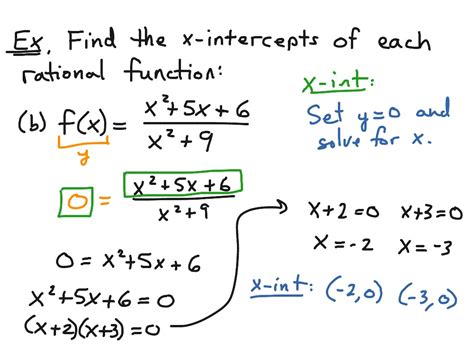
For linear equations that are not easily convertible to slope-intercept form, or when working with equations that involve variables other than x and y, substitution or using a table of values can help find the y-intercept. By setting x = 0 and solving for y, you can find where the line crosses the y-axis. This method is particularly useful in algebraic manipulations and when dealing with more complex equations.
Key Points
- The y-intercept is found where the line crosses the y-axis, meaning x = 0.
- The slope-intercept form (y = mx + b) directly shows the y-intercept as 'b'.
- Converting an equation to slope-intercept form can reveal the y-intercept.
- Graphing a line and finding where it crosses the y-axis visually identifies the y-intercept.
- Using the point-slope form or substitution method can also find the y-intercept, especially when the equation is not in slope-intercept form.
In conclusion, finding the y-intercept of a line is a fundamental skill in algebra and graphing, with applications across various disciplines. By mastering the different methods to find the y-intercept, individuals can better understand and analyze linear relationships, solve equations, and graph lines with precision.
What is the y-intercept in a linear equation?
+The y-intercept is the point at which the line crosses the y-axis, represented by the value of ‘b’ in the slope-intercept form (y = mx + b) of the equation.
How do I find the y-intercept from the slope-intercept form?
+In the slope-intercept form (y = mx + b), ‘b’ is the y-intercept. You directly read the value of ‘b’ from the equation.
Can I find the y-intercept without converting the equation to slope-intercept form?
+Yes, you can find the y-intercept by substituting x = 0 into the equation and solving for y, regardless of the equation’s form.