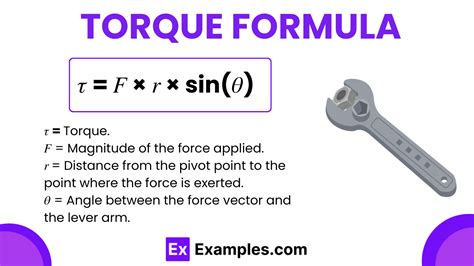
The concept of torque is a fundamental aspect of physics and engineering, playing a crucial role in understanding rotational motion and the forces that cause it. Torque, a measure of the twisting or rotational force that causes an object to rotate, is essential in various fields, including mechanics, physics, and engineering. In this article, we will explore five ways to find torque, discussing the principles, formulas, and applications of each method.
Key Points
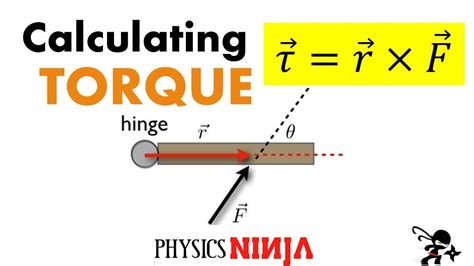
- The formula for calculating torque is τ = r x F, where τ is the torque, r is the radius, and F is the force applied.
- Torque can be calculated using the moment of inertia and angular acceleration.
- The work-energy principle can be used to find torque by calculating the work done by a force.
- Torque can be measured using a torque sensor or a dynamometer.
- Simulation software can be used to model and calculate torque in complex systems.
Method 1: Using the Formula τ = r x F
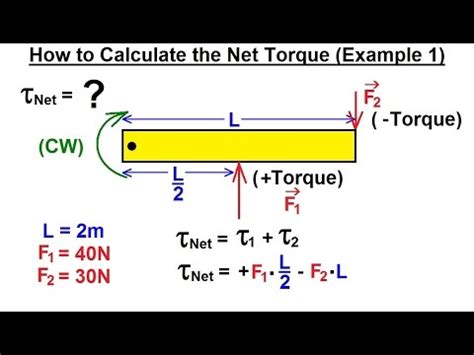
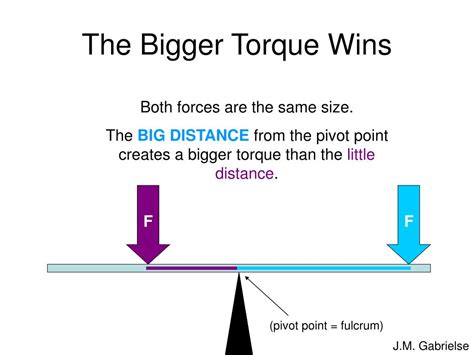
This method involves using the formula τ = r x F, where τ is the torque, r is the radius of the object, and F is the force applied. This formula is a fundamental concept in physics and engineering, and it provides a straightforward way to calculate torque. To use this method, you need to know the radius of the object and the force applied, as well as the angle between the force and the radius. The formula takes into account the magnitude of the force and the distance from the axis of rotation, providing a comprehensive understanding of the torque.
Calculating Torque using the Formula
To calculate torque using the formula τ = r x F, you need to follow these steps:
- Measure the radius of the object ®
- Measure the force applied (F)
- Measure the angle between the force and the radius (θ)
- Calculate the torque using the formula τ = r x F x sin(θ)
For example, if the radius of an object is 0.5 meters and a force of 10 Newtons is applied at an angle of 30 degrees, the torque can be calculated as follows:
τ = 0.5 x 10 x sin(30) = 2.5 Newton-meters
Method 2: Using the Moment of Inertia and Angular Acceleration
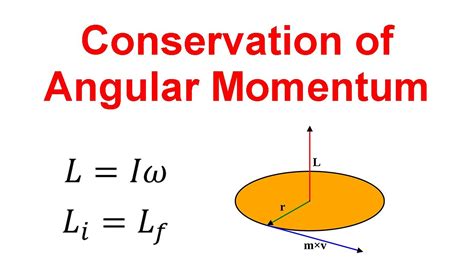
This method involves using the moment of inertia (I) and angular acceleration (α) to calculate torque. The moment of inertia is a measure of an object’s resistance to changes in its rotation, and angular acceleration is the rate of change of angular velocity. The formula for calculating torque using this method is τ = I x α. This method is particularly useful when dealing with complex systems, such as rotating machinery or vehicle dynamics.
Calculating Torque using the Moment of Inertia and Angular Acceleration
To calculate torque using the moment of inertia and angular acceleration, you need to follow these steps:
- Measure the moment of inertia (I) of the object
- Measure the angular acceleration (α) of the object
- Calculate the torque using the formula τ = I x α
For example, if the moment of inertia of an object is 0.1 kg-m^2 and its angular acceleration is 2 rad/s^2, the torque can be calculated as follows:
τ = 0.1 x 2 = 0.2 Newton-meters
Method 3: Using the Work-Energy Principle
This method involves using the work-energy principle to calculate torque. The work-energy principle states that the work done by a force is equal to the change in energy of the object. The formula for calculating torque using this method is τ = ΔU / θ, where ΔU is the change in energy and θ is the angle of rotation. This method is particularly useful when dealing with systems where energy is transferred from one form to another, such as in power transmission or mechanical advantage.
Calculating Torque using the Work-Energy Principle
To calculate torque using the work-energy principle, you need to follow these steps:
- Measure the change in energy (ΔU) of the object
- Measure the angle of rotation (θ) of the object
- Calculate the torque using the formula τ = ΔU / θ
For example, if the change in energy of an object is 10 Joules and the angle of rotation is 30 degrees, the torque can be calculated as follows:
τ = 10 / (30 x π/180) = 19.1 Newton-meters
Method 4: Using a Torque Sensor or Dynamometer
This method involves using a torque sensor or dynamometer to measure torque directly. A torque sensor is a device that measures the twisting or rotational force of an object, while a dynamometer is a device that measures the torque and power of a rotating machine. This method is particularly useful in industrial or laboratory settings where precise measurements are required.
Measuring Torque using a Torque Sensor or Dynamometer
To measure torque using a torque sensor or dynamometer, you need to follow these steps:
- Attach the torque sensor or dynamometer to the object
- Calibrate the device according to the manufacturer’s instructions
- Measure the torque using the device
For example, if a torque sensor is attached to a rotating shaft and calibrated according to the manufacturer’s instructions, the torque can be measured directly using the device.
Method 5: Using Simulation Software
This method involves using simulation software to model and calculate torque in complex systems. Simulation software can be used to simulate the behavior of rotating machines, vehicles, and other complex systems, allowing engineers to calculate torque and other parameters under various operating conditions. This method is particularly useful in the design and development of complex systems, where physical prototyping may be impractical or expensive.
Calculating Torque using Simulation Software
To calculate torque using simulation software, you need to follow these steps:
- Create a model of the system using the simulation software
- Define the operating conditions and parameters of the system
- Run the simulation and calculate the torque
For example, if a simulation model of a rotating machine is created using simulation software, the torque can be calculated under various operating conditions, such as different speeds or loads.
| Method | Description | Formula |
|---|---|---|
| 1. Using the Formula τ = r x F | Calculates torque using the radius and force applied | τ = r x F x sin(θ) |
| 2. Using the Moment of Inertia and Angular Acceleration | Calculates torque using the moment of inertia and angular acceleration | τ = I x α |
| 3. Using the Work-Energy Principle | Calculates torque using the work-energy principle | τ = ΔU / θ |
| 4. Using a Torque Sensor or Dynamometer | Measures torque directly using a torque sensor or dynamometer | N/A |
| 5. Using Simulation Software | Calculates torque using simulation software | N/A |
What is the unit of torque?
+The unit of torque is Newton-meters (N-m) in the International System of Units (SI).
How is torque related to rotational motion?
+Torque is a measure of the twisting or rotational force that causes an object to rotate. It is essential in understanding rotational motion and the forces that cause it.
What are some common applications of torque?
+Torque has numerous applications in various fields, including mechanics, physics, and engineering. Some common applications include power transmission, mechanical advantage, and vehicle dynamics.
How can torque be measured?
+Torque can be measured using a torque sensor or dynamometer, or calculated using various methods, such as the formula τ = r x F or the work-energy principle.
What are some common challenges in calculating torque?
+Some common challenges in calculating torque include accurately measuring the radius and force applied, accounting for friction and other losses, and ensuring the accuracy of the measurement or calculation method.
Meta description suggestion: “Learn about the five ways to find torque, including using the formula τ = r x F, the moment of inertia and angular acceleration, the work-energy principle, a torque sensor or dynamometer, and simulation software.”