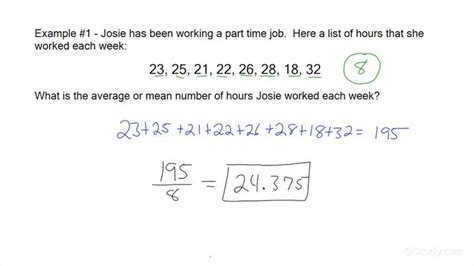
Calculating the mean, or average, of a set of numbers is a fundamental concept in statistics and mathematics. It's used to describe the central tendency of a dataset, giving us an idea of where the data points tend to cluster. There are several methods to find the mean, each with its own application depending on the nature of the data and the specific requirements of the analysis. Here, we'll explore five ways to find the mean, discussing the scenarios in which each method is most appropriately used.
Understanding the Mean
The mean is calculated by summing all the numbers in a dataset and then dividing by the count of the numbers. It’s a simple yet powerful metric for understanding datasets. However, the method of calculating the mean can vary based on whether the data is discrete, continuous, grouped, or if we’re dealing with a population versus a sample.
Method 1: Direct Calculation for Ungrouped Data
For ungrouped data, where each data point is distinct and not binned into categories, the mean can be found directly by summing all the values and dividing by the total number of values. This method is straightforward and commonly used in everyday calculations. For example, if you have the test scores of 10 students, you would add all the scores together and then divide by 10 to find the average score.
| Student | Score |
|---|---|
| 1 | 85 |
| 2 | 90 |
| 3 | 78 |
| 4 | 92 |
| 5 | 88 |
| 6 | 76 |
| 7 | 95 |
| 8 | 89 |
| 9 | 91 |
| 10 | 82 |

In this example, the sum of the scores is 876, and the mean is 876 / 10 = 87.6.
Method 2: Using the Formula for Grouped Data
When dealing with grouped data, where values are binned into intervals (e.g., age ranges), the mean is calculated using a formula that takes into account the midpoint of each interval and the frequency of observations within that interval. This method is essential for data that is not discrete but rather continuous and grouped for analytical purposes.
Method 3: Weighted Average for Different Weights
Sometimes, not all data points carry the same importance or weight. In such cases, a weighted average is used, where each data point is multiplied by its weight before summing and then dividing by the sum of the weights. This method is crucial in scenarios where some observations have a greater impact than others.
Method 4: Using Statistical Software for Large Datasets
For very large datasets, manual calculation of the mean can be impractical and prone to errors. Statistical software packages like SPSS, R, or Python libraries (e.g., Pandas) can efficiently calculate the mean, along with other statistical measures, with just a few commands. This method is not only faster but also reduces the likelihood of human error.
Method 5: Population Mean vs. Sample Mean
Finally, it’s essential to distinguish between the population mean and the sample mean. The population mean is the mean of all the data points in the entire population, which is often not feasible to calculate due to the sheer size of the population. The sample mean, on the other hand, is calculated from a subset of the population and is used as an estimate of the population mean. The formula for both is the same, but the interpretation and the implications for statistical inference can be quite different.
Key Points
- The mean can be calculated directly for ungrouped data by summing all values and dividing by the count of values.
- For grouped data, the mean is calculated using the formula that considers the midpoint and frequency of each group.
- A weighted average is used when data points have different weights or importance.
- Statistical software is invaluable for calculating the mean of large datasets efficiently and accurately.
- Distinguishing between population and sample means is crucial for appropriate statistical inference.
In conclusion, calculating the mean is a fundamental step in understanding datasets, and the method chosen depends on the nature of the data and the specific requirements of the analysis. Whether dealing with ungrouped, grouped, weighted, or large datasets, or distinguishing between population and sample means, each scenario requires an understanding of the appropriate method to apply.
What is the primary use of calculating the mean in statistics?
+The primary use of calculating the mean is to understand the central tendency of a dataset, providing insight into where the data points tend to cluster.
How does the calculation of the mean differ for grouped data versus ungrouped data?
+For grouped data, the mean is calculated using a formula that considers the midpoint and frequency of each group, whereas for ungrouped data, the mean is found by directly summing all values and dividing by the count of values.
What is the significance of distinguishing between the population mean and the sample mean?
+Distinguishing between the population mean and the sample mean is crucial because the population mean represents the average of the entire population, while the sample mean is an estimate of the population mean derived from a subset of the population, and is used for statistical inference.