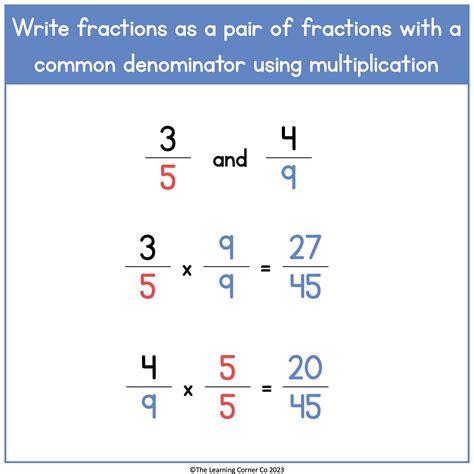
Finding common denominators is a fundamental concept in mathematics, particularly in fractions and algebra. It involves identifying the smallest common multiple of the denominators of two or more fractions, allowing them to be added, subtracted, or compared directly. In this article, we will delve into the world of common denominators, exploring what they are, why they are important, and how to find them easily.
Understanding Common Denominators
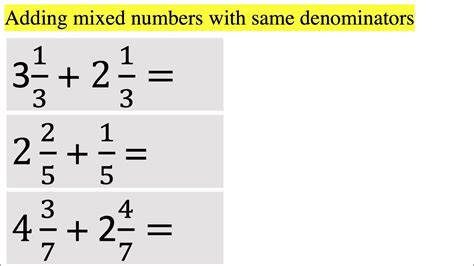
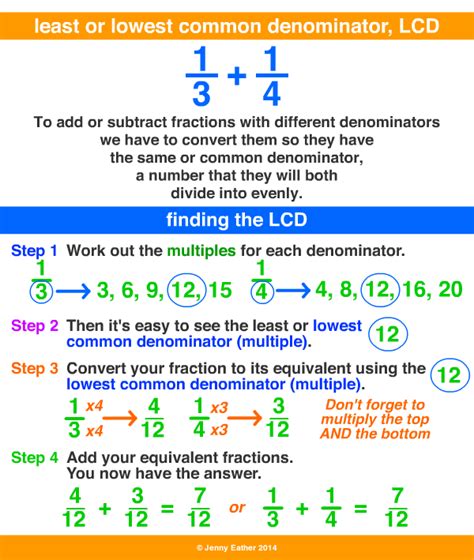
A common denominator is the least common multiple (LCM) of the denominators of two or more fractions. For instance, if we have the fractions 1⁄4 and 1⁄6, the common denominator would be the smallest number that both 4 and 6 can divide into evenly. In this case, the LCM of 4 and 6 is 12, making 12 the common denominator. To add or subtract these fractions, we would convert them to have the common denominator: 1⁄4 becomes 3⁄12, and 1⁄6 becomes 2⁄12.
Why Are Common Denominators Important?
Common denominators are crucial in mathematics because they enable us to perform arithmetic operations on fractions. Without a common denominator, adding or subtracting fractions would be challenging, as we cannot directly combine the numerators (the numbers on top) without considering the denominators (the numbers on the bottom). Common denominators provide a standardized basis for comparing and combining fractions, making them an essential tool in algebra, calculus, and other advanced mathematical disciplines.
Methods for Finding Common Denominators
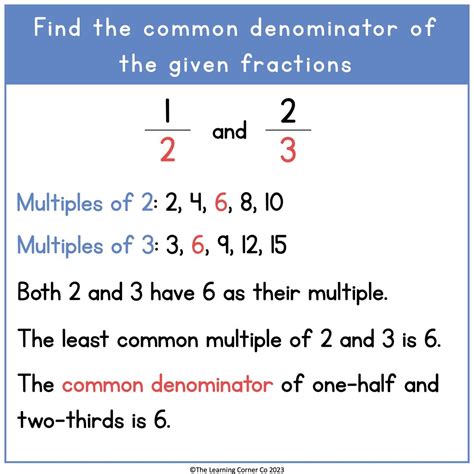
There are several methods to find the common denominator of two or more fractions, each with its own advantages and applications. Here, we will discuss the prime factorization method and the listing multiples method.
Prime Factorization Method
This method involves breaking down the denominators into their prime factors and then taking the highest power of each prime factor found in the factorizations. For example, to find the common denominator of 1⁄12 and 1⁄15, we first find the prime factors of 12 and 15. The prime factorization of 12 is 2^2 * 3, and the prime factorization of 15 is 3 * 5. The common denominator is then 2^2 * 3 * 5 = 60, as it includes the highest powers of all prime numbers found in the factorizations.
Listing Multiples Method
Another approach is to list the multiples of each denominator until we find the smallest common multiple. For the fractions 1⁄4 and 1⁄6, we list the multiples of 4 (4, 8, 12, 16,…) and the multiples of 6 (6, 12, 18, 24,…). The first number that appears in both lists is the common denominator, which in this case is 12.
| Method | Description | Example |
|---|---|---|
| Prime Factorization | Break down denominators into prime factors and take the highest power of each prime factor. | Find the common denominator of 1/12 and 1/15: 2^2 * 3 * 5 = 60 |
| Listing Multiples | List the multiples of each denominator until finding the smallest common multiple. | Find the common denominator of 1/4 and 1/6: multiples of 4 (4, 8, 12) and multiples of 6 (6, 12) |
Key Points
- Common denominators are essential for adding, subtracting, or comparing fractions.
- The prime factorization method involves breaking down denominators into their prime factors and taking the highest power of each prime factor.
- The listing multiples method requires listing the multiples of each denominator until finding the smallest common multiple.
- Choosing the right method depends on the number of fractions and the size of their denominators.
- Understanding common denominators is crucial for advanced mathematical operations and problem-solving.
Applications and Implications
Common denominators have numerous applications beyond basic arithmetic operations on fractions. They are fundamental in algebra for solving equations involving fractions, in calculus for integrating and differentiating functions with fractional coefficients, and in statistics for comparing and analyzing data presented in fractional form. Moreover, the concept of finding common denominators teaches important mathematical skills such as problem-solving, critical thinking, and analytical reasoning.
Real-World Examples
In real-world scenarios, common denominators can be applied to solve problems involving fractions in various fields. For instance, in cooking, recipes often involve fractional measurements (e.g., 1⁄4 cup of sugar, 3⁄4 teaspoon of salt). To combine or adjust these ingredients, finding a common denominator can simplify the process. Similarly, in finance, investment returns are often expressed as fractions or decimals, and comparing these returns requires finding a common basis, which can be achieved by determining the common denominator.
What is the easiest method to find the common denominator of two fractions?
+The easiest method often depends on the numbers involved. For smaller numbers, listing multiples can be straightforward. However, for larger numbers or when dealing with multiple fractions, the prime factorization method is usually more efficient.
Why is it important to find the common denominator when adding or subtracting fractions?
+Without a common denominator, fractions cannot be directly added or subtracted because the denominators represent different sized groups. Finding a common denominator allows us to compare and combine these groups accurately.
Can common denominators be used in fields other than mathematics?
+Yes, the concept of finding a common basis or standard can be applied in various fields, such as music (common time signatures), finance (comparing investment returns), and even in social sciences for comparative analysis.
In conclusion, finding common denominators is a critical skill in mathematics that extends beyond simple arithmetic operations to influence problem-solving strategies in algebra, calculus, and real-world applications. By mastering the prime factorization and listing multiples methods, individuals can efficiently find common denominators, facilitating their ability to work with fractions in a wide range of contexts. As we navigate through mathematical and real-world problems, the importance of common denominators becomes evident, highlighting the need for a deep understanding of this fundamental concept.