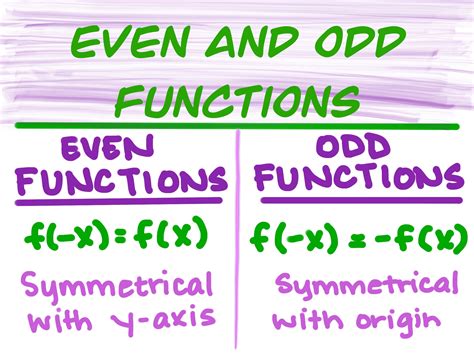
To determine whether a function is odd or even, we need to understand the definitions of these terms in the context of mathematics. An even function satisfies the condition $f(-x) = f(x)$ for all $x$ in the domain of $f$. This means that if we replace $x$ with $-x$ in the function and get the original function as the result, the function is even. On the other hand, an odd function satisfies the condition $f(-x) = -f(x)$ for all $x$ in the domain of $f$, meaning that replacing $x$ with $-x$ results in the negative of the original function.
Determining if a Function is Odd or Even

A function f(x) is classified as odd if f(-x) = -f(x) and as even if f(-x) = f(x). To illustrate this, let’s consider a simple example. The function f(x) = x^2 is even because f(-x) = (-x)^2 = x^2 = f(x). In contrast, the function f(x) = x^3 is odd because f(-x) = (-x)^3 = -x^3 = -f(x).
Mathematical Definitions and Examples
Mathematically, we can represent the properties of odd and even functions as follows:
- An even function: f(x) = f(-x)
- An odd function: f(x) = -f(-x)
Examples of even functions include f(x) = \cos(x), f(x) = x^2, and f(x) = x^4, among others. Examples of odd functions include f(x) = \sin(x), f(x) = x^3, and f(x) = x^5. Understanding whether a function is odd or even is crucial for simplifying expressions, solving equations, and analyzing the symmetry of graphs.
| Function Type | Example | Property |
|---|---|---|
| Even | $f(x) = x^2$ | $f(-x) = f(x)$ |
| Odd | $f(x) = x^3$ | $f(-x) = -f(x)$ |
Key Points
- Even functions satisfy $f(-x) = f(x)$, indicating symmetry about the y-axis.
- Odd functions satisfy $f(-x) = -f(x)$, indicating rotational symmetry about the origin.
- Not all functions are strictly odd or even; some may exhibit properties of both or neither.
- Understanding the parity (oddness or evenness) of a function is crucial for various mathematical operations and analyses.
- The symmetry properties of functions can significantly impact the solutions to equations and the shapes of graphs.
In conclusion, determining whether a function is odd or even involves substituting $-x$ for $x$ in the function and observing the result. This simple test can provide valuable insights into the function's symmetry and behavior, which are essential in many areas of mathematics and science.
What is the difference between an odd and an even function?
+An odd function satisfies f(-x) = -f(x), showing rotational symmetry about the origin, whereas an even function satisfies f(-x) = f(x), showing symmetry about the y-axis.
Can a function be both odd and even?
+The only function that is both odd and even is f(x) = 0, because it satisfies both conditions f(-x) = f(x) and f(-x) = -f(x), since 0 = 0 and 0 = -0.
How do I determine if a function is odd or even?
+To determine if a function f(x) is odd or even, substitute -x for x and simplify. If f(-x) = f(x), the function is even. If f(-x) = -f(x), the function is odd. If neither condition is met, the function is neither odd nor even.