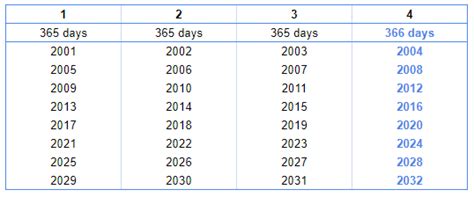
Understanding the relationship between years and days is essential for various calculations, especially in planning, scheduling, and historical research. A year, in the context of the Gregorian calendar, which is the most widely used calendar in the world, consists of 365 days in non-leap years and 366 days in leap years. To find out how many days are in 4 years, we must consider whether these years include leap years or not.
Calculating Days in 4 Years Without Leap Years

In a non-leap year, there are 365 days. Therefore, for 4 non-leap years, the calculation would be straightforward: 4 years * 365 days/year = 1460 days. This calculation gives us the total number of days in 4 years without considering the possibility of leap years.
Incorporating Leap Years
A leap year occurs every 4 years, adding an extra day to February, making it a 366-day year. If our 4-year period includes a leap year, we need to account for this extra day. For simplicity, let’s consider a scenario where one of these years is a leap year. The calculation then becomes: 3 years * 365 days/year (for the non-leap years) + 1 year * 366 days/year (for the leap year) = 1095 days + 366 days = 1461 days.
| Year Type | Days in Year | Total Days in 4 Years |
|---|---|---|
| Non-leap Years | 365 | 1460 |
| With 1 Leap Year | 365 (3 years) + 366 (1 year) | 1461 |
To generalize, if you're calculating the number of days in a 4-year period and you know that period includes a leap year, the total will be 1461 days. However, if you're working with a hypothetical or simplified scenario where leap years are not considered, the total would be 1460 days.
Key Points
- 4 non-leap years have 1460 days.
- A 4-year period including 1 leap year has 1461 days.
- Leap years occur every 4 years, adding 1 extra day to the calendar.
- Accurate calculations over periods including leap years require accounting for the extra day.
- Understanding the distinction between leap and non-leap years is crucial for precise time-related calculations.
Real-World Applications
The distinction between leap and non-leap years is not just a matter of calendar mechanics; it has practical implications in various fields such as finance, law, and science. For instance, in financial markets, the calculation of interest rates and investment returns must accurately account for the number of days in a year to ensure fairness and precision. Similarly, in legal contracts, the duration of agreements and the calculation of deadlines can depend on whether a year is a leap year or not.
Conclusion and Future Considerations
In conclusion, when calculating the number of days in a 4-year period, it’s essential to consider whether the period includes a leap year. This consideration can significantly affect the total number of days, leading to either 1460 days for periods without a leap year or 1461 days for periods that include one. As our understanding of time and its measurement evolves, so too will the complexity of our calendars and the calculations based on them. For now, recognizing the role of leap years in our calendar system provides a foundational understanding necessary for a wide range of applications and calculations.
How often do leap years occur?
+Leap years occur every 4 years, according to the Gregorian calendar, which is the most widely used calendar in the world.
Why are leap years important in calculations?
+Leap years are important because they add an extra day to the calendar, which can affect calculations involving time, such as interest rates, investment returns, and legal deadlines.
How do I calculate the total days in a 4-year period that includes a leap year?
+To calculate the total days in a 4-year period that includes a leap year, you multiply 3 years by 365 days (for the non-leap years) and add 366 days for the leap year, resulting in a total of 1461 days.