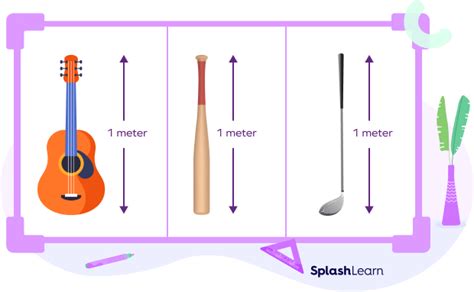
The concept of length is a fundamental aspect of physics and geometry, and understanding what constitutes 1 meter is crucial in various fields, including science, engineering, and everyday applications. The meter is a unit of length in the International System of Units (SI), defined as the distance traveled by light in a vacuum in 1/299,792,458 of a second. This definition, adopted in 1983, replaced the previous standard based on a physical prototype, the International Prototype Meter, which was a metal bar kept in Paris.
Historical Context and Evolution of the Meter
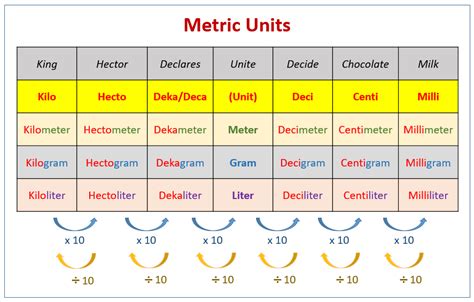
The meter has its roots in the French Revolution, where it was introduced as a decimal-based unit to replace the diverse and often confusing systems of measurement used across France and other parts of the world. Initially, it was defined as one ten-millionth of the distance from the equator to the North Pole along a meridian passing through Paris. Over time, as science and technology advanced, the need for a more precise and universal definition became apparent, leading to the current definition based on the speed of light.
Practical Applications and Significance
In practical terms, 1 meter is a length that is commonly encountered in daily life. For example, it is slightly longer than a standard yardstick used in the United States, which is 3 feet or 36 inches long. The meter is used in a wide range of applications, from measuring the dimensions of rooms and buildings to specifying the length of sports fields and tracks. In scientific research, precise measurements in meters are crucial for experiments and data analysis, especially in fields like physics and engineering.
| Measurement Unit | Equivalent Length |
|---|---|
| 1 Meter | 100 Centimeters or 1,000 Millimeters |
| 1 Yard (US) | 0.9144 Meters |
| 1 Foot (US) | 0.3048 Meters |
Key Points
- The meter is defined as the distance light travels in 1/299,792,458 of a second, providing a universal and precise standard for length measurements.
- The evolution of the meter from a physical prototype to a definition based on the speed of light reflects advancements in science and technology, aiming for greater precision and universality.
- Practical applications of the meter are diverse, ranging from everyday measurements to critical scientific experiments, where precision is paramount.
- Understanding the meter and its equivalents in other measurement systems is essential for facilitating international communication and collaboration in science, trade, and education.
- The use of the meter as a standard unit of length supports the development of consistent and comparable data across various fields, contributing to global progress and innovation.
Technical Specifications and Precision
The precision of the meter as a unit of length is unparalleled, thanks to its definition being tied to a fundamental constant of nature. This precision is critical in scientific research, where small variations in measurements can significantly impact experimental outcomes and theoretical models. Furthermore, the use of the meter in engineering and construction ensures that structures are built to exacting standards, contributing to safety and efficiency.
Evidence-Based Analysis and Implications
Studies and experiments have consistently demonstrated the reliability and universality of the meter as a standard unit of length. For instance, international collaborations in physics, such as those involving particle accelerators, rely on precise length measurements in meters to achieve their goals. The implications of this precision are far-reaching, enabling advancements in fields like materials science, where understanding the properties of materials at the atomic and molecular level is crucial.
In conclusion, the concept of 1 meter length is fundamental to our understanding of the physical world and our ability to measure and describe it with precision. Through its evolution from a physical standard to a definition based on the speed of light, the meter has become an indispensable tool in science, technology, and everyday applications, facilitating international communication, collaboration, and progress.
What is the current definition of the meter?
+The meter is currently defined as the distance light travels in a vacuum in 1⁄299,792,458 of a second.
Why was the definition of the meter changed?
+The definition was changed to provide a more precise and universal standard, replacing the reliance on a physical prototype with a definition based on a fundamental physical constant.
What are some practical applications of the meter?
+The meter is used in a wide range of applications, including the measurement of rooms, sports fields, and in scientific research for precise experiments and data analysis.