Mary Magdalene, one of the most fascinating and misunderstood figures in Christian history, has been the subject of numerous legends, myths, and speculations over the centuries. While the Bible provides limited information about her life and death, various apocryphal texts, historical accounts, and traditions have attempted to fill in the gaps. Here, we will delve into the topic of Mary Magdalene's death, exploring seven key facts and insights that shed light on this enigmatic figure.
Key Points
- Mary Magdalene's death is not explicitly mentioned in the New Testament, leading to various speculations and legends.
- The Gospel of Philip, an apocryphal text, suggests that Mary Magdalene was a close companion of Jesus and possibly his wife.
- According to medieval legend, Mary Magdalene traveled to France after Jesus' resurrection and died in the city of Saint-Maximin-la-Sainte-Baume.
- Some traditions believe that Mary Magdalene was martyred, while others propose that she died of natural causes.
- The relics of Mary Magdalene are claimed to be housed in the Basilica of Saint-Maximin-la-Sainte-Baume, where they have been venerated for centuries.
- Despite the lack of concrete evidence, Mary Magdalene's legacy has endured, inspiring countless works of art, literature, and devotion throughout history.
- Modern scholarship continues to uncover new insights into Mary Magdalene's life and death, offering a more nuanced understanding of this complex and multifaceted figure.
The New Testament Account

The New Testament provides limited information about Mary Magdalene’s life and death. She is first introduced in the Gospel of Luke (8:2) as a woman from whom Jesus had cast out seven demons. Mary Magdalene is also mentioned in the Gospels of Matthew (27:55-56, 61; 28:1), Mark (15:40, 47; 16:1, 9), and John (19:25; 20:1, 18), where she is depicted as a devoted follower of Jesus and a witness to his crucifixion and resurrection.
The Apocryphal Tradition
Apocryphal texts, such as the Gospel of Philip, offer additional insights into Mary Magdalene’s life and relationship with Jesus. This text, dated to the 3rd century, suggests that Mary Magdalene was a close companion of Jesus and possibly his wife. The Gospel of Philip also implies that Mary Magdalene was a prominent figure in the early Christian community, possessing a deep understanding of Jesus’ teachings.
| Text | Description |
|---|---|
| Gospel of Philip | Apocryphal text suggesting Mary Magdalene's close relationship with Jesus |
| Gospel of Mary | Apocryphal text portraying Mary Magdalene as a leader in the early Christian community |
| Acts of Philip | Apocryphal text describing Mary Magdalene's missionary work and martyrdom |
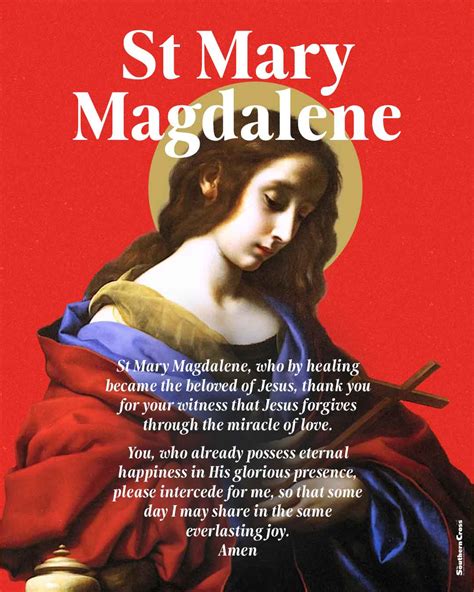
Medieval Legend and the Death of Mary Magdalene
According to medieval legend, Mary Magdalene traveled to France after Jesus’ resurrection, where she preached the Gospel and converted many to Christianity. This tradition claims that Mary Magdalene died in the city of Saint-Maximin-la-Sainte-Baume, where her relics are still venerated today. While this account is not supported by historical evidence, it has become an integral part of the Mary Magdalene legend.
The Relics of Mary Magdalene
The relics of Mary Magdalene are claimed to be housed in the Basilica of Saint-Maximin-la-Sainte-Baume, where they have been venerated for centuries. The basilica, built in the 13th century, is said to contain the remains of Mary Magdalene, including her skull, which is displayed in a reliquary. While the authenticity of these relics is disputed, they remain an important part of the Mary Magdalene tradition and a testament to her enduring legacy.
The death of Mary Magdalene remains a topic of fascination and speculation, with various traditions and legends attempting to fill in the gaps left by the New Testament account. As we continue to uncover new insights into her life and legacy, we are reminded of the complexity and multifaceted nature of this enigmatic figure, who has captivated the imagination of people for centuries.
What is the biblical account of Mary Magdalene’s death?
+The Bible does not provide a detailed account of Mary Magdalene’s death. However, she is mentioned in the Gospels as a witness to Jesus’ crucifixion and resurrection.
What is the significance of the apocryphal tradition surrounding Mary Magdalene?
+The apocryphal tradition surrounding Mary Magdalene highlights her importance in the early Christian community and provides additional insights into her relationship with Jesus and her role in the spread of Christianity.
What is the legend surrounding Mary Magdalene’s death in France?
+According to medieval legend, Mary Magdalene traveled to France after Jesus’ resurrection, where she preached the Gospel and converted many to Christianity. She is said to have died in the city of Saint-Maximin-la-Sainte-Baume, where her relics are still venerated today.