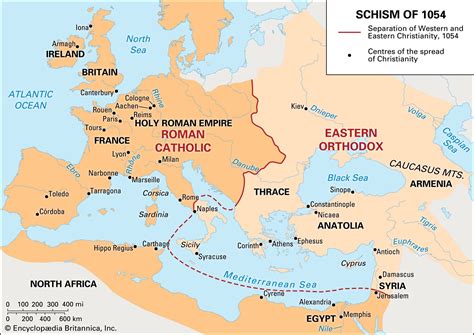
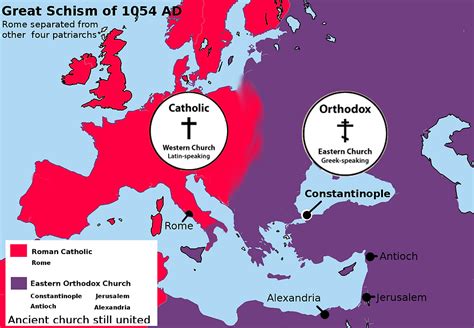
The Great Schism of 1054, also known as the East-West Schism, was a pivotal event in Christian history that marked the formal separation between the Eastern Orthodox Church and the Roman Catholic Church. This schism was the culmination of centuries of theological, cultural, and political differences between the two branches of Christianity. To understand the significance of this event, it is essential to delve into the historical context and the key factors that led to the division.
The early Christian Church was unified under the leadership of the apostles and their successors, with the Bishop of Rome, also known as the Pope, holding a position of authority. However, as the Church grew and expanded, differences in theology, practice, and governance began to emerge between the Eastern and Western branches. The Eastern Church, also known as the Greek Church, was centered in Constantinople (modern-day Istanbul), while the Western Church was based in Rome. Over time, these differences became more pronounced, leading to a gradual drifting apart of the two branches.
Key Points
- The Great Schism of 1054 was a formal separation between the Eastern Orthodox Church and the Roman Catholic Church.
- The schism was the result of centuries of theological, cultural, and political differences between the two branches of Christianity.
- The Eastern Church and Western Church had different views on the role of the Pope, the use of the filioque clause, and the practice of clerical celibacy.
- The schism was formalized in 1054, when the Patriarch of Constantinople, Michael Cerularius, and the Pope, Leo IX, excommunicated each other.
- The Great Schism had significant consequences for the development of Christianity, including the emergence of distinct Eastern Orthodox and Roman Catholic traditions.
Causes of the Great Schism
The Great Schism was the result of a complex interplay of factors, including theological, cultural, and political differences. One of the primary causes of the schism was the disagreement over the role of the Pope in the Church. The Western Church believed in the primacy of the Pope, while the Eastern Church saw the Pope as one of several equal bishops. This disagreement was exacerbated by the use of the filioque clause, which stated that the Holy Spirit proceeded from both the Father and the Son. The Eastern Church rejected this clause, believing that it altered the traditional Nicene Creed.
Another significant factor contributing to the schism was the practice of clerical celibacy. The Western Church required priests to be celibate, while the Eastern Church allowed priests to be married. This difference in practice reflected deeper cultural and theological differences between the two branches. The Eastern Church placed a strong emphasis on the importance of family and community, while the Western Church emphasized the importance of individual asceticism.
Theological Differences
Theological differences between the Eastern and Western Churches also played a significant role in the Great Schism. The Eastern Church placed a strong emphasis on the importance of tradition and the authority of the early Church Fathers. In contrast, the Western Church was more open to innovation and the use of reason in theological inquiry. This difference in approach led to disagreements over issues such as the nature of the Trinity and the role of the sacraments.
| Doctrine | Eastern Orthodox View | Roman Catholic View |
|---|---|---|
| Filioque Clause | Rejected as an alteration of the Nicene Creed | Accepted as a legitimate development of doctrine |
| Clerical Celibacy | Allowed priests to be married | Required priests to be celibate |
| Papal Primacy | Rejected the idea of papal supremacy | Believed in the primacy of the Pope |
Consequences of the Great Schism
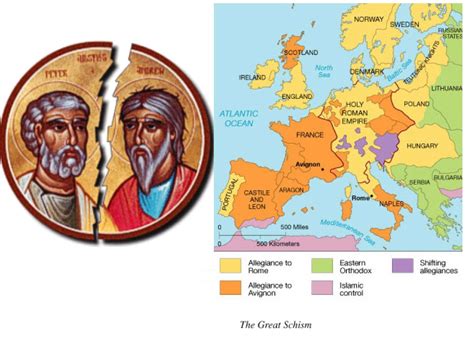
The Great Schism had significant consequences for the development of Christianity. The division between the Eastern and Western Churches led to the emergence of distinct traditions and practices. The Eastern Orthodox Church developed a unique liturgical and theological tradition, while the Roman Catholic Church developed a more centralized and hierarchical structure. The schism also led to a decline in ecumenical dialogue and cooperation between the two branches, which would not be revived until the 20th century.
The Great Schism also had significant political and cultural consequences. The division between the Eastern and Western Churches reflected deeper cultural and political differences between the Byzantine Empire and Western Europe. The schism contributed to the decline of the Byzantine Empire and the rise of Western Europe as a dominant cultural and political force.
Modern Implications
Today, the Great Schism of 1054 remains an important event in Christian history, with ongoing implications for ecumenical dialogue and cooperation. The division between the Eastern Orthodox and Roman Catholic Churches continues to be a significant obstacle to unity, despite efforts towards reconciliation. However, the Great Schism also serves as a reminder of the diversity and richness of Christian tradition, highlighting the importance of respecting and appreciating differences in theology and practice.
What were the main causes of the Great Schism of 1054?
+The main causes of the Great Schism of 1054 were the disagreement over the role of the Pope, the use of the filioque clause, and the practice of clerical celibacy. These differences reflected deeper cultural and theological differences between the Eastern and Western Churches.
What were the consequences of the Great Schism?
+The Great Schism had significant consequences for the development of Christianity, including the emergence of distinct Eastern Orthodox and Roman Catholic traditions. The schism also led to a decline in ecumenical dialogue and cooperation between the two branches, which would not be revived until the 20th century.
What is the current state of ecumenical dialogue between the Eastern Orthodox and Roman Catholic Churches?
+Today, there are ongoing efforts towards ecumenical dialogue and cooperation between the Eastern Orthodox and Roman Catholic Churches. While significant differences remain, there is a growing recognition of the importance of unity and cooperation between the two branches.
In conclusion, the Great Schism of 1054 was a pivotal event in Christian history, marking the formal separation between the Eastern Orthodox and Roman Catholic Churches. The schism was the result of centuries of theological, cultural, and political differences between the two branches, and had significant consequences for the development of Christianity. Today, the Great Schism remains an important reminder of the diversity and richness of Christian tradition, and highlights the importance of respecting and appreciating differences in theology and practice.