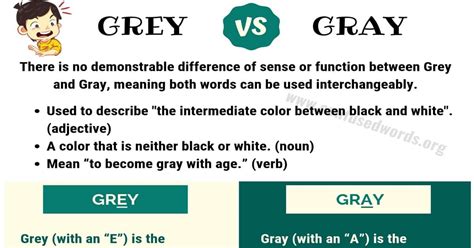
The debate over whether to use "gray" or "grey" has been ongoing, with both spellings being widely accepted. The difference lies in the regional spelling preferences, with "gray" being more commonly used in American English and "grey" in British English. This distinction is not merely a matter of personal preference but is rooted in the historical development of the English language.
Etymology and Historical Context

The word “gray” or “grey” has its roots in Old English, where it was spelled “græg.” This word is derived from the Proto-Germanic word “*grēwaz,” which is also the source of the Modern German word “grau.” Over time, the spelling evolved, and by the 15th century, both “gray” and “grey” were in use. The choice between the two spellings has since been influenced by regional dialects and spelling conventions.
Regional Preferences
In American English, “gray” is the preferred spelling, as recommended by most style guides, including the Chicago Manual of Style and the AP Stylebook. This preference is not absolute, and there are instances where “grey” may be used, particularly in proper nouns or in reference to specific British contexts. On the other hand, in British English, “grey” is the standard spelling, as per the Oxford English Dictionary and other UK style guides. The distinction between the two is not just about spelling but also reflects the broader differences in vocabulary and spelling conventions between American and British English.
| Region | Preferred Spelling |
|---|---|
| American English | Gray |
| British English | Grey |

Key Points
- The difference between "gray" and "grey" is primarily a matter of regional spelling preference, with "gray" used in American English and "grey" in British English.
- Both spellings are acceptable, and the choice between them should be guided by the context and the style guide being followed.
- The etymology of the word shows that both "gray" and "grey" have been in use since the 15th century, derived from the Old English word "græg" and the Proto-Germanic word "*grēwaz."
- For consistency and clarity, it is essential to adhere to one spelling convention throughout a document or publication, based on the target audience and the style guide in use.
- Understanding the nuances of language and spelling conventions is crucial for effective communication, especially in professional and academic contexts.
Practical Applications and Considerations
In practical terms, the choice between “gray” and “grey” can impact how a piece of writing is received by its audience. For instance, using “grey” in an American context might be seen as affected or pretentious, while using “gray” in a British publication could be viewed as inconsistent with local standards. It is also worth noting that in certain fields, such as color theory or design, the precise spelling might be less critical than the understanding of the color itself and its applications.
Color Theory and Design
In the realm of color theory and design, the distinction between “gray” and “grey” becomes less relevant as the focus shifts to the properties and applications of the color. Gray, or grey, is a versatile color used in various design contexts, from typography to interior design, due to its neutrality and ability to complement other colors. The psychological effects of gray, such as conveying balance, calmness, and sophistication, are independent of the spelling used to describe it.
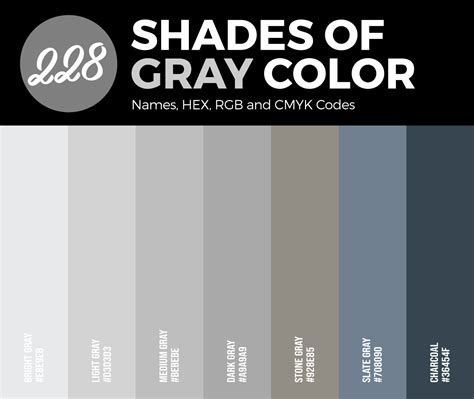
Moreover, the hex code for different shades of gray (#808080 for a medium gray, for example) provides a precise and universal way to refer to the color, transcending the spelling debate. This highlights the importance of understanding the technical aspects of color in design, where the actual color properties and their effects are more significant than the linguistic differences in how they are named.
Is "gray" or "grey" more commonly used globally?
+While both "gray" and "grey" are widely used, the preference can vary significantly by region. American English tends to use "gray," while British English uses "grey." The global usage can depend on the audience and the context in which the word is used.
Does the spelling affect the meaning of the word?
+No, the meaning of the word "gray" or "grey" remains the same regardless of the spelling. The difference is purely in the spelling convention used in different varieties of English.
How should I choose between "gray" and "grey" in my writing?
+The choice between "gray" and "grey" should be based on the style guide you are following or the regional English variant that is most appropriate for your audience. Consistency is key, so it's best to stick with one spelling throughout your document or publication.
In conclusion, the debate over “gray” versus “grey” is a reflection of the broader diversity within the English language, influenced by regional preferences and historical developments. By understanding these nuances and applying them appropriately, communicators can enhance the clarity and effectiveness of their messages, ensuring that their intended meaning is conveyed without distraction from the spelling variations.