Understanding French numbers is an essential part of communicating effectively in the French language. From basic counting to more complex numerical expressions, mastering French numbers can open doors to a richer cultural experience and more nuanced interactions with native speakers. This guide will delve into the world of French numbers, exploring their pronunciation, usage, and the cultural context in which they are used.
Key Points
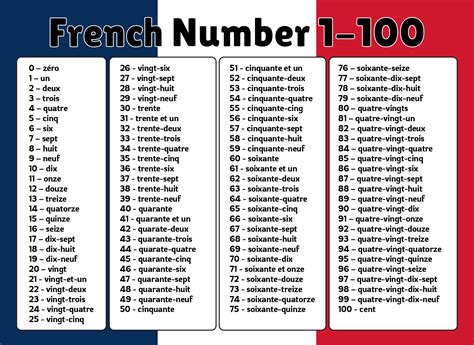
- Basic French numbers from 0 to 100, including their pronunciation and spelling.
- Understanding the unique structure of French numbers, particularly the numbers 70 to 99.
- Exploring the cultural significance of numbers in French society and their everyday applications.
- Practical tips for learners to improve their proficiency in using French numbers.
- Common mistakes to avoid when using French numbers and how to correct them.
Introduction to French Numbers
French numbers are relatively straightforward for the first twenty numbers, with each having a unique name. However, the system becomes more complex from twenty onwards, especially for numbers between seventy and ninety-nine, where the French language uses a combination of base numbers and additions to form the desired numerical value.
Basic French Numbers
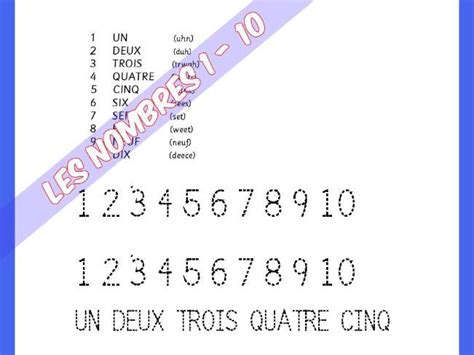
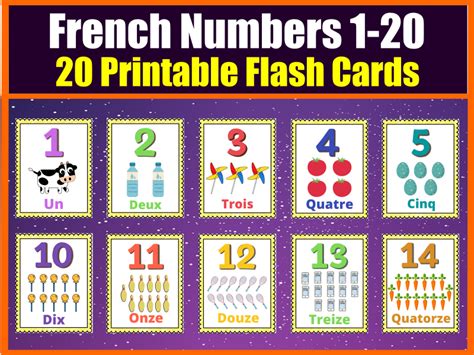
The foundation of French numbers lies in understanding the basic numerical values from 0 to 20. These numbers are: zéro (0), un (1), deux (2), trois (3), quatre (4), cinq (5), six (6), sept (7), huit (8), neuf (9), dix (10), onze (11), douze (12), treize (13), quatorze (14), quinze (15), seize (16), dix-sept (17), dix-huit (18), dix-neuf (19), and vingt (20). Each of these numbers has a unique pronunciation and spelling that learners must familiarize themselves with.
Understanding Complex French Numbers
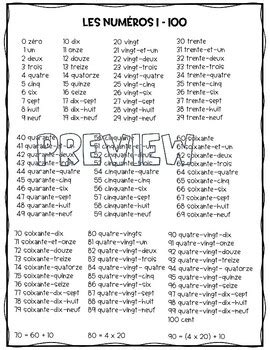
For numbers above twenty, the French system starts to diverge significantly from the English system. For example, the number 70 in French is soixante-dix, literally “sixty-ten,” and 80 is quatre-vingts, or “four-twenty.” This pattern continues up to 99, with 90 being quatre-vingt-dix, or “four-twenty-ten.” Mastering these combinations is crucial for accurately expressing numerical values in French.
Numbers 70 to 99
This range is particularly challenging for learners due to its unique structure. The numbers are formed by combining base numbers (soixante for 60, soixante-dix for 70, quatre-vingts for 80, and quatre-vingt-dix for 90) with the numbers 1 through 19. For instance, 71 is soixante-et-onze (sixty and eleven), 81 is quatre-vingt-un (four-twenty-one), and 95 is quatre-vingt-quinze (four-twenty-fifteen). Understanding and practicing these combinations is essential for fluency in French.
| Number Range | French Expression |
|---|---|
| 70 | Soixante-dix |
| 71 | Soixante-et-onze |
| 80 | Quatre-vingts |
| 81 | Quatre-vingt-un |
| 90 | Quatre-vingt-dix |
| 95 | Quatre-vingt-quinze |
Cultural Significance and Practical Applications
French numbers are not just about mathematical values; they also carry cultural significance and are used in various contexts such as telling time, counting money, and expressing quantities. Understanding these applications can enrich one’s experience of the French language and culture.
Telling Time and Counting Money
In French, time is told using the 24-hour clock, and numbers play a crucial role in this system. For example, 3:45 PM is quinze heures quarante-cinq (fifteen hours forty-five). When it comes to money, the Euro is the standard currency, and prices are expressed using French numbers. For instance, €45.99 would be quarante-cinq euros et quatre-vingt-dix-neuf centimes.
Conclusion and Future Directions
Mastery of French numbers is a gradual process that requires practice, patience, and dedication. By understanding the unique structure of the French numerical system and practicing its application in various contexts, learners can significantly improve their proficiency in the language. Whether for personal enrichment, professional advancement, or cultural exploration, the ability to use French numbers confidently is a valuable skill that can open many doors.
How do I pronounce French numbers correctly?
+Correct pronunciation of French numbers involves paying close attention to the accents and the way numbers are combined. Listening to native speakers and practicing regularly can help improve your pronunciation.
What are some common mistakes to avoid when using French numbers?
+Common mistakes include mispronouncing numbers, especially in the 70 to 99 range, and not using the correct combinations of base numbers and additions. Practicing with a tutor or language exchange partner can help identify and correct these mistakes.
How can I practice using French numbers in context?
+Practicing with real-life scenarios such as telling time, counting money, and expressing quantities can help. Watching French media, engaging in conversations with native speakers, and using language learning apps are also effective ways to practice.
Meta Description: Learn French numbers from 0 to 100, including their pronunciation, unique structures, and cultural significance, with practical tips for improvement and common mistakes to avoid.