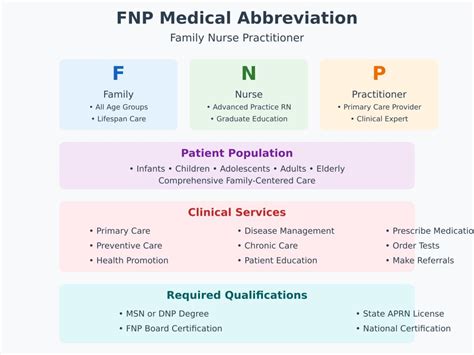
The abbreviation "FNP" in the medical field stands for Family Nurse Practitioner. A Family Nurse Practitioner is an advanced practice registered nurse (APRN) who has completed specialized education and training in the care of individuals and families across the lifespan. FNPs are qualified to provide comprehensive primary and specialty care to patients of all ages, from infants to older adults.
Role and Responsibilities of a Family Nurse Practitioner

FNPs work in a variety of settings, including primary care clinics, hospitals, community health centers, and private practices. Their role encompasses a wide range of responsibilities, including conducting physical exams, diagnosing and treating illnesses, prescribing medications, ordering and interpreting diagnostic tests, and providing health education and counseling to patients and their families. FNPs are also involved in health promotion, disease prevention, and the management of chronic conditions.
Education and Certification
To become an FNP, one must first earn a Bachelor of Science in Nursing (BSN) degree and obtain a license as a registered nurse (RN). Following this, they must complete a Master of Science in Nursing (MSN) or Doctor of Nursing Practice (DNP) degree with a specialization in family nurse practitioner studies. The curriculum for FNP programs includes both classroom and clinical components, covering topics such as advanced health assessment, pharmacology, pathophysiology, and health systems leadership. Upon completion of their graduate degree, aspiring FNPs must pass a national certification exam, such as the one offered by the American Association of Nurse Practitioners (AANP) or the American Nurses Credentialing Center (ANCC), to become certified.
| Professional Organization | Certification |
|---|---|
| American Association of Nurse Practitioners (AANP) | Family Nurse Practitioner Certification (FNP-C) |
| American Nurses Credentialing Center (ANCC) | Family Nurse Practitioner-Board Certified (FNP-BC) |
Key Points
Key Points
- FNPs are advanced practice registered nurses specializing in family care.
- They provide comprehensive primary and specialty care to patients of all ages.
- To become an FNP, one must earn an MSN or DNP degree and pass a national certification exam.
- FNPs work in various settings, including primary care clinics, hospitals, and community health centers.
- Their responsibilities include diagnosing and treating illnesses, prescribing medications, and providing health education.
In conclusion, Family Nurse Practitioners play a vital role in the healthcare system, offering a unique blend of nursing and medical care to individuals and families. Their advanced education and training enable them to provide high-quality, patient-centered care, addressing the complex health needs of diverse populations.
What does an FNP do on a daily basis?
+On a daily basis, an FNP conducts physical exams, diagnoses and treats illnesses, prescribes medications, and provides health education and counseling to patients and their families.
How do I become a certified FNP?
+To become a certified FNP, you must earn a Master of Science in Nursing (MSN) or Doctor of Nursing Practice (DNP) degree with a specialization in family nurse practitioner studies, and then pass a national certification exam offered by a professional organization such as the AANP or ANCC.
What settings can FNPs work in?
+FNPs can work in a variety of settings, including primary care clinics, hospitals, community health centers, and private practices, providing care to patients of all ages.