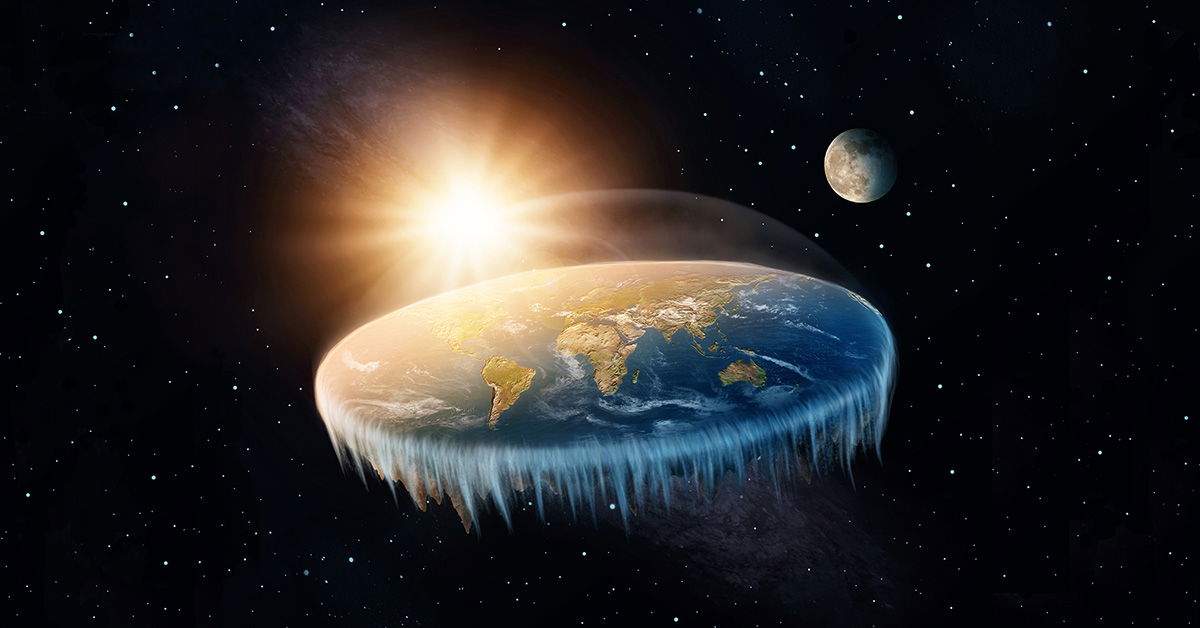
The concept of a flat Earth has been a topic of debate for centuries, with many individuals claiming that the Earth is not a sphere, but rather a flat disc. However, with the advancement of technology and scientific discoveries, the theory of a flat Earth has been proven wrong time and time again. One of the primary reasons for the dismissal of the flat Earth theory is the existence of time zones. If the Earth were flat, it would be impossible for different regions to have different times, as the sun would be visible from all locations on the Earth at the same time. However, with the Earth being a sphere, different regions experience different times due to their position on the Earth's surface.
Another significant piece of evidence that disproves the flat Earth theory is the existence of ships disappearing over the horizon. When a ship sails away from an observer on the shore, it will eventually disappear from view as it sinks below the horizon. This phenomenon can only be explained by the curvature of the Earth, as the observer's line of sight is gradually lowered as the ship moves further away. If the Earth were flat, the ship would remain visible on the horizon, as there would be no curvature to obstruct the observer's view. Furthermore, the existence of satellite imagery and spacecraft has provided conclusive evidence of the Earth's spherical shape. Satellite images of the Earth have been taken from space, providing a clear visual representation of the planet's curvature. Additionally, spacecraft have orbited the Earth, providing further evidence of its spherical shape.
Key Points
- The existence of time zones is a primary reason for the dismissal of the flat Earth theory
- The disappearance of ships over the horizon can only be explained by the curvature of the Earth
- Satellite imagery and spacecraft have provided conclusive evidence of the Earth's spherical shape
- The Earth's shadow on the moon during a lunar eclipse is also evidence of the Earth's spherical shape
- The existence of the Earth's gravitational field is also a strong indication of the planet's spherical shape
The Scientific Consensus

The overwhelming majority of the scientific community agrees that the Earth is a sphere. The evidence from various fields of science, including astronomy, geology, and physics, all point to the same conclusion. The concept of a flat Earth is not supported by scientific evidence and is often considered a pseudoscience. The scientific consensus is based on a wide range of observations and experiments, including the measurement of the Earth’s gravity field, the observation of the Earth’s shadow on the moon during a lunar eclipse, and the existence of the Earth’s magnetic field.
Gravity and the Earth’s Shape
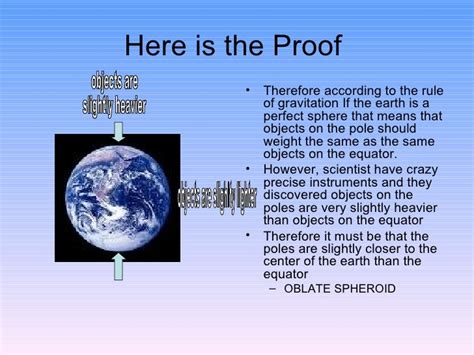
The Earth’s gravity field is a strong indication of the planet’s spherical shape. According to the theory of gravity, the force of gravity is proportional to the mass of the object and inversely proportional to the square of the distance from the center of the object. The Earth’s gravity field is consistent with a spherical shape, as the force of gravity is strongest at the center of the Earth and decreases as you move away from the center. If the Earth were flat, the gravity field would be significantly different, with the force of gravity being strongest at the edges of the flat disc and decreasing as you move towards the center.
| Scientific Discipline | Evidence for Spherical Earth |
|---|---|
| Astronomy | Observation of the Earth's shadow on the moon during a lunar eclipse |
| Geology | Measurement of the Earth's gravity field |
| Physics | Existence of the Earth's magnetic field |
Addressing Flat Earth Theories
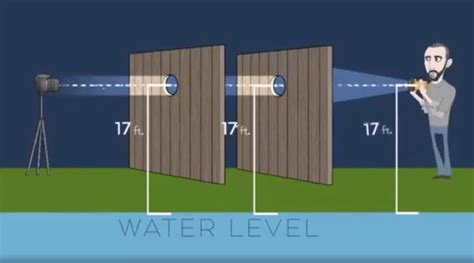
Despite the overwhelming evidence for a spherical Earth, some individuals still claim that the Earth is flat. These claims are often based on unproven assumptions and a lack of understanding of the scientific evidence. One of the most common arguments made by flat Earth theorists is that the horizon always appears to be at eye level, which they claim is evidence that the Earth is flat. However, this argument is based on a misunderstanding of the concept of perspective. The horizon appears to be at eye level because the Earth is curved, and the observer’s line of sight is gradually lowered as they look out towards the horizon.
Another argument made by flat Earth theorists is that the lack of visible curvature of the Earth is evidence that the planet is flat. However, this argument is also based on a misunderstanding of the concept of perspective. The Earth is so large that its curvature is not visible to the naked eye, except at very high altitudes. The curvature of the Earth can be observed from space, where the planet's shape is clearly visible. Additionally, the existence of the Earth's gravitational field and the behavior of objects on the planet's surface are also strong indications of the planet's spherical shape.
What is the primary reason for the dismissal of the flat Earth theory?
+The primary reason for the dismissal of the flat Earth theory is the existence of time zones. If the Earth were flat, it would be impossible for different regions to have different times, as the sun would be visible from all locations on the Earth at the same time.
What is the evidence for the Earth's spherical shape from the field of astronomy?
+The observation of the Earth's shadow on the moon during a lunar eclipse is a strong indication of the Earth's spherical shape. The Earth's shadow on the moon is always circular, which is only possible if the Earth is a sphere.
How does the concept of gravity support the idea of a spherical Earth?
+The concept of gravity supports the idea of a spherical Earth because the force of gravity is proportional to the mass of the object and inversely proportional to the square of the distance from the center of the object. The Earth's gravity field is consistent with a spherical shape, as the force of gravity is strongest at the center of the Earth and decreases as you move away from the center.
In conclusion, the concept of a flat Earth has been proven wrong by the overwhelming evidence from various fields of science. The existence of time zones, the disappearance of ships over the horizon, and the observation of the Earth’s shadow on the moon during a lunar eclipse are all strong indications of the Earth’s spherical shape. The scientific consensus is clear: the Earth is a sphere, and the evidence from various fields of science all point to the same conclusion. As we continue to explore and learn more about our planet, it is essential to rely on scientific evidence and expert opinions rather than unproven assumptions and misconceptions.