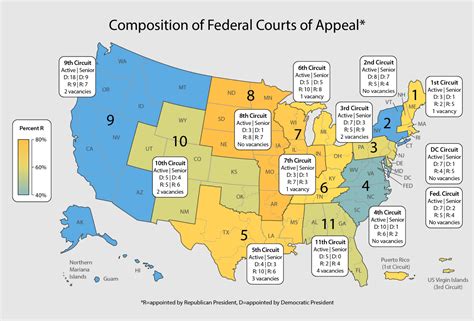
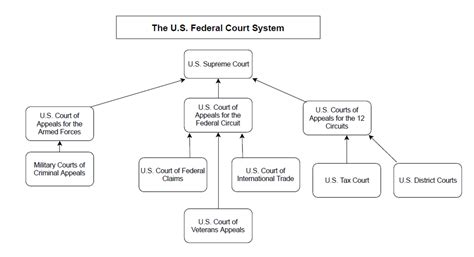
The Federal Circuit Court system in the United States is a vital component of the country's judicial framework, responsible for overseeing the application of federal law in a wide range of cases, including those involving patents, trademarks, and federal contracts. At the heart of this system is the Federal Circuit Court of Appeals, also known as the Court of Appeals for the Federal Circuit (CAFC), which has jurisdiction over specific types of cases that involve federal laws. However, the broader landscape of federal courts includes the district courts, which are the trial courts of the federal system, and the circuit courts of appeals, which hear appeals from the district courts. Understanding the map or structure of these courts is essential for navigating the federal judiciary.
Introduction to the Federal Circuit Court System
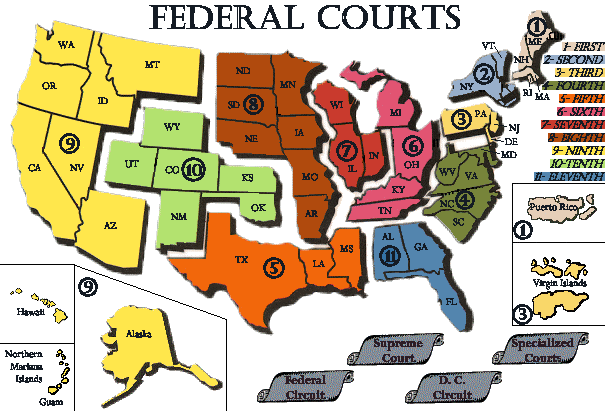
The United States is divided into thirteen circuits, each with its own court of appeals. These circuits are numbered from 1 to 11, with the District of Columbia Circuit (D.C. Circuit) and the Federal Circuit making up the remaining two. Each circuit encompasses several states, with the exception of the Federal Circuit, which has nationwide jurisdiction over specific subject matters. The Federal Circuit Court of Appeals, headquartered in Washington, D.C., is unique among the circuits because it does not have a defined geographic area but instead hears cases involving patent and trademark law, among other areas, from across the country.
Geographic Jurisdiction of the Circuit Courts
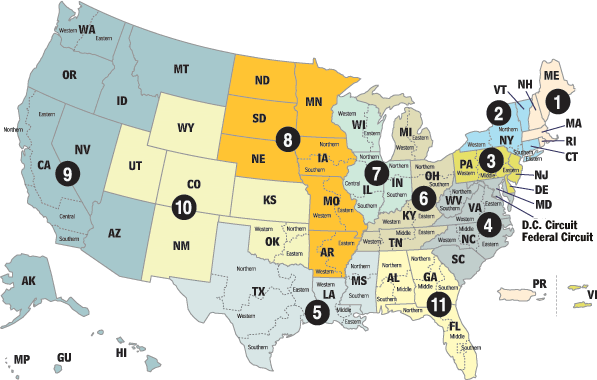
The geographic jurisdiction of the circuit courts is as follows: - The First Circuit covers Maine, Massachusetts, New Hampshire, Puerto Rico, and Rhode Island. - The Second Circuit includes Connecticut, New York, and Vermont. - The Third Circuit encompasses Delaware, New Jersey, and Pennsylvania. - The Fourth Circuit covers Maryland, North Carolina, South Carolina, Virginia, and West Virginia. - The Fifth Circuit includes Louisiana, Mississippi, and Texas. - The Sixth Circuit encompasses Kentucky, Michigan, Ohio, and Tennessee. - The Seventh Circuit covers Illinois, Indiana, and Wisconsin. - The Eighth Circuit includes Arkansas, Iowa, Minnesota, Missouri, Nebraska, North Dakota, and South Dakota. - The Ninth Circuit, the largest by population, covers Alaska, Arizona, California, Guam, Hawaii, Idaho, Montana, Nevada, the Northern Mariana Islands, Oregon, and Washington. - The Tenth Circuit encompasses Colorado, Kansas, New Mexico, Oklahoma, Utah, and Wyoming. - The Eleventh Circuit covers Alabama, Florida, and Georgia. - The D.C. Circuit has jurisdiction over cases originating in the District of Columbia. - The Federal Circuit, as mentioned, has jurisdiction over specific subject matters nationwide, including patent and trademark cases, and cases involving federal contracts and veterans’ benefits.
| Circuit Number | States Covered |
|---|---|
| First Circuit | Maine, Massachusetts, New Hampshire, Puerto Rico, Rhode Island |
| Second Circuit | Connecticut, New York, Vermont |
| Third Circuit | Delaware, New Jersey, Pennsylvania |
| Fourth Circuit | Maryland, North Carolina, South Carolina, Virginia, West Virginia |
| Fifth Circuit | Louisiana, Mississippi, Texas |
| Sixth Circuit | Kentucky, Michigan, Ohio, Tennessee |
| Seventh Circuit | Illinois, Indiana, Wisconsin |
| Eighth Circuit | Arkansas, Iowa, Minnesota, Missouri, Nebraska, North Dakota, South Dakota |
| Ninth Circuit | Alaska, Arizona, California, Guam, Hawaii, Idaho, Montana, Nevada, Northern Mariana Islands, Oregon, Washington |
| Tenth Circuit | Colorado, Kansas, New Mexico, Oklahoma, Utah, Wyoming |
| Eleventh Circuit | Alabama, Florida, Georgia |
| D.C. Circuit | Washington, D.C. |
| Federal Circuit | Nationwide for specific subject matters |
Key Points
Key Points
- The Federal Circuit Court of Appeals has nationwide jurisdiction over specific subject matters, including patent and trademark law.
- The United States is divided into thirteen circuits, each with its own court of appeals, with the exception of the Federal Circuit.
- Each circuit (except the Federal Circuit and D.C. Circuit) covers a defined geographic area, encompassing several states.
- The circuit courts of appeals hear appeals from the federal district courts within their respective jurisdictions.
- Understanding the circuit map is essential for navigating the federal judiciary and determining the appropriate court for a case.
Historical and Evolutionary Developments
The structure of the federal circuit courts has evolved over time, with changes in jurisdiction, the creation of new circuits, and adjustments to the geographic areas covered by each circuit. These developments reflect the growing complexity of federal law and the need for specialized courts to handle specific types of cases efficiently and effectively. The Federal Circuit, established in 1982, is a prime example of this evolution, consolidating the jurisdiction over patent and trademark cases to ensure consistency and expertise in these critical areas of federal law.
In conclusion, the federal circuit court map is a dynamic and specialized structure designed to meet the legal needs of the United States. By understanding the jurisdictional boundaries and the unique roles of each circuit, individuals and businesses can better navigate the federal judiciary and ensure that their cases are heard in the appropriate forum.
What is the primary function of the Federal Circuit Court of Appeals?
+The primary function of the Federal Circuit Court of Appeals is to hear appeals in cases involving patent and trademark law, among other specific subject matters, from across the United States, providing a specialized and consistent approach to these areas of federal law.
How many circuits are there in the United States, and what areas do they cover?
+There are thirteen circuits in the United States. Twelve of these circuits cover defined geographic areas, each encompassing several states, while the Federal Circuit has nationwide jurisdiction over specific subject matters.
What is the role of the district courts within the federal judiciary?
+The district courts are the trial courts of the federal system, hearing cases that fall under federal jurisdiction. Appeals from these courts are heard by the circuit courts of appeals.