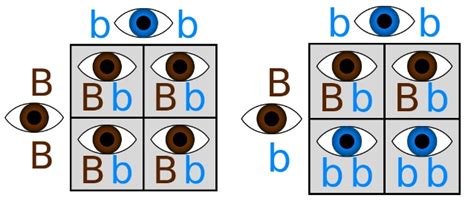
The study of eye colour is a fascinating aspect of genetics, and one of the most effective ways to predict the probability of certain eye colours being passed down from parents to offspring is through the use of Punnett squares. A Punnett square is a graphical representation of all possible genotypes that can result from a cross between two parents. In the context of eye colour, it's essential to understand that eye colour is a complex trait determined by multiple genes, but for simplicity, we'll focus on the basics of brown and blue eye colours, which are often used as examples in genetic studies.
Eye colour is primarily determined by the amount and distribution of pigment in the iris. Brown eye colour is dominant, while blue eye colour is recessive. This means that an individual needs to inherit two copies of the recessive allele (one from each parent) to express blue eyes. The genotype of an individual can be either BB or Bb for brown eyes, where "B" represents the dominant allele for brown eyes, and "bb" for blue eyes, where "b" represents the recessive allele for blue eyes.
Understanding Punnett Squares for Eye Colour

A Punnett square for eye colour would involve the genotypes of the two parents. Let’s consider a simple scenario where both parents are carriers of the recessive allele for blue eyes, but both have brown eyes themselves, making their genotype Bb. The Punnett square for this cross would look like this:
| Father's Alleles | Mother's Alleles | Offspring Genotype | Offspring Phenotype |
|---|---|---|---|
| B | B | BB | Brown Eyes |
| B | b | Bb | Brown Eyes |
| b | B | Bb | Brown Eyes |
| b | b | bb | Blue Eyes |
This Punnett square shows that there's a 25% chance (1 out of 4) that the offspring will have blue eyes (bb), a 50% chance (2 out of 4) that the offspring will be carriers of the blue eye allele but have brown eyes themselves (Bb), and a 25% chance (1 out of 4) that the offspring will have brown eyes and not be a carrier of the blue eye allele (BB).
Interpreting the Results of a Punnett Square for Eye Colour
Interpreting the results of a Punnett square for eye colour involves understanding the probabilities associated with each possible genotype and phenotype. For parents who are both carriers of the blue eye allele (Bb), there’s a significant chance that their offspring could have blue eyes, even if neither parent has blue eyes. This demonstrates the complexity of genetics and how traits can be passed down through generations in unpredictable ways.
It's also important to note that while Punnett squares can predict probabilities, they cannot guarantee specific outcomes. The actual eye colour of offspring can vary based on a variety of genetic and environmental factors. Nonetheless, Punnett squares remain a valuable tool for understanding the basics of genetic inheritance and predicting the likelihood of certain traits being passed down.
Key Points
- Eye colour is a complex trait influenced by multiple genes, with brown eye colour being dominant and blue eye colour being recessive.
- Punnett squares can be used to predict the probability of certain eye colours in offspring based on the genotypes of the parents.
- For two parents who are carriers of the blue eye allele (Bb), there's a 25% chance their offspring will have blue eyes, a 50% chance their offspring will be carriers with brown eyes, and a 25% chance their offspring will have brown eyes without being carriers.
- The actual expression of eye colour can be influenced by more than just the genes considered in a simple Punnett square model.
- Understanding genetic inheritance patterns, such as those illustrated by Punnett squares, is crucial for predicting and understanding traits like eye colour.
In conclusion, the study of eye colour through Punnett squares offers insights into the genetic principles that govern the inheritance of traits. While the model is simplified and doesn't account for the full complexity of eye colour genetics, it provides a foundational understanding that can be built upon to explore more complex aspects of genetic inheritance.
What determines eye colour in humans?
+Eye colour is determined by the amount and distribution of pigment in the iris. Multiple genes contribute to eye colour, but the basics can be understood through the dominant/recessive model of brown and blue eye colours.
Can Punnett squares accurately predict eye colour?
+Punnett squares can predict probabilities of certain eye colours based on parental genotypes but cannot guarantee specific outcomes due to the complexity of genetics and environmental factors.
What is the genotype and phenotype of a person with brown eyes who is not a carrier of the blue eye allele?
+The genotype would be BB, and the phenotype would be brown eyes. This individual would not be a carrier of the blue eye allele.