Here are five examples of diction in different contexts, along with explanations and analysis:
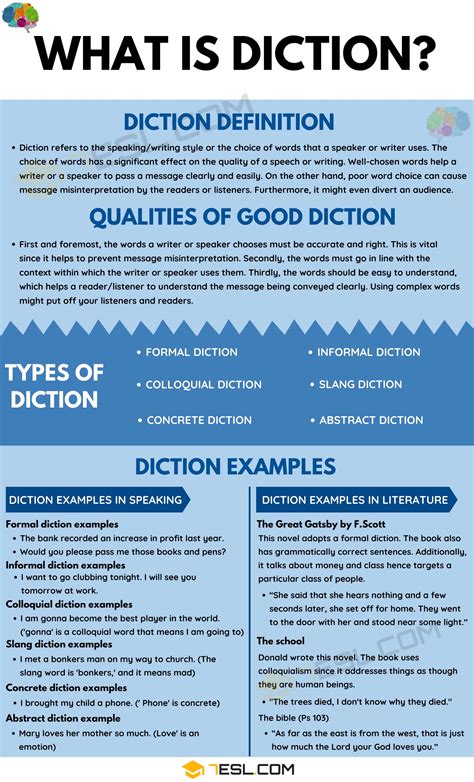
- Formal Diction: “The implementation of the new policy will necessitate a thorough examination of the existing infrastructure, thereby ensuring a seamless transition and mitigating potential risks.”
In this example, the diction is formal, characterized by the use of complex vocabulary (e.g., “necessitate,” “mitigating”), technical terms (e.g., “infrastructure”), and a structured sentence pattern. This type of diction is commonly used in academic, professional, or technical writing.
- Informal Diction: “I’m gonna grab a coffee and catch up with you later, okay? I’ve got a ton of work to do and I’m already running behind schedule.”
This example illustrates informal diction, marked by the use of colloquial expressions (e.g., “gonna,” “catch up”), contractions (e.g., “I’m”), and a relaxed sentence structure. Informal diction is often used in everyday conversations, social media, or casual writing.
- Technical Diction: “The novel utilizes a cutting-edge lithium-ion battery, which boasts an energy density of 250 Wh/kg, thereby enabling a prolonged operating time and reducing the need for frequent recharging.”
In this example, the diction is technical, characterized by the use of specialized vocabulary (e.g., “lithium-ion battery,” “energy density”), precise data (e.g., “250 Wh/kg”), and a formal tone. Technical diction is commonly used in scientific, engineering, or technical writing.
- Poetic Diction: “The moon’s silvery glow cast an ethereal light upon the landscape, as the night blooming flowers swayed gently in the breeze, their sweet fragrance wafting like a lover’s whispered promise.”
This example illustrates poetic diction, marked by the use of lyrical language (e.g., “silvery glow,” “ethereal light”), figurative expressions (e.g., “like a lover’s whispered promise”), and a musical sentence structure. Poetic diction is often used in literary, creative, or descriptive writing.
- Colloquial Diction: “Y’all won’t believe what happened to me yesterday – I was driving down the road and I saw this crazy accident, and I’m like, ‘Oh my god, what’s going on?’ And then I realized it was just a movie shoot, and I felt like such a fool.”
In this example, the diction is colloquial, characterized by the use of regional expressions (e.g., “y’all”), informal language (e.g., “I’m like”), and a conversational tone. Colloquial diction is often used in everyday conversations, social media, or casual writing, particularly in regional or cultural contexts.
These examples demonstrate how diction can vary depending on the context, purpose, and audience, and how it can be used to convey meaning, tone, and style in different types of writing.