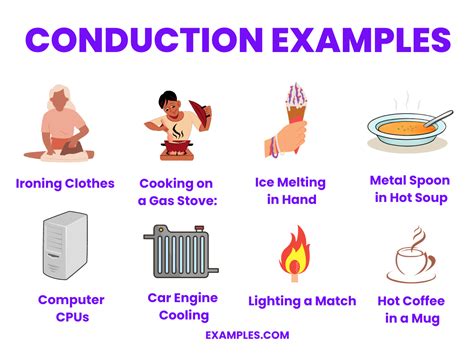
Conduction, one of the three primary methods of heat transfer, plays a significant role in our daily lives. It is the process by which heat is transferred through a solid material, where atoms or molecules vibrate and collide, passing energy from one to another. This fundamental principle is observed and utilized in various aspects of daily life, from cooking and construction to electronics and clothing. Understanding conduction is crucial for designing and optimizing systems that involve heat transfer, ensuring efficiency, safety, and comfort in numerous applications.
Principles of Conduction
Before diving into examples of conduction in daily life, it’s essential to grasp the basic principles. Conduction occurs in solids, where the particles are closely packed, allowing for efficient energy transfer through direct contact. The rate of heat transfer by conduction depends on the temperature difference between the particles, the material’s thermal conductivity, and the distance over which the heat is transferred. Materials with high thermal conductivity, such as metals (especially silver, copper, and aluminum), are good conductors of heat, while materials with low thermal conductivity, like wood, plastic, and air, are poor conductors.
Examples in Cooking and Food Preparation
Cooking is one of the most common areas where conduction is applied. When you place a pot on a stove, the heat from the burner is conducted through the pot’s material (usually metal) to the food inside. The efficiency of heat transfer can depend on the type of cookware used; for instance, copper pots are excellent conductors and can distribute heat evenly, while stainless steel pots, although durable, may not conduct heat as well. Similarly, when you hold a hot cup of coffee, the heat is conducted from the coffee, through the cup, and to your hands, which is why it’s often more comfortable to use a handle or a sleeve to reduce direct contact.
| Material | Thermal Conductivity (W/m·K) |
|---|---|
| Silver | 429 |
| Copper | 386 |
| Aluminum | 237 |
| Stainless Steel | 15 |
| Wood | 0.13 |
| Air | 0.025 |

Conduction in Construction and Insulation

In the context of building construction, conduction plays a critical role in determining the thermal efficiency of a structure. The choice of materials for walls, floors, and roofs can significantly impact how heat is conducted into or out of a building. For example, concrete and brick are good conductors and can absorb and release heat slowly, making them useful for thermal mass applications. On the other hand, materials like fiberglass, cellulose, and foam board insulation are poor conductors and are used to reduce heat conduction, keeping buildings warm in the winter and cool in the summer.
Applications in Electronics
In electronics, conduction is vital for the operation and cooling of devices. Electronic components, such as CPUs and GPUs, generate heat during operation, which must be conducted away to prevent overheating and damage. Heat sinks, made from materials with high thermal conductivity like aluminum or copper, are used to absorb and dissipate this heat. Similarly, the choice of material for the printed circuit board (PCB) can affect the conduction of heat among components, with some materials designed to enhance thermal conductivity while others are chosen for their electrical insulation properties.
Key Points
- Conduction is a primary method of heat transfer in solids, affecting various aspects of daily life.
- The efficiency of conduction depends on the material's thermal conductivity, temperature difference, and distance of heat transfer.
- Examples of conduction include cooking, construction, electronics, and clothing, where understanding and manipulating heat transfer is crucial for efficiency, safety, and comfort.
- Materials with high thermal conductivity, such as metals, are used in applications where efficient heat transfer is desired, while materials with low thermal conductivity are used for insulation.
- The principle of conduction is fundamental in designing systems that involve heat transfer, from cookware and building insulation to electronic components and clothing.
In conclusion, conduction is not just a theoretical concept but a practical principle that influences numerous aspects of our daily lives. From the pots we use for cooking to the materials used in constructing our homes and the devices that power our modern world, understanding and applying the principles of conduction are essential for creating efficient, safe, and comfortable living and working environments.
What is the primary factor affecting the rate of heat transfer by conduction?
+The primary factors include the material’s thermal conductivity, the temperature difference between the particles, and the distance over which the heat is transferred.
Why are metals often used in cookware and electronics?
+Metals are used in these applications because they have high thermal conductivity, allowing for efficient heat transfer.
How does conduction impact the construction of buildings?
+Conduction affects the choice of materials for walls, floors, and roofs, influencing the thermal efficiency of a structure. Materials with low thermal conductivity are used for insulation to reduce heat conduction.