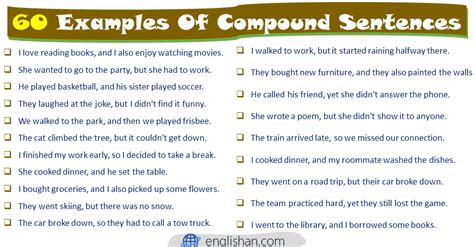
Compound sentences are a fundamental aspect of the English language, allowing speakers and writers to express complex ideas by combining two or more independent clauses. An independent clause is a group of words that contains a subject and a predicate, expressing a complete thought. When two independent clauses are joined by a conjunction, a compound sentence is formed. This conjunction can be a coordinating conjunction such as "and," "but," "or," "nor," "for," "so," or "yet." Understanding how to construct and use compound sentences effectively can significantly enhance communication clarity and efficiency.
Basic Structure of Compound Sentences
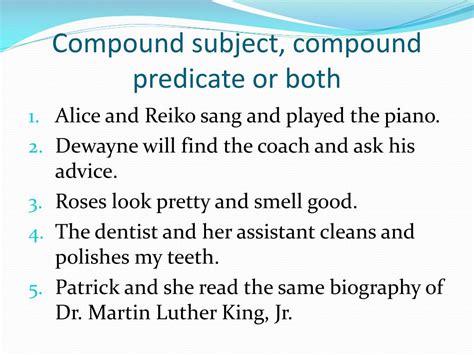
A compound sentence typically follows a specific structure: Independent Clause + Conjunction + Independent Clause. For instance, “I went to the store, and I bought some milk.” In this example, “I went to the store” and “I bought some milk” are two independent clauses joined by the coordinating conjunction “and.” Each clause has a subject (I) and a verb (went, bought), and each could stand alone as a separate sentence. The use of a compound sentence here allows the expression of two related ideas in a single sentence, improving the flow of information.
Examples of Compound Sentences
Let’s consider a few examples to illustrate the versatility and common usage of compound sentences:
- Example 1: I wanted to go to the beach, but the weather was bad. This sentence combines two independent clauses (“I wanted to go to the beach” and “the weather was bad”) with the conjunction “but,” indicating a contrast between the two clauses.
- Example 2: She studied for three hours, and then she took a short break. Here, “She studied for three hours” and “then she took a short break” are joined by “and,” showing a sequence of actions.
- Example 3: He didn’t like the movie, nor did he enjoy the play. This example uses “nor” to connect two independent clauses, emphasizing a negative aspect of both clauses.
- Example 4: The new policy will be implemented next year, so we need to prepare for the changes. In this case, “so” is used to indicate a reason or consequence, linking “The new policy will be implemented next year” with “we need to prepare for the changes.”
- Example 5: The company will hire more staff, for they are experiencing an increase in demand. The conjunction “for” explains the reason behind the action in the first clause (“The company will hire more staff”), providing a cause-and-effect relationship between the two clauses.
In conclusion, compound sentences offer a powerful tool for effective communication, allowing the combination of multiple ideas into a single, coherent statement. By understanding the basic structure and practicing the use of different conjunctions, individuals can improve their ability to express complex thoughts with precision and clarity.
What is a compound sentence?
+A compound sentence is a sentence that contains two or more independent clauses joined by a conjunction.
What are independent clauses?
+Independent clauses are groups of words that contain a subject and a predicate, expressing a complete thought.
What are the types of conjunctions used in compound sentences?
+The conjunctions used in compound sentences are coordinating conjunctions, such as “and,” “but,” “or,” “nor,” “for,” “so,” and “yet.”