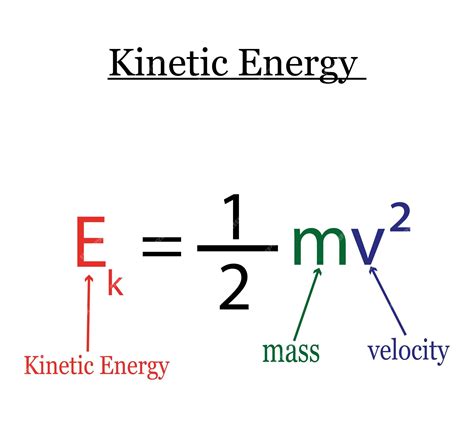
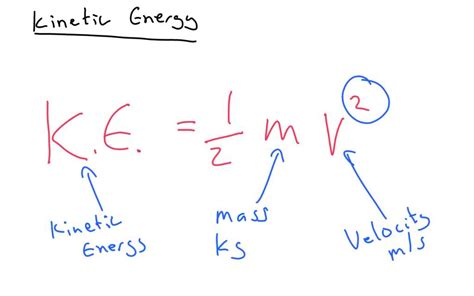
The concept of energy is fundamental to understanding the workings of the universe, from the smallest subatomic particles to the vast expanse of cosmic structures. At its core, energy is the capacity to do work, and it comes in various forms, such as kinetic energy, potential energy, thermal energy, and more. The equation of energy, often represented by the formula E = mc^2, where E is energy, m is mass, and c is the speed of light in a vacuum, reveals a profound relationship between mass and energy. This equation, derived by Albert Einstein as part of his theory of special relativity, shows that mass and energy are interchangeable; a certain amount of mass can be converted into a corresponding amount of energy, and vice versa.
Key Points
- The equation E = mc^2 demonstrates the equivalence of mass and energy.
- Mass (m) and the speed of light (c) are the fundamental components in calculating energy (E).
- This equation is a cornerstone of nuclear physics, explaining both nuclear fission and fusion reactions.
- The conversion of mass into energy, and energy into mass, is a process observed in various phenomena, from radioactive decay to the sun's energy production.
- The speed of light (c) is a constant, approximately 299,792 kilometers per second, and it plays a crucial role in the equation as it is squared, indicating the immense energy potential in even small amounts of mass.
Understanding the Equation
The equation E = mc^2 is deceptively simple. It suggests that a small amount of mass can be converted into a large amount of energy, given that the speed of light is approximately 299,792 kilometers per second and the equation squares this value. This relationship has been experimentally confirmed and forms the basis of nuclear power generation and nuclear weapons, among other applications. For instance, in nuclear fission, a small amount of the mass of the nucleus is converted into a significant amount of energy, illustrating the potency of Einstein’s equation.
Implications of the Equation
The implications of E = mc^2 are profound, affecting our understanding of physics, chemistry, and engineering. In the realm of particle physics, the equation explains how particles can be created and annihilated, processes that are fundamental to understanding the universe at its most basic level. Furthermore, the equation underpins the concept of nuclear binding energy, which is the energy required to disassemble a nucleus into its constituent protons and neutrons. This, in turn, helps in understanding the stability of nuclei and the processes that occur within stars.
| Physical Quantity | Unit | Description |
|---|---|---|
| Energy (E) | Joules (J) | The capacity to do work. |
| Mass (m) | Kilograms (kg) | A measure of the amount of matter in an object. |
| Speed of Light (c) | Meters per second (m/s) | The speed at which light travels in a vacuum, approximately 299,792,458 m/s. |
Applications and Examples
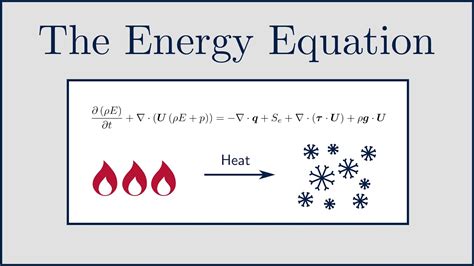
The applications of E = mc^2 are diverse and widespread. In nuclear power plants, the fission of heavy nuclei like uranium-235 releases a significant amount of energy, which is then used to generate electricity. This process is a direct application of the equation, where a small portion of the mass of the nuclei is converted into energy. Similarly, in the sun and other stars, nuclear fusion reactions convert a small amount of the mass of hydrogen into an enormous amount of energy, which is then radiated into space as light and heat.
Nuclear Reactions
Nuclear reactions, whether fission or fusion, are prime examples of the equation in action. During these reactions, a tiny amount of mass is converted into a large amount of energy, illustrating the equation’s potency. The energy released per reaction can be calculated using E = mc^2, providing a quantitative understanding of these processes. This knowledge is crucial for designing more efficient reactors and for understanding the energy output of celestial bodies like stars.
In conclusion, the equation E = mc^2 is a fundamental principle of physics that has far-reaching implications for our understanding of the universe and the development of technologies. Its applications in nuclear physics, astrophysics, and engineering are a testament to the power of human discovery and the importance of continued exploration and research in the sciences.
What is the significance of the speed of light in the equation E = mc^2?
+The speed of light © is significant because it is a universal constant that relates mass and energy. The fact that it is squared in the equation means that even a small amount of mass can be converted into a large amount of energy, highlighting the potency of the equation.
How does the equation E = mc^2 apply to nuclear power generation?
+In nuclear power generation, the equation applies through the process of nuclear fission. A small amount of the mass of the nuclei of heavy elements like uranium is converted into energy, which is then used to generate electricity. This process illustrates the practical application of E = mc^2 in converting mass into usable energy.
What are the implications of E = mc^2 for our understanding of the universe?
+The equation has profound implications for our understanding of the universe, from the smallest subatomic particles to the vast scales of cosmic phenomena. It explains how stars generate their energy, how matter and energy are interchangeable, and provides insights into the fundamental nature of reality itself.