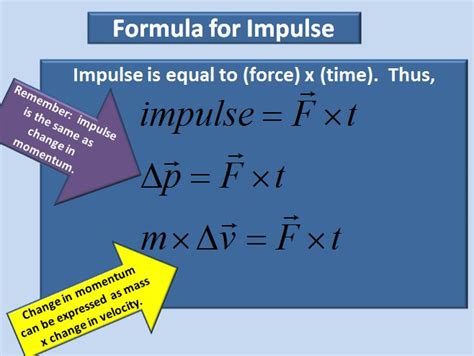
The impulse equation is a fundamental concept in physics, particularly in the field of mechanics. It describes the relationship between the force applied to an object and the resulting change in its momentum. The impulse equation is often expressed as Δp = F * Δt, where Δp is the change in momentum, F is the average force applied, and Δt is the time over which the force is applied. This equation is a direct result of the definition of impulse, which is the product of the average force and the time interval for which it is applied.
Understanding the impulse equation is crucial in various fields, including engineering, astronomy, and sports science. It helps in calculating the force required to change the momentum of an object, which is essential in designing systems, predicting trajectories, and optimizing performance. For instance, in rocket propulsion, the impulse equation is used to determine the thrust required to achieve a specific change in momentum, thereby enabling the rocket to reach its desired velocity.
Key Points
- The impulse equation (Δp = F * Δt) relates the change in momentum of an object to the average force applied and the time over which it is applied.
- Understanding the impulse equation is crucial for calculating the force required to change the momentum of an object.
- The equation has applications in various fields, including engineering, astronomy, and sports science.
- It is essential for designing systems, predicting trajectories, and optimizing performance in these fields.
- The impulse equation is a direct result of the definition of impulse and is derived from Newton's second law of motion.
Derivation and Explanation of the Impulse Equation
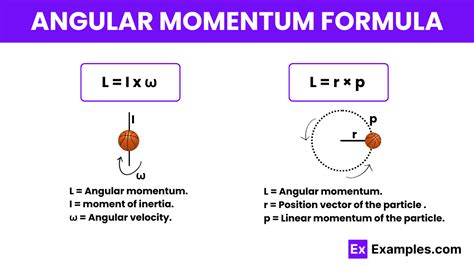
The impulse equation can be derived from Newton’s second law of motion, which states that the force acting on an object is equal to the rate of change of its momentum. Mathematically, this is expressed as F = dp/dt, where F is the force, and dp/dt is the derivative of momentum with respect to time. By integrating both sides of this equation over a time interval Δt, we obtain the impulse equation: Δp = ∫F dt = F * Δt, assuming that the force F is constant over the time interval.
Application of the Impulse Equation in Real-World Scenarios
The impulse equation has numerous applications in real-world scenarios. For example, in the design of seatbelts in vehicles, the impulse equation is used to calculate the force exerted on the occupants during a crash. By applying the impulse equation, engineers can determine the required strength of the seatbelts to ensure that the occupants’ momentum is reduced safely and effectively. Similarly, in sports, the impulse equation is used to analyze the performance of athletes, such as the force applied by a golfer’s club to the ball, which determines the ball’s initial velocity and trajectory.
| Category | Description | Formula |
|---|---|---|
| Momentum Change | Change in momentum of an object | Δp = m * Δv |
| Impulse | Product of average force and time interval | J = F * Δt |
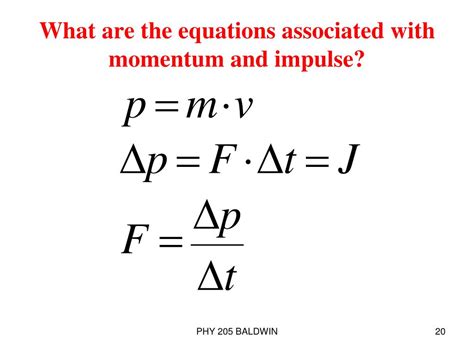
| Force | Rate of change of momentum | F = dp/dt |
Advanced Applications and Considerations
In advanced applications, the impulse equation must be integrated with other physical principles, such as energy conservation and rotational kinematics. For instance, in the analysis of collisions, the impulse equation is combined with the principle of conservation of momentum to determine the final velocities of the objects involved. Additionally, in the study of rotational motion, the impulse equation is used to calculate the torque applied to an object, which causes a change in its angular momentum.
Furthermore, the impulse equation has implications for the design of safety features in vehicles and protective gear in sports. By understanding how forces are transmitted and momentum is changed during impacts, engineers can design systems that effectively reduce the risk of injury. This involves not only applying the impulse equation but also considering the materials science and biomechanics of the human body to develop safer and more effective protective technologies.
Limitations and Potential Misconceptions
While the impulse equation is a powerful tool for analyzing the relationship between force and momentum change, it does have limitations. One of the primary assumptions of the impulse equation is that the force applied is constant over the time interval. In many real-world scenarios, forces can vary significantly over time, requiring a more complex analysis involving the integration of the force function. Additionally, the impulse equation does not account for energy losses due to friction or other dissipative forces, which can be significant in certain applications.
What is the primary application of the impulse equation in physics?
+The primary application of the impulse equation is to calculate the change in momentum of an object when a force is applied over a specific time interval. It is widely used in various fields, including engineering, astronomy, and sports science, to predict trajectories, design systems, and optimize performance.
How does the impulse equation relate to Newton's laws of motion?
+The impulse equation is directly derived from Newton's second law of motion, which states that the force acting on an object is equal to the rate of change of its momentum. By integrating this law over a time interval, we obtain the impulse equation, highlighting the relationship between the force applied, the time interval, and the resulting change in momentum.
What are some common misconceptions about the impulse equation?
+One common misconception is that the impulse equation assumes a constant force, which may not always be the case in real-world scenarios. Another misconception is that the equation only applies to linear motion, whereas it can also be applied to rotational motion by considering torque and angular momentum.
In conclusion, the impulse equation is a fundamental concept in physics that provides a direct relationship between the force applied to an object, the time over which it is applied, and the resulting change in momentum. Its applications are diverse, ranging from the design of safety features in vehicles to the analysis of athletic performance in sports. By understanding and applying the impulse equation, engineers and scientists can develop more effective systems, predict outcomes, and optimize performance in a wide range of fields.