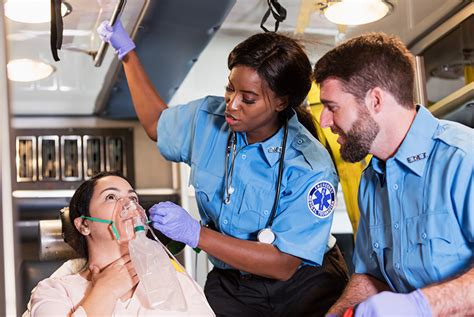
The role of an Emergency Room (ER) Technician, also known as an Emergency Medical Technician (EMT) or Emergency Department Technician, is crucial in the fast-paced environment of emergency medicine. These professionals work under the supervision of physicians and registered nurses to provide immediate care to patients in emergency situations. With the increasing demand for emergency medical services, the importance of ER Technicians has grown significantly, making them an integral part of the healthcare team. According to the Bureau of Labor Statistics, employment of EMTs and paramedics is projected to grow 11% from 2020 to 2030, faster than the average for all occupations.
Key Points
- ER Technicians play a vital role in providing immediate care to patients in emergency situations.
- Their responsibilities include taking vital signs, conducting basic medical tests, and preparing patients for examination by physicians.
- ER Technicians must possess strong communication and interpersonal skills to effectively interact with patients, families, and other healthcare professionals.
- They work in a variety of settings, including hospitals, emergency medical services, and urgent care centers.
- The median annual salary for EMTs and paramedics was $36,650 in May 2020, according to the Bureau of Labor Statistics.
Responsibilities and Duties
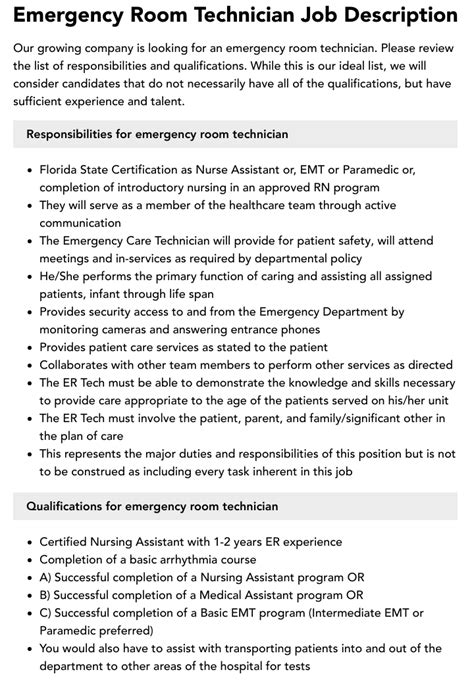
ER Technicians are responsible for a wide range of tasks, including taking vital signs, such as blood pressure, pulse, and oxygen saturation, and conducting basic medical tests, such as electrocardiograms (ECGs) and urinalyses. They also prepare patients for examination by physicians, which may involve undressing and positioning patients, as well as providing emotional support and reassurance. Additionally, ER Technicians are often responsible for maintaining patient records, restocking supplies, and cleaning equipment.
Education and Training
To become an ER Technician, one must complete a training program in emergency medical technology, which typically includes both classroom instruction and clinical training. These programs are usually offered at community colleges, technical schools, and universities, and can last from several months to two years. Coursework includes topics such as anatomy, physiology, and patient assessment, as well as training in emergency medical procedures, such as cardiopulmonary resuscitation (CPR) and trauma care. Many states also require ER Technicians to be certified, which involves passing a national certification exam, such as the National Registry of Emergency Medical Technicians (NREMT) certification exam.
| Education Level | Program Length | Certification |
|---|---|---|
| Postsecondary non-degree award | Several months to two years | NREMT certification |
| Associate's degree | Two years | State certification |
Work Environment

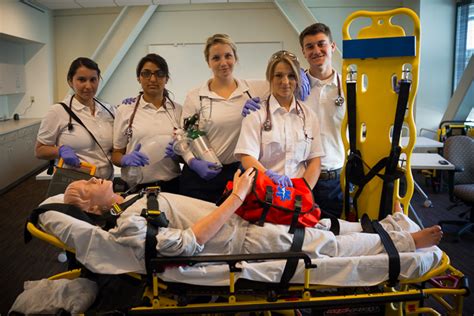
ER Technicians work in a variety of settings, including hospitals, emergency medical services, urgent care centers, and clinics. They may work indoors or outdoors, depending on their specific job duties and work environment. For example, those working in emergency medical services may spend a significant amount of time outdoors, responding to emergency calls and transporting patients to hospitals. In contrast, those working in hospitals or clinics may spend most of their time indoors, providing care to patients in a more controlled environment.
Skills and Qualities
ER Technicians must possess a range of skills and qualities to be successful in their roles. These include strong communication and interpersonal skills, as well as the ability to work well under pressure and in high-stress situations. They must also be able to lift and move patients, as well as equipment, and be comfortable with the sight of blood and other bodily fluids. Additionally, ER Technicians must be able to maintain patient confidentiality and handle sensitive information with discretion.
In terms of specific skills, ER Technicians should be proficient in basic life support skills, such as CPR and first aid, as well as more advanced skills, such as ECG interpretation and medication administration. They should also be familiar with medical terminology and be able to use electronic medical records systems. Strong problem-solving and critical thinking skills are also essential, as ER Technicians must be able to quickly assess patients and make decisions about their care.
What is the average salary for an ER Technician?
+The median annual salary for EMTs and paramedics was $36,650 in May 2020, according to the Bureau of Labor Statistics. However, salaries can vary depending on factors such as location, employer, and level of experience.
What kind of training is required to become an ER Technician?
+To become an ER Technician, one must complete a training program in emergency medical technology, which typically includes both classroom instruction and clinical training. Many states also require ER Technicians to be certified, which involves passing a national certification exam.
What are the working hours like for an ER Technician?
+ER Technicians often work long, irregular hours, including nights, weekends, and holidays. They may also be required to work overtime, depending on the specific needs of their employer.
In conclusion, ER Technicians play a vital role in the healthcare system, providing immediate care to patients in emergency situations. Their responsibilities are diverse and demanding, requiring a range of skills and qualities, including strong communication and interpersonal skills, the ability to work well under pressure, and proficiency in basic life support skills. As the demand for emergency medical services continues to grow, the importance of ER Technicians will only continue to increase, making this a rewarding and challenging career path for those who are passionate about helping others.