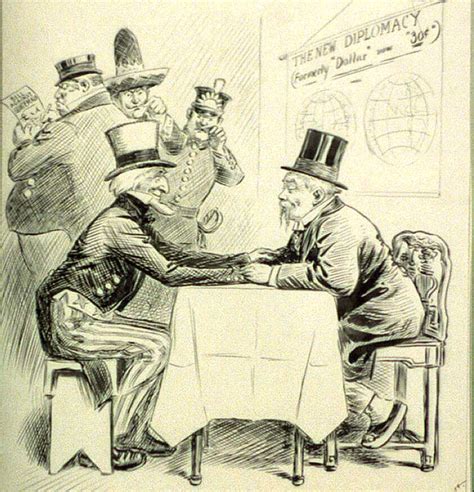
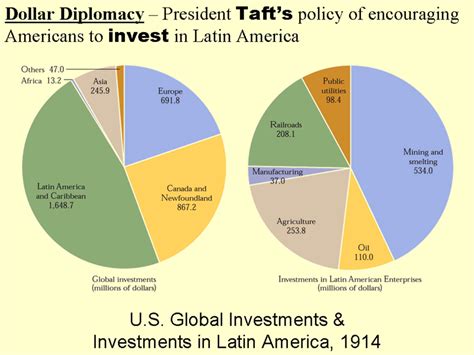
The concept of Dollar Diplomacy, a significant aspect of United States foreign policy, emerged during the early 20th century, particularly under the presidency of William Howard Taft. This approach marked a departure from the traditional gunboat diplomacy, where military power was the primary means of achieving foreign policy objectives. Instead, Dollar Diplomacy focused on using American economic power, specifically investments and loans, to exert influence over other nations. This strategy was designed to promote stability, protect American interests abroad, and extend U.S. influence without resorting to military intervention.
At its core, Dollar Diplomacy was about leveraging the economic might of the United States to achieve political goals. The U.S. government and American businesses would invest in foreign countries, provide loans, and engage in other economic activities that would not only generate profits but also secure political leverage. This approach was especially directed towards regions that were considered critical for American economic and strategic interests, such as Central America, the Caribbean, and East Asia. By doing so, the U.S. aimed to create a more stable and predictable international environment, conducive to American economic expansion and political influence.
Key Points
- Dollar Diplomacy was a U.S. foreign policy approach that emphasized the use of economic power to achieve political goals.
- This strategy was employed primarily during the presidency of William Howard Taft as a departure from traditional military-based diplomacy.
- The approach focused on using American investments and loans to promote stability, protect American interests, and extend U.S. influence abroad.
- Central America, the Caribbean, and East Asia were key regions where Dollar Diplomacy was applied.
- Critics argue that Dollar Diplomacy often led to economic exploitation and undermined the sovereignty of the countries involved.
Historical Context and Evolution
The historical context in which Dollar Diplomacy emerged is crucial for understanding its motivations and implications. The late 19th and early 20th centuries saw the United States transitioning from a regional power to a global player. The U.S. had recently emerged from the Spanish-American War with significant territorial gains, including Puerto Rico, Guam, and the Philippines. This expansion, coupled with the country’s rapid industrialization and economic growth, positioned the U.S. as a major economic power with significant interests abroad.
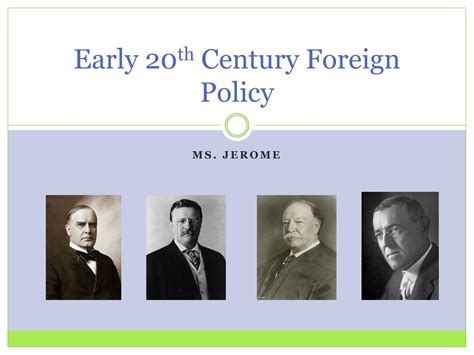
The policy of Dollar Diplomacy was formally articulated by President Taft, who believed in the power of American business and finance to shape international relations. Taft's Secretary of State, Philander C. Knox, was a key architect of this policy, emphasizing the role of private capital in advancing U.S. foreign policy objectives. The approach was initially applied in Central America, where the U.S. had significant strategic interests, including the construction of the Panama Canal. American investments and loans were used to stabilize governments, promote economic development, and secure U.S. control over critical infrastructure.
Critique and Controversies
Despite its aims, Dollar Diplomacy was not without its critics and controversies. Many argued that this policy led to the economic exploitation of weaker nations, as American businesses and the U.S. government often imposed harsh terms on loans and investments. This could result in the debtor countries losing control over their natural resources and economic policies, leading to a form of neo-colonialism. Furthermore, the use of economic leverage to influence political outcomes was seen as undermining the sovereignty of the affected countries.
In practice, Dollar Diplomacy sometimes led to interventionist policies, where the U.S. would send marines or other military forces to countries that defaulted on loans or were otherwise deemed unstable. This was the case in several Central American nations, where U.S. military interventions were justified as necessary to protect American economic interests. Such actions were widely criticized, both domestically and internationally, as a form of imperialism, contradicting the original intent of Dollar Diplomacy to avoid military intervention.
| Region | Examples of Dollar Diplomacy |
|---|---|
| Central America | Construction of the Panama Canal, economic interventions in Nicaragua and Honduras |
| Caribbean | U.S. intervention in Haiti, financial control over the Dominican Republic |
| East Asia | Investments in China, particularly in the railway sector, and economic influence in Japan |
Legacy and Impact
The legacy of Dollar Diplomacy is multifaceted and reflects both the successes and failures of this policy. On one hand, it marked an important shift in U.S. foreign policy, recognizing the potential of economic power as a tool of diplomacy. This approach paved the way for future U.S. foreign policy initiatives that would emphasize economic aid, trade, and investment as means of promoting stability and influence abroad.
On the other hand, the criticisms of Dollar Diplomacy, particularly regarding its impact on the sovereignty and economic development of the countries involved, are significant. The policy's association with interventionism and exploitation has led to a reevaluation of the role of economic power in U.S. foreign policy, with an increased emphasis on respecting the sovereignty of other nations and promoting more equitable economic relationships.
Today, the principles of Dollar Diplomacy continue to influence U.S. foreign policy, albeit in more nuanced and complex forms. The use of economic sanctions, foreign aid, and trade agreements as tools of diplomacy reflects the ongoing recognition of economic power as a critical component of international relations. However, the historical lessons of Dollar Diplomacy also underscore the importance of transparency, fairness, and respect for sovereignty in the application of economic diplomacy.
What was the primary goal of Dollar Diplomacy?
+The primary goal of Dollar Diplomacy was to use American economic power to achieve political goals, promoting stability and extending U.S. influence abroad without resorting to military intervention.
Which regions were targeted by Dollar Diplomacy?
+Central America, the Caribbean, and East Asia were key regions where Dollar Diplomacy was applied, reflecting significant U.S. economic and strategic interests.
What are the criticisms of Dollar Diplomacy?
+Critics argue that Dollar Diplomacy led to economic exploitation, undermined the sovereignty of affected countries, and sometimes resulted in military intervention, contrary to its original intent.