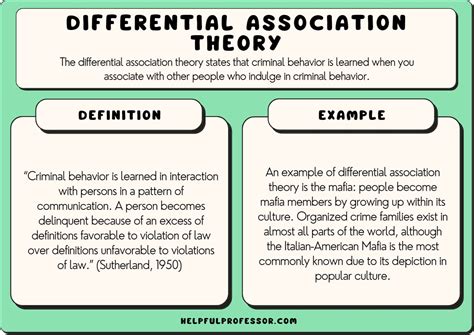
Differential association theory, first introduced by Edwin H. Sutherland in 1939, is a criminological concept that explains how individuals learn and adopt deviant behaviors. This theory suggests that people learn to engage in criminal activities through interactions with others who have already learned such behaviors. The learning process involves acquiring the techniques, attitudes, and motivations necessary for criminal conduct. Over the years, differential association theory has evolved and been refined, providing valuable insights into the mechanisms of deviant behavior. In this article, we will explore five ways differential association theory works, examining its core principles, applications, and implications for understanding criminal behavior.
Key Points
- Differential association theory posits that deviant behavior is learned through interactions with others.
- The theory emphasizes the importance of social environments and peer groups in shaping individual behavior.
- Learning deviant behaviors involves acquiring techniques, attitudes, and motivations.
- Differential association can occur through direct interactions or indirect exposure to deviant behaviors.
- The theory has been applied in various contexts, including criminology, sociology, and psychology, to understand and address deviant behavior.
The Learning Process in Differential Association Theory
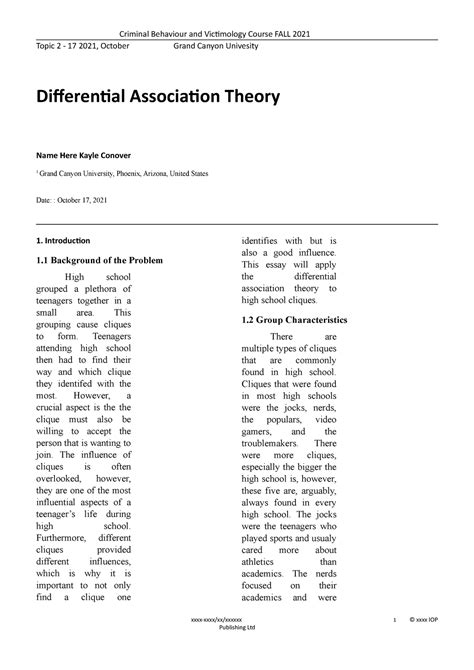
According to Sutherland, the learning process in differential association theory involves several key elements. First, individuals must be exposed to deviant behaviors and attitudes through interactions with others. This exposure can occur in various settings, including family, peer groups, or community environments. Second, the individual must learn the techniques and methods involved in the deviant behavior. This can include learning how to commit a specific crime, such as burglary or fraud, or acquiring the skills necessary for drug use or other forms of substance abuse. Third, the individual must develop the attitudes and motivations that support deviant behavior. This can involve adopting a sense of justification or rationalization for the behavior, or developing a sense of belonging to a group that engages in such activities.
Direct and Indirect Differential Association
Differential association can occur through both direct and indirect means. Direct differential association involves face-to-face interactions with individuals who have already learned deviant behaviors. For example, a young person may learn how to commit crimes by associating with older, more experienced offenders. Indirect differential association, on the other hand, involves exposure to deviant behaviors through media, social media, or other forms of indirect communication. For instance, an individual may learn about deviant behaviors by watching videos or reading about them online. Both direct and indirect forms of differential association can contribute to the learning and adoption of deviant behaviors.
| Type of Differential Association | Description |
|---|---|
| Direct Differential Association | Face-to-face interactions with individuals who have learned deviant behaviors |
| Indirect Differential Association | Exposure to deviant behaviors through media, social media, or other indirect means |
The Role of Social Environments and Peer Groups

Social environments and peer groups play a crucial role in differential association theory. The theory suggests that individuals are more likely to learn and adopt deviant behaviors when they are part of a social group that supports or encourages such activities. Peer groups, in particular, can exert a significant influence on individual behavior, as individuals often seek to conform to the norms and expectations of their peer group. This can involve adopting deviant behaviors as a means of gaining acceptance or status within the group. Furthermore, social environments can provide the opportunity for individuals to interact with others who have already learned deviant behaviors, facilitating the learning process.
Applications of Differential Association Theory
Differential association theory has been applied in various contexts to understand and address deviant behavior. In criminology, the theory has been used to explain the causes of crime and to develop strategies for crime prevention. In sociology, the theory has been used to study the social factors that contribute to deviant behavior, such as poverty, inequality, and social isolation. In psychology, the theory has been used to understand the psychological factors that underlie deviant behavior, such as cognitive distortions and emotional regulation. By understanding how differential association works, policymakers and practitioners can develop more effective interventions to prevent and reduce deviant behavior.
| Field of Application | Description |
|---|---|
| Criminology | Explaining the causes of crime and developing crime prevention strategies |
| Sociology | Studying social factors that contribute to deviant behavior, such as poverty and inequality |
| Psychology | Understanding psychological factors that underlie deviant behavior, such as cognitive distortions and emotional regulation |
Implications and Future Directions
The implications of differential association theory are far-reaching, with significant consequences for our understanding of deviant behavior and the development of effective interventions. The theory suggests that addressing deviant behavior requires a comprehensive approach that takes into account the social, environmental, and psychological factors that contribute to such behavior. This can involve developing strategies to prevent exposure to deviant behaviors, providing alternative social environments and peer groups that support positive behaviors, and addressing the underlying psychological and emotional factors that underlie deviant behavior. Future research should continue to refine and expand our understanding of differential association theory, exploring its applications in diverse contexts and populations.
What is differential association theory?
+Differential association theory is a criminological concept that explains how individuals learn and adopt deviant behaviors through interactions with others.
How does differential association occur?
+Differential association can occur through direct face-to-face interactions with individuals who have already learned deviant behaviors, or through indirect exposure to deviant behaviors through media, social media, or other forms of indirect communication.
What are the implications of differential association theory for addressing deviant behavior?
+The implications of differential association theory suggest that addressing deviant behavior requires a comprehensive approach that takes into account the social, environmental, and psychological factors that contribute to such behavior. This can involve developing strategies to prevent exposure to deviant behaviors, providing alternative social environments and peer groups that support positive behaviors, and addressing the underlying psychological and emotional factors that underlie deviant behavior.
Meta description: Discover how differential association theory explains the learning and adoption of deviant behaviors, and explore its implications for addressing crime and promoting positive social change. (149 characters)