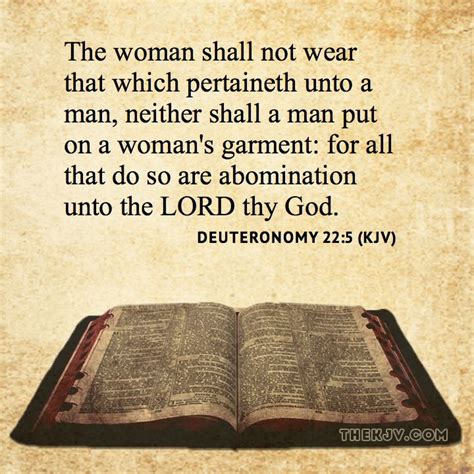
The book of Deuteronomy, chapter 22, verse 5, states: "A woman shall not wear a man's garment, nor shall a man put on a woman's cloak, for whoever does these things is an abomination to the Lord your God." This verse has been the subject of interpretation and discussion among scholars, theologians, and the general public for centuries. To understand the context and meaning of this verse, it is essential to delve into the historical, cultural, and biblical background.
Historical and Cultural Context
In ancient Israel, where this verse was written, there were strict social norms and customs regarding clothing and gender roles. Clothing was a significant aspect of a person’s identity, status, and occupation. Men and women had distinct garments that reflected their roles in society. For example, men wore tunics and cloaks, while women wore dresses and veils. The distinction in clothing was not just about aesthetics but also about maintaining social order and avoiding confusion between genders.
Gender Roles and Social Norms
In ancient Israelite society, gender roles were clearly defined, and any blurring of these lines was considered a threat to the social order. Men were expected to be strong, courageous, and providers, while women were expected to be nurturing, submissive, and caregivers. The idea of a woman wearing a man’s garment or a man wearing a woman’s cloak would have been seen as a challenge to these established roles and potentially lead to confusion and chaos in society.
| Aspect | Description |
|---|---|
| Clothing | Distinct garments for men and women, reflecting their roles and status |
| Gender Roles | Clearly defined roles for men and women, with specific expectations |
| Social Norms | Strict norms against blurring gender lines to maintain social order |
Biblical Interpretation and Application

The interpretation of Deuteronomy 22:5 has evolved over time, with various perspectives on its meaning and application. Some have viewed this verse as a prohibition against cross-dressing or any form of gender nonconformity, while others have seen it as a command to respect and maintain the gender distinctions as understood in the biblical context.
Modern Perspectives
In modern times, the understanding and application of this verse have become more nuanced, considering the advancements in human rights, gender equality, and individual freedoms. Many scholars and theologians now interpret this verse within its historical context, recognizing that the societal norms and gender roles of ancient Israel are not directly applicable to contemporary societies. Instead, they focus on the underlying principles of respect, dignity, and the avoidance of actions that could lead to social confusion or harm.
Key Points
- The verse is set within the historical and cultural context of ancient Israel, where clothing and gender roles were strictly defined.
- The primary concern was maintaining social order and avoiding confusion between genders.
- Interpretations have evolved, with modern perspectives considering human rights, gender equality, and individual freedoms.
- The underlying principles of respect, dignity, and avoidance of harm are key to understanding the verse's application in contemporary times.
- Scholars and theologians interpret the verse within its historical context, recognizing the differences between ancient and modern societies.
Conclusion and Reflection
Deuteronomy 22:5 presents a complex issue that requires careful consideration of its historical, cultural, and biblical context. Understanding the reasons behind the prohibition and its application in ancient Israelite society helps in appreciating the evolution of societal norms and gender roles over time. As we reflect on this verse, it’s essential to balance the respect for traditional interpretations with the need for modern understanding and application, ensuring that our approach is grounded in empathy, respect for human dignity, and a deep understanding of the biblical text.
What is the main concern of Deuteronomy 22:5?
+The main concern is maintaining social order and avoiding confusion between genders by adhering to distinct clothing for men and women.
How has the interpretation of Deuteronomy 22:5 evolved over time?
+The interpretation has become more nuanced, considering historical context, human rights, gender equality, and individual freedoms, focusing on principles of respect, dignity, and avoidance of harm.
What is the significance of understanding the historical context of Deuteronomy 22:5?
+Understanding the historical context helps in appreciating the evolution of societal norms and gender roles, and in applying the underlying principles of the verse in a manner that is respectful and relevant to contemporary society.