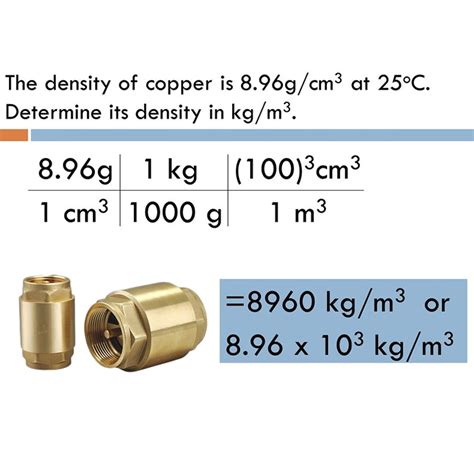
Copper, a widely used metal in various industries due to its excellent electrical and thermal conductivity, has a well-defined set of physical properties. One of the key properties of copper is its density, which is crucial for calculating its volume, weight, and other physical characteristics. The density of copper is a fundamental constant that has been precisely measured and documented in scientific literature.
The density of copper is 8.96 grams per cubic centimeter (g/cm³) at 20 degrees Celsius. This value is based on experimental measurements and is widely accepted in the scientific community. To understand the significance of this value, it's essential to consider the atomic structure of copper and how it contributes to its overall density. Copper has an atomic number of 29 and an atomic mass of approximately 63.55 u (unified atomic mass units). Its crystal structure, which is face-centered cubic, also plays a critical role in determining its density.
Key Points
- The density of copper is 8.96 g/cm³ at 20 degrees Celsius.
- Copper's atomic structure, including its atomic number and mass, influences its density.
- The face-centered cubic crystal structure of copper contributes to its physical properties, including density.
- Understanding copper's density is crucial for various applications, including electrical wiring, thermal management, and alloy development.
- Accurate measurement and documentation of copper's density are essential for scientific and industrial applications.
Natural Occurrence and Extraction of Copper

Copper is naturally occurring and can be found in various forms, including ores and native copper deposits. The extraction of copper typically involves mining, followed by refining and purification processes to produce high-purity copper. The density of copper is an important consideration in these processes, as it affects the separation and concentration of copper ores.
Copper Alloys and Their Applications
Copper is often alloyed with other metals to enhance its properties, such as strength, corrosion resistance, and ductility. These alloys have a wide range of applications, from electrical components and heat exchangers to architectural features and coinage. The density of copper alloys can vary depending on the composition and proportions of the constituent metals. For example, brass, an alloy of copper and zinc, has a density ranging from 8.4 to 8.7 g/cm³, while bronze, an alloy of copper and tin, has a density of approximately 8.7 to 9.0 g/cm³.
| Material | Density (g/cm³) |
|---|---|
| Copper | 8.96 |
| Brass | 8.4-8.7 |
| Bronze | 8.7-9.0 |

Technical Specifications and Industry Standards
The technical specifications and industry standards for copper and its alloys are well-established and documented. These standards, such as those provided by the American Society for Testing and Materials (ASTM) and the International Organization for Standardization (ISO), cover various aspects, including chemical composition, physical properties, and testing methods. The density of copper, as specified in these standards, serves as a reference point for quality control, material selection, and design calculations.
Evidence-Based Analysis and Balanced Perspective
A comprehensive analysis of copper’s density must consider both the theoretical aspects, such as its atomic structure and crystal lattice, and the practical implications, such as its applications in engineering and industry. A balanced perspective recognizes the importance of copper’s density in various contexts, from the efficiency of electrical circuits to the durability of architectural features. By understanding the intricacies of copper’s density, researchers and engineers can develop more efficient, sustainable, and innovative solutions.
What is the density of copper at room temperature?
+The density of copper at room temperature (20 degrees Celsius) is 8.96 g/cm³.
How does the density of copper affect its applications?
+The density of copper is crucial for its applications, as it influences its strength, ductility, and electrical conductivity. Accurate knowledge of copper's density is essential for designing and engineering applications, such as electrical wiring, heat exchangers, and architectural features.
What is the significance of copper's crystal structure in determining its density?
+Copper's face-centered cubic crystal structure plays a critical role in determining its density. The arrangement of atoms within the crystal lattice affects the overall packing efficiency and, consequently, the density of the material.
In conclusion, the density of copper is a fundamental property that underlies its applications in various industries. Understanding the intricacies of copper’s density, from its atomic structure to its practical implications, is essential for developing innovative solutions and pushing the boundaries of what is possible with this versatile metal.