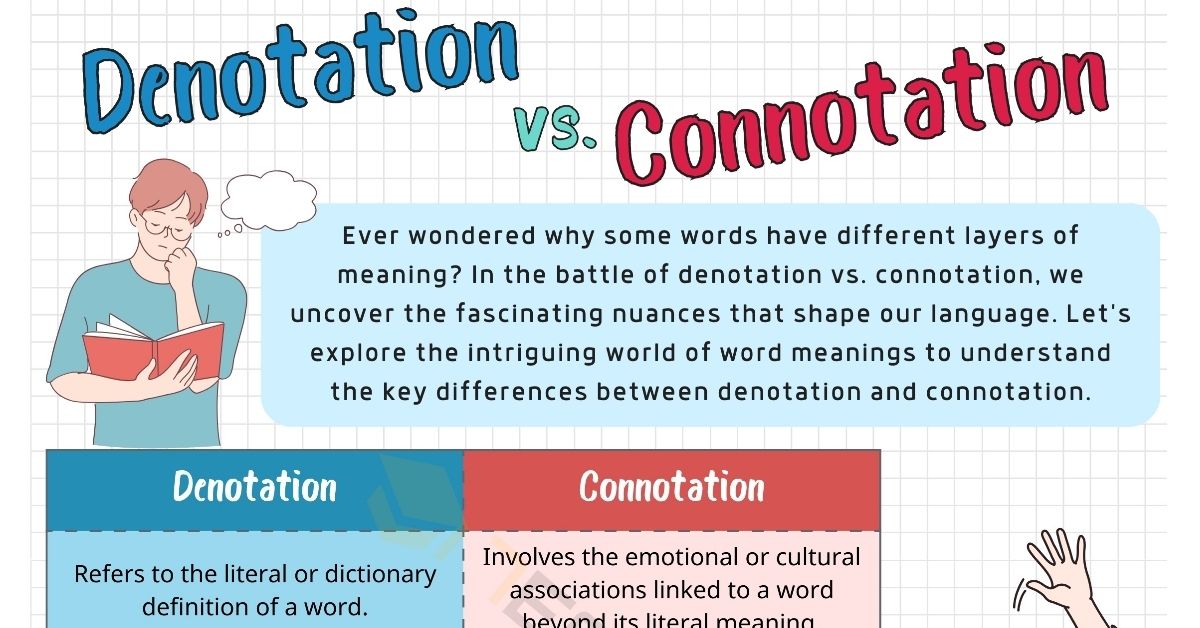
Understanding the nuances of language is crucial in effective communication, and connotation plays a significant role in conveying the intended meaning. Connotation refers to the emotional or cultural associations that a word or phrase carries, beyond its literal meaning. Mastering the use of connotation can enhance your ability to express ideas with precision and impact. Here are five tips to help you navigate the complex world of connotations:
Recognizing Positive and Negative Connotations

The first step in leveraging connotations is to recognize whether a word or phrase has a positive, negative, or neutral connotation. For instance, the words “home” and “house” both refer to a place of residence, but “home” often carries a warmer, more personal connotation, evoking feelings of comfort and belonging. In contrast, “house” is more neutral, focusing on the physical structure. Understanding these distinctions can help you choose the right words to convey your intended message.
Being Aware of Cultural Connotations
Connotations can vary significantly across different cultures and contexts. What may have a positive connotation in one culture could have a negative or even offensive connotation in another. For example, in many Western cultures, the color white is associated with purity and innocence, whereas in some Asian cultures, it is associated with mourning. Being sensitive to these cultural differences is essential in avoiding misunderstandings and ensuring that your message is received as intended.
| Word/Phrase | Positive Connotation | Negative Connotation |
|---|---|---|
| Home | Comfort, Belonging | - |
| House | - | - |
| White (Western) | Purity, Innocence | - |
| White (Some Asian Cultures) | - | Mourning |

Using Connotations to Enhance Expression
Once you have a good grasp of the connotations associated with different words and phrases, you can use this knowledge to enhance your expression. By choosing words that carry the right connotations, you can add depth and nuance to your communication, making it more engaging and impactful. For instance, in a speech about environmental conservation, using words with positive connotations like “green,” “sustainable,” and “eco-friendly” can evoke feelings of responsibility and urgency in your audience.
Navigating Neutral Connotations
Not all words have strong positive or negative connotations. Many words are neutral, providing a safe choice when you want to avoid emotional or cultural associations. However, even neutral words can take on connotations based on the context in which they are used. For example, the word “firm” can be neutral, but when used in a sentence like “She gave a firm handshake,” it can imply confidence and strength. Understanding how context influences connotation can help you use even neutral words effectively.
Key Points
- Recognize the connotations of words and phrases to convey intended meanings.
- Be aware of cultural differences in connotations to avoid misunderstandings.
- Use connotations to add depth and nuance to your communication.
- Navigate neutral connotations by considering the context of use.
- Stay updated on changes in connotations over time to ensure respectful and effective communication.
Conclusion and Future Directions
In conclusion, mastering the art of connotation is a powerful tool in effective communication. By recognizing, being aware of, using, navigating, and staying updated on connotations, you can enhance your ability to express ideas with precision and impact. As language continues to evolve, it’s crucial to remain sensitive to the nuances of connotation, ensuring that your communication is not only effective but also respectful and considerate of your audience’s diverse backgrounds and experiences.
How do connotations affect the meaning of words and phrases?
+Connotations can significantly affect the meaning of words and phrases by adding emotional or cultural associations that go beyond their literal definitions. These associations can influence how messages are perceived and interpreted by the audience.
Why is it important to consider cultural differences in connotations?
+Considering cultural differences in connotations is crucial to avoid misunderstandings and ensure that the intended message is conveyed effectively across different cultural contexts. What may be positively connoted in one culture could be negatively connoted in another.
How can one stay updated on changes in connotations over time?
+Staying updated on changes in connotations requires ongoing engagement with language and culture. This can involve reading widely, participating in discussions, and being open to feedback from others. It’s also important to recognize that language is dynamic and that connotations can shift based on societal trends, historical events, and cultural evolution.