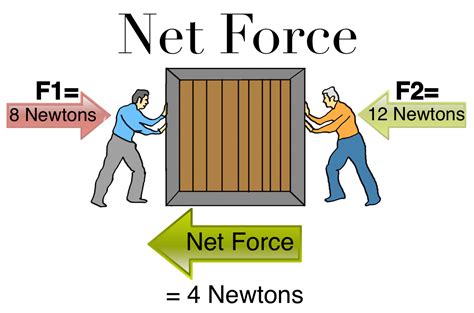
The concept of net force is a fundamental principle in physics, particularly in the realm of mechanics. It refers to the overall force acting on an object, resulting from the combination of all the individual forces that are applied to it. The net force is a vector quantity, which means it has both magnitude (amount of force) and direction. Understanding net force is crucial in predicting the motion of objects, as it is the net force that determines whether an object will remain at rest, accelerate, or decelerate.
In everyday life, numerous forces act on objects, including friction, gravity, normal force, and applied forces. For instance, when you push a box across the floor, several forces are at play: the force you apply to the box, the frictional force opposing the motion, the normal force exerted by the floor on the box, and the gravitational force pulling the box downwards. The net force is the sum of these forces, and it is this net force that actually causes the box to move or change its state of motion.
Key Points
- The net force is the vector sum of all forces acting on an object.
- It determines the acceleration of an object, according to Newton's second law of motion (F = ma).
- Net force is a vector quantity, having both magnitude and direction.
- Understanding net force is essential for predicting the motion of objects under various conditions.
- Real-world applications of net force include vehicle dynamics, structural engineering, and sports physics.
Net Force Calculation and Newton’s Laws
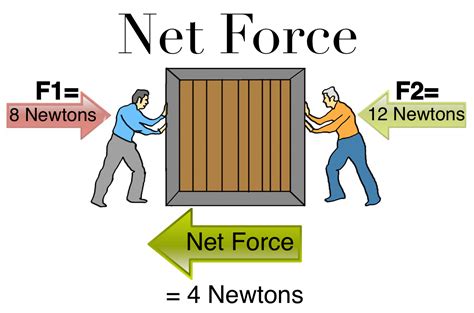
The calculation of net force involves adding all the forces acting on an object vectorially. This means considering both the magnitude and direction of each force. Newton’s laws of motion provide a framework for understanding how net force affects the motion of objects. The first law, also known as the law of inertia, states that an object at rest stays at rest, and an object in motion continues with the same velocity, unless acted upon by an unbalanced force. The second law relates the net force acting on an object to its mass and acceleration (F = ma), indicating that the more massive an object is, the more net force is required to produce a given acceleration. The third law, the law of reciprocal actions, states that for every action, there is an equal and opposite reaction, which is crucial for understanding the forces involved in interactions between objects.
Components of Net Force
When calculating the net force, it’s essential to consider all the forces acting on an object. These can be categorized into external forces, such as applied forces and frictional forces, and internal forces, which are not typically considered in the calculation of net force as they cancel each other out. The primary external forces include:
- Applied Forces: These are forces exerted on an object by another object or person, such as pushing or pulling.
- Frictional Forces: These forces oppose motion between two surfaces that are in contact and can either slow down a moving object or prevent an object from moving.
- Normal Forces: Exerted by a surface on an object in contact with it, perpendicular to the surface, and preventing the object from passing through the surface.
- Gravitational Forces: The force of gravity acting on the mass of an object, pulling it towards the center of the Earth or other celestial body.
| Force Type | Description | Direction |
|---|---|---|
| Applied Force | Force exerted by one object on another | Depends on the action (push or pull) |
| Frictional Force | Opposes motion between surfaces | Opposite to the direction of motion |
| Normal Force | Perpendicular force exerted by a surface | Perpendicular to the surface |
| Gravitational Force | Force due to gravity | Towards the center of the Earth or celestial body |
Real-World Applications of Net Force
The concept of net force has numerous real-world applications across different fields. In engineering, understanding net force is essential for designing structures that can withstand various loads and stresses. In transportation, the net force acting on a vehicle determines its acceleration, braking distance, and overall safety. In sports, athletes and coaches use the concept of net force to optimize performance, whether it’s maximizing the distance of a jump or the speed of a sprint. Additionally, in the field of robotics and mechatronics, precise control over net forces is critical for achieving desired motions and tasks.
Implications and Future Directions
The study of net force continues to evolve, with advancements in technology and materials science enabling the development of more sophisticated systems and devices. The integration of artificial intelligence and machine learning into mechanical systems is allowing for more precise control over forces and motions, opening up new possibilities in areas such as autonomous vehicles and advanced manufacturing. Furthermore, the understanding of net force at the microscopic and nanoscopic levels is crucial for the development of nanotechnology and nanomechanical systems, which have the potential to revolutionize fields ranging from medicine to energy production.
What is the relationship between net force and acceleration?
+According to Newton's second law of motion, the net force acting on an object is equal to the mass of the object multiplied by its acceleration (F = ma). This means that the acceleration of an object is directly proportional to the net force acting upon it and inversely proportional to its mass.
How does friction affect the net force on an object?
+Friction is a force that opposes motion between two surfaces that are in contact. It reduces the net force acting on an object in the direction of motion, thus affecting its acceleration. The magnitude of the frictional force depends on the nature of the surfaces in contact and the force pressing them together.
Can the net force on an object be zero?
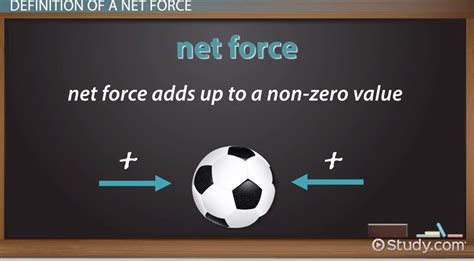
+Yes, the net force on an object can be zero. According to Newton's first law of motion, if the net force on an object is zero, the object will either remain at rest or continue moving with a constant velocity. This occurs when all the forces acting on the object are balanced, resulting in no net acceleration.
In conclusion, the concept of net force is fundamental to understanding the behavior of objects under the influence of various forces. Its applications are diverse and critical in fields ranging from engineering and transportation to sports and nanotechnology. By grasping the principles of net force and how it relates to motion, we can better design, predict, and optimize the performance of systems and devices, leading to advancements in technology and our understanding of the physical world.