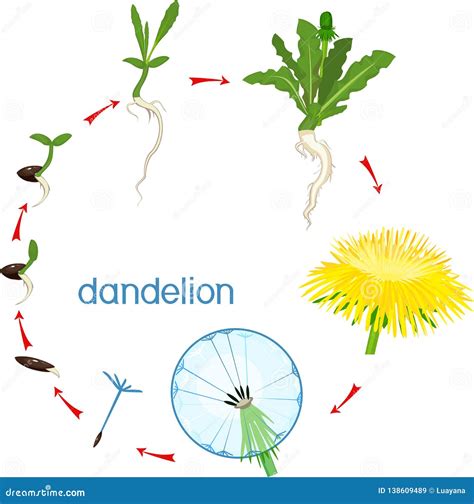
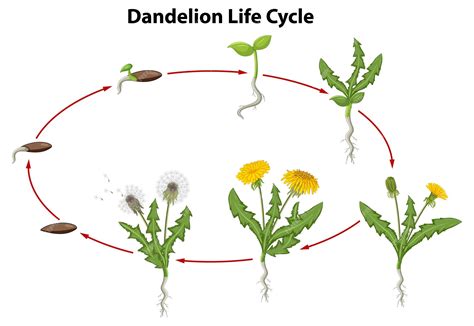
The dandelion, a plant often viewed as a weed, has a fascinating life cycle that consists of five distinct stages of growth. Understanding these stages can provide insight into the biology and ecology of this widespread plant. The five stages of dandelion growth are: germination, seedling, rosette, flowering, and seed dispersal. Each stage plays a crucial role in the life cycle of the dandelion, allowing it to propagate and spread efficiently.
Germination Stage

The life cycle of a dandelion begins with the germination stage. During this stage, a dandelion seed, which is typically brown or tan in color and has a feathery, umbrella-like structure attached to it (known as a pappus), germinates in the soil. The germination process usually occurs in the spring or fall when the soil temperature and moisture levels are favorable. The seed absorbs water, and the embryo inside the seed begins to grow, eventually breaking through the seed coat. This stage is critical for the establishment of the dandelion plant, as it marks the transition from a dormant seed to an actively growing organism.
Seedling Establishment
Following germination, the dandelion enters the seedling stage. At this point, the young plant begins to develop its first set of leaves, known as cotyledons or seed leaves, which are usually rounded and different from the leaves that will develop later. The seedling relies on the stored nutrients in the seed for its initial growth. As it grows, the seedling develops its root system and starts to produce its true leaves, which are more elongated and have the characteristic jagged edges of dandelion leaves. This stage is vulnerable to environmental stresses and competition from other plants, making it a critical period for the establishment and survival of the dandelion.
| Stage | Description | Duration |
|---|---|---|
| Germination | Seed germinates in soil | 1-3 weeks |
| Seedling | Development of first leaves and root system | 2-6 weeks |
Key Points
- The dandelion life cycle consists of five stages: germination, seedling, rosette, flowering, and seed dispersal.
- Germination occurs when a dandelion seed absorbs water and the embryo begins to grow.
- The seedling stage is critical for the establishment of the plant, during which it develops its first leaves and root system.
- The duration of each stage can vary based on environmental conditions such as temperature, moisture, and light.
- Understanding the life cycle of the dandelion can provide insights into its biology and ecology.
Rosette Stage
As the seedling continues to grow, it enters the rosette stage. During this stage, the dandelion develops a cluster of leaves that grow close to the ground in a rosette pattern. The leaves are typically dark green, jagged, and can grow quite large. The plant focuses its energy on developing a strong root system, including a deep taproot that can extend several feet into the soil. This taproot allows the dandelion to access water and nutrients deep in the soil, making it more resilient to drought and competition. The rosette stage can last from several weeks to several months, depending on environmental conditions and the health of the plant.
Flowering Stage
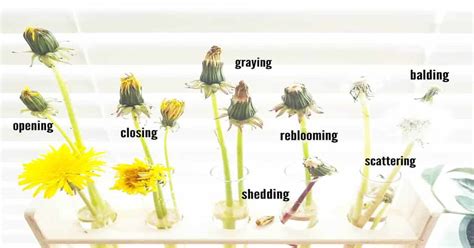
Once the dandelion has developed a strong root system and a robust rosette of leaves, it enters the flowering stage. This stage is perhaps the most recognizable, as the dandelion produces a tall stem (often 2 to 18 inches tall) that bears a single flower head. The flower head is bright yellow and composed of hundreds of tiny flowers. The flowering stage is a critical period for the dandelion’s reproduction, as it produces seeds that will disperse and propagate new plants. The flowering stage typically lasts about 1 to 2 weeks, after which the flower head closes, and the seeds begin to develop.
Technical specifications of the dandelion flower are quite unique, with each flower head containing two types of flowers: ray flowers (the large, yellow petals on the outside) and disc flowers (the small, tubular flowers in the center). The combination of these flowers allows for efficient pollination by a variety of insects and other pollinators.
Seed Dispersal Stage
The final stage of the dandelion life cycle is seed dispersal. After the seeds have matured, the flower head opens again, and the seeds, each equipped with a pappus, are released into the air. The pappus acts like a parachute, allowing the seeds to float away from the parent plant and disperse over a wide area. This stage is crucial for the spread of dandelions, as it enables them to colonize new areas and ensure the continuation of the species. The dispersal of seeds can be facilitated by wind, water, or animals, making dandelions highly effective at propagating themselves.
| Dispersal Method | Efficiency | Distance |
|---|---|---|
| Wind | High | Up to several miles |
| Water | Medium | Up to several hundred feet |
| Animals | Low to Medium | Up to several hundred feet |
What are the primary factors influencing dandelion seed germination?
+The primary factors influencing dandelion seed germination include soil temperature, moisture levels, and light exposure. Optimal germination occurs in moist soil with temperatures between 60°F and 80°F (15°C and 27°C) and adequate light.
How do dandelions adapt to different environmental conditions?
+Dandelions adapt to different environmental conditions through their deep taproot, which allows them to access water deep in the soil, and their ability to reproduce without cross-pollination, ensuring genetic consistency and efficient seed production.
What role do dandelions play in ecosystems?
+Dandelions play a significant role in ecosystems as a food source for various animals, from insects to larger mammals, and as a pioneer species in disturbed areas, helping to stabilize soil and facilitate the growth of other plant species.
In conclusion, the life cycle of a dandelion, from germination through seed dispersal, is a complex and highly adaptable process. Understanding these stages and how they contribute to the dandelion’s ability to thrive in a wide range of environments can provide valuable insights into the biology and ecology of this fascinating plant. As we continue to learn more about the dandelion and its role in ecosystems, we may uncover new appreciations for this often-underestimated species.