The D major scale is a fundamental concept in music theory, serving as the foundation for countless musical compositions across various genres. As a musician or music enthusiast, understanding the D major scale is essential for navigating the world of music with confidence and precision. In this article, we will delve into the intricacies of the D major scale, exploring its structure, applications, and significance in music theory.
Key Points
- The D major scale consists of seven natural pitches within an octave, following the pattern W-W-H-W-W-W-H.
- The scale's tonal center is D, and it is often used in music to convey a sense of grandeur, majesty, or triumph.
- The D major scale has numerous applications in music composition, including melody writing, harmony, and chord progressions.
- Understanding the D major scale is crucial for musicians, as it provides a foundation for improvisation, soloing, and music interpretation.
- The scale's properties and characteristics make it a popular choice for composers and musicians seeking to create uplifting, inspiring, or dramatic music.
Structure and Properties of the D Major Scale
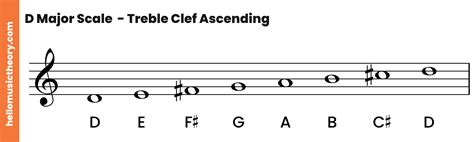
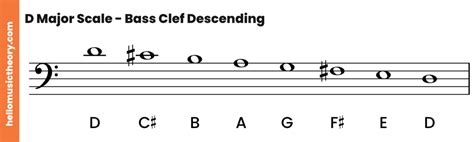
The D major scale is constructed from seven natural pitches within an octave, following the specific pattern of whole and half steps: W-W-H-W-W-W-H. This pattern yields the notes D, E, F#, G, A, B, and C#. The tonal center of the scale is D, which serves as the reference point for all other pitches within the scale. The D major scale’s structure and properties make it a versatile and widely used scale in music composition.
Intervallic Relationships and Chord Progressions
One of the key aspects of the D major scale is its intervallic relationships, which govern the way notes interact with each other. The scale’s intervallic structure gives rise to various chord progressions, such as the I-IV-V progression (D-G-A), which is a fundamental harmonic pattern in music. By understanding the intervallic relationships within the D major scale, musicians can create complex and sophisticated chord progressions that add depth and richness to their music.
| Scale Degree | Note | Interval |
|---|---|---|
| 1 | D | Tonic |
| 2 | E | Major second |
| 3 | F# | Major third |
| 4 | G | Perfect fourth |
| 5 | A | Perfect fifth |
| 6 | B | Major sixth |
| 7 | C# | Major seventh |
Applications of the D Major Scale in Music Composition
The D major scale has numerous applications in music composition, ranging from melody writing and harmony to chord progressions and improvisation. By understanding the scale’s properties and characteristics, musicians can create music that is both technically proficient and emotionally resonant. The D major scale’s versatility and expressiveness make it a popular choice for composers and musicians across various genres, from classical and jazz to rock and pop.
Melody Writing and Soloing
The D major scale provides a rich foundation for melody writing and soloing, as its intervallic structure and tonal center offer a wide range of creative possibilities. Musicians can use the scale to craft memorable melodies, improvise solos, or create complex and intricate musical lines. By mastering the D major scale, musicians can unlock new levels of expressiveness and technical proficiency in their playing.
In conclusion, the D major scale is a fundamental concept in music theory, offering a wealth of creative possibilities for musicians and composers. By understanding the scale's structure, properties, and applications, musicians can tap into its expressive potential and create music that is both technically proficient and emotionally resonant. Whether you are a seasoned musician or just starting out, the D major scale is an essential tool for navigating the world of music with confidence and precision.
What is the tonal center of the D major scale?
+The tonal center of the D major scale is D, which serves as the reference point for all other pitches within the scale.
What are some common chord progressions based on the D major scale?
+Some common chord progressions based on the D major scale include the I-IV-V progression (D-G-A) and the ii-V-I progression (E minor-A-D).
How can I use the D major scale in melody writing and soloing?
+The D major scale provides a rich foundation for melody writing and soloing, as its intervallic structure and tonal center offer a wide range of creative possibilities. You can use the scale to craft memorable melodies, improvise solos, or create complex and intricate musical lines.
Meta Description: Discover the fundamentals of the D major scale, including its structure, properties, and applications in music composition. Learn how to use the D major scale to create memorable melodies, improvise solos, and craft complex chord progressions.