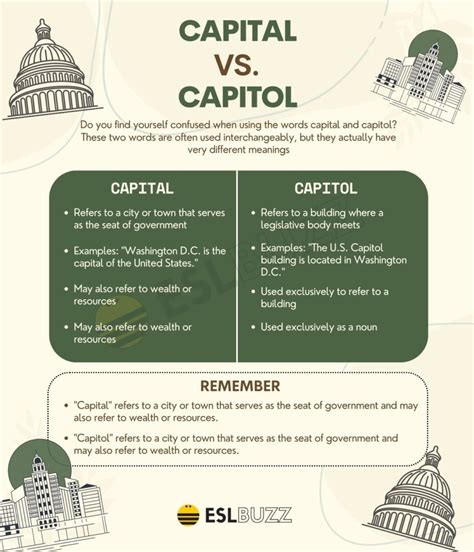
The terms "capital" and "capitol" are often confused with one another due to their similar spellings and pronunciations. However, these words have distinct meanings and uses. Understanding the difference between them is essential for effective communication, especially in contexts involving geography, politics, and architecture. In this article, we will delve into the definitions, usage, and historical background of "capital" and "capitol," providing clarity on when to use each term.
Definitions and Usage
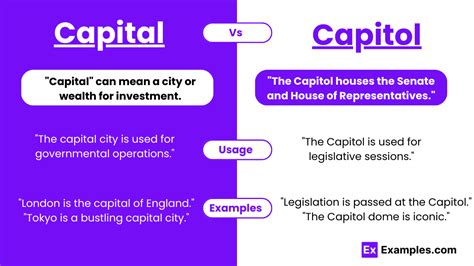
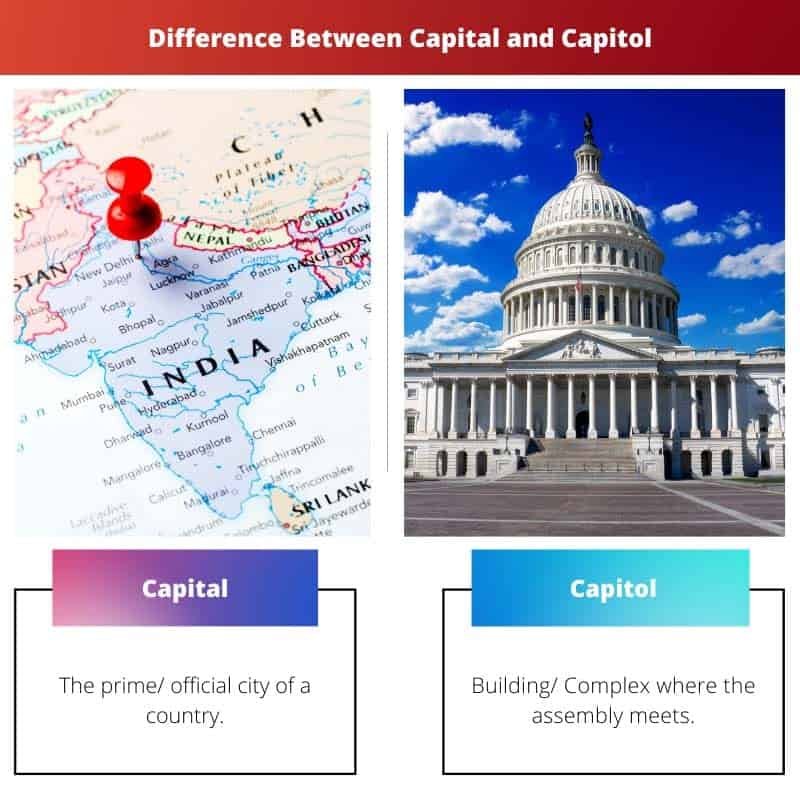
A capital refers to the city or town that serves as the seat of government for a country, state, or province. It is the primary city where the government’s administrative and legislative functions are centered. For example, Paris is the capital of France, and Washington, D.C. is the capital of the United States. The term “capital” can also refer to wealth, funds, or assets, but in the context of geography and politics, it pertains to the governmental hub.
On the other hand, a capitol refers specifically to the building where a government's legislative body meets. In the United States, for instance, each state has its own capitol building where the state legislature convenes. The United States Capitol in Washington, D.C. is a prominent example, serving as the meeting place for the U.S. Congress. The term "capitol" is less commonly used in other English-speaking countries, where the terms "parliament building" or "legislative building" might be preferred.
Historical Background
The distinction between “capital” and “capitol” has historical roots. The word “capital” comes from the Latin “capitalis,” meaning “of the head” or “chief,” which is fitting for a city that serves as the primary governmental center. The term “capitol,” however, derives from the Capitoline Hill in Rome, one of the seven hills upon which the city was built. The Capitoline Hill was the site of the Temple of Jupiter, an important landmark in ancient Rome. When the United States was founded, the term “capitol” was adopted to refer to the building that housed the legislative branch of government, in homage to the historical significance of the Capitoline Hill.
| Term | Definition | Example |
|---|---|---|
| Capital | City or town serving as the seat of government | Paris, France; Washington, D.C., USA |
| Capitol | Building where a government's legislative body meets | United States Capitol; State Capitol buildings |
Key Points
- The terms "capital" and "capitol" have distinct meanings and uses in the context of geography and politics.
- "Capital" refers to the city or town that serves as the seat of government, while "capitol" refers to the building where the legislative body meets.
- Historically, the term "capitol" is derived from the Capitoline Hill in Rome, reflecting the significance of the location for governmental and legislative functions.
- Correct usage of these terms is essential for effective communication, particularly in formal and professional contexts.
- Understanding the difference between "capital" and "capitol" can enhance one's credibility and demonstrate a nuanced understanding of political and geographical terminology.
In conclusion, while the terms "capital" and "capitol" might seem interchangeable at first glance, they represent two distinct concepts within the realms of politics, geography, and architecture. By grasping the definitions, historical context, and proper usage of these terms, individuals can communicate more effectively and accurately convey their intended meaning, whether in professional, academic, or casual discourse.
What is the primary difference between “capital” and “capitol”?
+The primary difference is that “capital” refers to the city or town that serves as the seat of government, whereas “capitol” refers specifically to the building where the legislative body meets.
How did the term “capitol” originate?
+The term “capitol” is derived from the Capitoline Hill in Rome, which was the site of the Temple of Jupiter and an important landmark in ancient Rome.
Why is correct usage of “capital” and “capitol” important?
+Correct usage is essential for effective communication, especially in formal and professional contexts, as it reflects an understanding of the nuances of political and geographical terminology and can enhance one’s credibility.