The concept of elasticity is crucial in understanding how responsive the quantity demanded of a product is to changes in its price or other influential factors. Calculating elasticity provides businesses and economists with valuable insights into consumer behavior and market dynamics. There are several methods to calculate elasticity, each serving a specific purpose and offering unique perspectives on market responsiveness. This article will delve into five primary ways to calculate elasticity, exploring their applications, interpretations, and the contexts in which they are most relevant.
Key Points
- The price elasticity of demand measures how responsive the quantity demanded of a product is to changes in its price.
- Income elasticity of demand assesses the responsiveness of quantity demanded to changes in consumer income.
- Cross-price elasticity of demand examines the relationship between the quantity demanded of one product and the price of another product.
- Advertising elasticity of demand evaluates the impact of advertising expenditures on the quantity demanded of a product.
- Supply elasticity measures how responsive the quantity supplied of a product is to changes in its price or other factors.
Price Elasticity of Demand

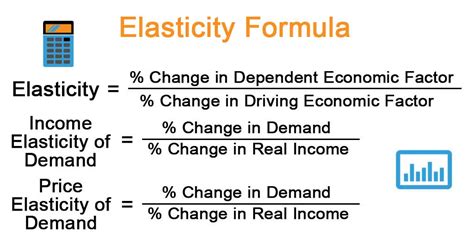
One of the most common elasticity calculations is the price elasticity of demand. This measures how responsive the quantity demanded of a product is to changes in its price. The formula for price elasticity of demand is given by E_d = (ΔQ/Q) / (ΔP/P), where E_d is the price elasticity of demand, ΔQ is the change in quantity demanded, Q is the original quantity demanded, ΔP is the change in price, and P is the original price. A negative value indicates that quantity demanded decreases as price increases, which is typical for most goods. However, the magnitude of E_d determines whether the demand is elastic (|E_d| > 1), inelastic (|E_d| < 1), or unit elastic (|E_d| = 1).
Interpretation and Application
The interpretation of price elasticity of demand is critical for businesses in setting their pricing strategies. For instance, if a company finds that the demand for its product is elastic, it may consider reducing the price to increase the quantity demanded and potentially revenue. Conversely, if the demand is inelastic, the company might increase the price, as consumers are less responsive to price changes, potentially increasing revenue without significantly affecting the quantity demanded.
Income Elasticity of Demand

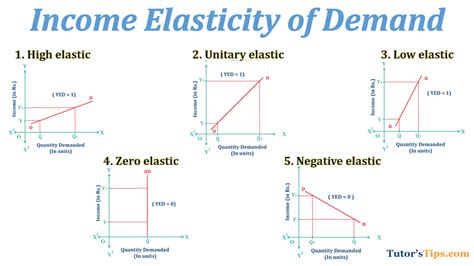
Income elasticity of demand assesses how responsive the quantity demanded of a product is to changes in consumer income. The formula for income elasticity of demand is E_i = (ΔQ/Q) / (ΔI/I), where E_i is the income elasticity of demand, ΔQ is the change in quantity demanded, Q is the original quantity demanded, ΔI is the change in income, and I is the original income. A positive value indicates a normal good, for which demand increases with income, while a negative value suggests an inferior good, where demand decreases as income increases.
Normal and Inferior Goods
The distinction between normal and inferior goods based on income elasticity of demand is vital for understanding consumer behavior across different income levels. For normal goods, an increase in income leads to an increase in demand, which can guide marketing strategies towards higher-income segments. For inferior goods, targeting lower-income segments or repositioning the product as a value offering might be more effective.
| Elasticity Type | Formula | Interpretation |
|---|---|---|
| Price Elasticity of Demand | E_d = (ΔQ/Q) / (ΔP/P) | Measures responsiveness of quantity demanded to price changes |
| Income Elasticity of Demand | E_i = (ΔQ/Q) / (ΔI/I) | Assesses responsiveness of quantity demanded to income changes |
| Cross-Price Elasticity of Demand | E_x = (ΔQ_x/Q_x) / (ΔP_y/P_y) | Evaluates the impact of changes in one product's price on another's demand |
| Advertising Elasticity of Demand | E_a = (ΔQ/Q) / (ΔA/A) | Measures the effect of advertising on quantity demanded |
| Supply Elasticity | E_s = (ΔQ_s/Q_s) / (ΔP/P) | Assesses how responsive the quantity supplied is to price changes |
Cross-Price Elasticity of Demand
Cross-price elasticity of demand examines the relationship between the quantity demanded of one product and the price of another product. The formula for cross-price elasticity of demand is E_x = (ΔQ_x/Q_x) / (ΔP_y/P_y), where E_x is the cross-price elasticity of demand, ΔQ_x is the change in quantity demanded of product X, Q_x is the original quantity demanded of product X, ΔP_y is the change in price of product Y, and P_y is the original price of product Y. A positive value indicates that the two products are substitutes, while a negative value suggests they are complements.
Substitutes and Complements
Understanding whether products are substitutes or complements based on cross-price elasticity of demand is crucial for businesses in developing their product and pricing strategies. For substitutes, an increase in the price of one product can lead to an increase in the demand for the other, suggesting that companies might benefit from differential pricing strategies. For complements, the demand for one product decreases when the price of the other increases, indicating that bundled pricing or joint promotions could be effective.
Advertising Elasticity of Demand
Advertising elasticity of demand evaluates the impact of advertising expenditures on the quantity demanded of a product. The formula for advertising elasticity of demand is E_a = (ΔQ/Q) / (ΔA/A), where E_a is the advertising elasticity of demand, ΔQ is the change in quantity demanded, Q is the original quantity demanded, ΔA is the change in advertising expenditure, and A is the original advertising expenditure. A positive value indicates that advertising is effective in increasing demand.
Effective Advertising Strategies
The calculation of advertising elasticity of demand helps businesses assess the effectiveness of their advertising efforts. A high elasticity value suggests that advertising has a significant impact on demand, indicating that increased advertising expenditures could lead to substantial increases in quantity demanded. Conversely, a low elasticity might suggest that advertising efforts are less effective, potentially leading companies to reconsider their advertising strategies or allocate their budget more efficiently.
Supply Elasticity
Supply elasticity measures how responsive the quantity supplied of a product is to changes in its price or other factors. The formula for supply elasticity is E_s = (ΔQ_s/Q_s) / (ΔP/P), where E_s is the supply elasticity, ΔQ_s is the change in quantity supplied, Q_s is the original quantity supplied, ΔP is the change in price, and P is the original price. A high supply elasticity indicates that suppliers can easily increase production in response to price increases, while a low elasticity suggests that supply is less responsive to price changes.
Policymaking and Production Strategies
The calculation of supply elasticity has significant implications for both businesses and policymakers. For businesses, knowing the supply elasticity can help in forecasting the potential supply chain responses to changes in market conditions, guiding production planning and inventory management. For policymakers, understanding supply elasticity is essential in designing effective policies that consider the responsiveness of suppliers to price changes, thereby avoiding unintended consequences such as shortages or surpluses.
What is the primary use of calculating elasticity in economics?
+The primary use of calculating elasticity in economics is to understand how responsive the quantity demanded or supplied of a product is to changes in its price or other influential factors, guiding business and policy decisions.
How does the income elasticity of demand distinguish between normal and inferior goods?
+The income elasticity of demand distinguishes between normal and inferior goods based on whether the demand increases (normal goods) or decreases (inferior goods) with an increase in consumer income.
What does a high advertising elasticity of demand indicate?
+A high advertising elasticity of demand indicates that advertising efforts have a significant impact on the quantity demanded of a product, suggesting that increased advertising expenditures could lead to substantial increases in demand.
In conclusion, the calculation of elasticity is a fundamental tool in economics for understanding market dynamics and consumer behavior. Through the various methods of calculating elasticity, including price elasticity of demand, income elasticity of demand, cross-price elasticity of demand, advertising elasticity of demand, and supply elasticity, businesses and policymakers can make informed decisions that account for the responsiveness of markets to changes in price, income, advertising, and other factors. By applying these concepts, stakeholders can develop effective strategies that maximize benefits and minimize risks in an ever-changing economic landscape.