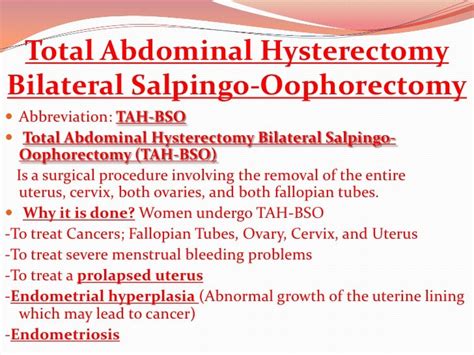
The medical abbreviation BSO stands for Bilateral Salpingo-Oophorectomy. This is a surgical procedure where both ovaries (oophorectomy) and fallopian tubes (salpingectomy) are removed. The procedure is often performed to treat various medical conditions, including ovarian cancer, fallopian tube cancer, and other diseases affecting the reproductive system.
Understanding BSO: Procedure and Implications
A BSO is typically performed under general anesthesia and can be done through an open surgery or a minimally invasive approach, such as laparoscopy. The choice of method depends on the patient’s overall health, the reason for the surgery, and the surgeon’s preference. After the procedure, patients are closely monitored for any potential complications and are usually required to stay in the hospital for a few days for recovery.
Reasons for BSO
There are several reasons why a BSO might be recommended. These include:
- Ovarian Cancer: If cancer is detected in one or both ovaries, removing them can help prevent the spread of the disease.
- Fallopian Tube Cancer: Similar to ovarian cancer, if cancer is found in one or both fallopian tubes, a BSO can be an effective treatment option.
- BRCA1 or BRCA2 Gene Mutations: Individuals with these genetic mutations have a higher risk of developing ovarian and breast cancer. A BSO can significantly reduce this risk.
- Endometriosis: In severe cases of endometriosis, where other treatments have not been effective, a BSO might be considered to alleviate symptoms.
| Procedure | Description |
|---|---|
| Open Surgery | A traditional surgical method where a large incision is made to access the reproductive organs. |
| Laparoscopy | A minimally invasive technique involving small incisions through which a camera and surgical instruments are inserted. |

Post-Operative Care and Recovery
After a BSO, patients will need to follow a specific recovery plan to ensure a smooth and safe healing process. This may include pain management, follow-up appointments, and guidance on returning to normal activities. It’s also essential to address any emotional or psychological impacts of the surgery, as the removal of reproductive organs can have significant effects on a person’s identity and well-being.
Long-Term Effects
The long-term effects of a BSO can vary depending on the individual’s age at the time of surgery and their overall health. For those who undergo the procedure before natural menopause, hormone replacement therapy (HRT) may be recommended to manage symptoms of menopause, such as hot flashes and osteoporosis. However, the decision to start HRT should be made after consulting with a healthcare provider, as it carries its own set of risks and benefits.
Key Points
- A BSO is a surgical procedure involving the removal of both ovaries and fallopian tubes.
- The procedure can be performed to treat or prevent ovarian and fallopian tube cancers, among other conditions.
- It's essential to discuss the potential long-term effects, including early menopause and the possible need for hormone replacement therapy.
- Patients should follow a specific recovery plan post-surgery to ensure a safe healing process.
- Addressing the emotional and psychological impacts of the surgery is crucial for overall well-being.
In conclusion, a BSO is a significant surgical procedure with profound implications for a patient's health and quality of life. It is vital for individuals considering this procedure to be fully informed about what to expect, the potential risks and benefits, and the long-term effects on their physical and emotional well-being.
What is the primary reason for undergoing a BSO?
+The primary reason for a BSO is often to treat or prevent cancers of the ovaries and fallopian tubes, though it may also be considered for other medical conditions.
How long does it take to recover from a BSO?
+Recovery time can vary, but most patients can return to their normal activities within a few weeks to a couple of months after surgery, depending on the method used and their overall health.
Will a BSO cause menopause?
+If the surgery is performed before a woman has naturally entered menopause, it will induce immediate menopause. This is because the ovaries, which produce hormones, are removed.