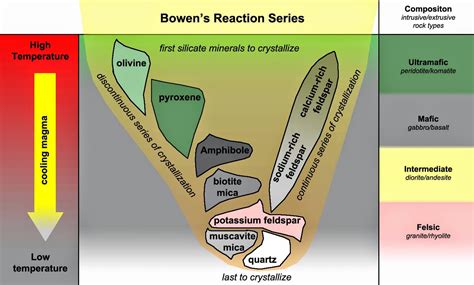
The Bowen reaction series is a fundamental concept in geology, specifically in the field of igneous petrology, that describes the sequence of mineral formation as magma cools and solidifies. Developed by Norman L. Bowen in the early 20th century, this series provides a framework for understanding the crystallization of minerals from magma and the resulting rock textures. The Bowen reaction series is a critical tool for geologists to interpret the origin and evolution of igneous rocks, which are formed from the cooling and solidification of magma or lava.
At its core, the Bowen reaction series is based on the concept of discontinuous reaction series, where minerals crystallize from magma in a specific order, influenced by the decreasing temperature. This series is divided into two main branches: the continuous and discontinuous reaction series. The continuous reaction series involves the formation of minerals that are chemically similar, such as plagioclase feldspars, which exhibit a continuous range of compositions between the end-members albite (NaAlSi3O8) and anorthite (CaAl2Si2O8). In contrast, the discontinuous reaction series involves the formation of minerals that are chemically distinct, such as the separation of ferromagnesian minerals like olivine, pyroxene, and hornblende.
Understanding the Continuous Reaction Series

The continuous reaction series is characterized by the crystallization of plagioclase feldspars, which are among the most common minerals in igneous rocks. As magma cools, the plagioclase feldspars crystallize in a sequence from more calcium-rich (anorthite) to more sodium-rich (albite) compositions. This sequence is a result of the gradual decrease in temperature, which affects the chemical equilibrium between the magma and the crystallizing minerals. The continuous reaction series is significant because it provides insights into the thermal history of the magma and the conditions under which the igneous rock formed.
Role of Temperature in Mineral Formation
Temperature plays a critical role in the Bowen reaction series, as it influences the crystallization sequence of minerals. As magma cools, the minerals that crystallize first are those that are stable at higher temperatures. For example, olivine, which is a common mineral in basaltic rocks, crystallizes at temperatures around 1200°C to 1300°C. In contrast, minerals like biotite and muscovite, which are more common in granitic rocks, crystallize at significantly lower temperatures, typically below 600°C. The temperature-dependent crystallization of minerals is a key factor in the formation of igneous rocks with diverse textures and compositions.
| Mineral | Crystallization Temperature (°C) |
|---|---|
| Olivine | 1200-1300 |
| Pyroxene | 1000-1200 |
| Amphibole | 800-1000 |
| Biotite | 600-800 |
| Muscovite | <500 |
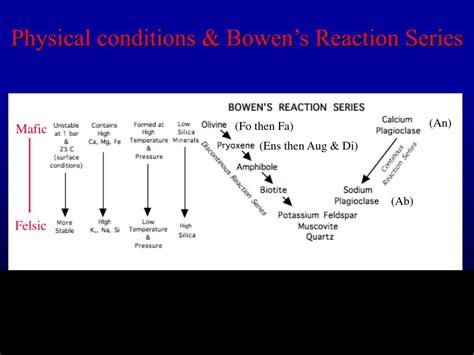
Discontinuous Reaction Series and Its Significance
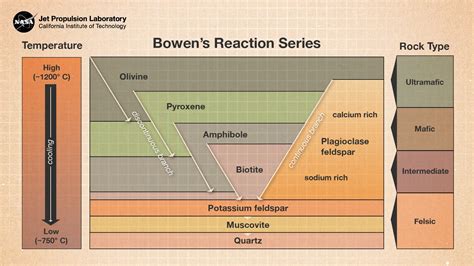
The discontinuous reaction series, on the other hand, involves the crystallization of minerals that are chemically distinct, such as ferromagnesian minerals (e.g., olivine, pyroxene, amphibole). These minerals crystallize in a sequence that reflects the decreasing temperature of the magma, with olivine being the first to crystallize, followed by pyroxene, and then amphibole. The discontinuous reaction series is significant because it provides a framework for understanding the formation of igneous rocks with diverse mineral assemblages and textures.
The Bowen reaction series has far-reaching implications for our understanding of igneous petrology and the formation of igneous rocks. By applying the principles of the Bowen reaction series, geologists can reconstruct the thermal history of magma chambers, understand the conditions under which igneous rocks formed, and gain insights into the Earth's magmatic and tectonic processes. Moreover, the Bowen reaction series has practical applications in fields such as geothermal energy, mineral exploration, and natural hazard mitigation.
Key Points
- The Bowen reaction series describes the sequence of mineral formation as magma cools and solidifies.
- The series is divided into continuous and discontinuous reaction series, reflecting the chemical similarity or distinctness of the crystallizing minerals.
- Temperature plays a critical role in the Bowen reaction series, influencing the crystallization sequence of minerals.
- The continuous reaction series involves the formation of plagioclase feldspars, while the discontinuous reaction series involves the formation of ferromagnesian minerals.
- The Bowen reaction series has significant implications for our understanding of igneous petrology, the formation of igneous rocks, and the Earth's magmatic and tectonic processes.
In conclusion, the Bowen reaction series is a fundamental concept in geology that provides a framework for understanding the crystallization of minerals from magma and the resulting rock textures. By applying the principles of the Bowen reaction series, geologists can gain valuable insights into the Earth's magmatic and tectonic processes, reconstruct the thermal history of magma chambers, and understand the conditions under which igneous rocks formed. The Bowen reaction series remains a cornerstone of igneous petrology, with ongoing research and applications continuing to refine our understanding of the Earth's igneous systems.
What is the Bowen reaction series, and why is it important in geology?
+The Bowen reaction series is a concept in geology that describes the sequence of mineral formation as magma cools and solidifies. It is important because it provides a framework for understanding the crystallization of minerals from magma and the resulting rock textures, which is crucial for reconstructing the thermal history of magma chambers and understanding the Earth’s magmatic and tectonic processes.
What is the difference between the continuous and discontinuous reaction series in the Bowen reaction series?
+The continuous reaction series involves the formation of minerals that are chemically similar, such as plagioclase feldspars, while the discontinuous reaction series involves the formation of minerals that are chemically distinct, such as ferromagnesian minerals (e.g., olivine, pyroxene, amphibole).
How does temperature influence the crystallization sequence of minerals in the Bowen reaction series?
+Temperature plays a critical role in the Bowen reaction series, as it influences the crystallization sequence of minerals. As magma cools, the minerals that crystallize first are those that are stable at higher temperatures, such as olivine, followed by pyroxene, and then amphibole.