The binomial random variable is a fundamental concept in probability theory, widely used in statistics, engineering, and computer science. It represents the number of successes in a fixed number of independent trials, each with a constant probability of success. This concept has far-reaching implications in various fields, including quality control, finance, and social sciences. In this article, we will delve into the world of binomial random variables, exploring their definition, properties, and applications.
Definition and Properties

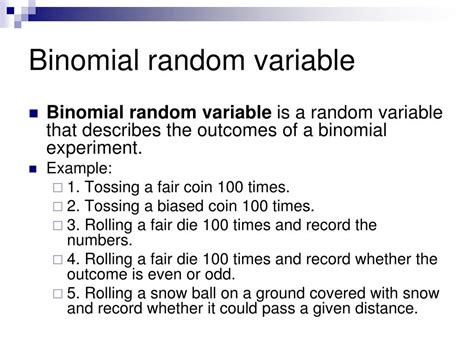
A binomial random variable is defined as the number of successes in n independent trials, each with a probability of success p. The probability of failure is denoted as q, where q = 1 - p. The binomial random variable is typically denoted as X and can take on values from 0 to n. The probability mass function (PMF) of a binomial random variable is given by the formula:
P(X = k) = (n choose k) \* p^k \* q^(n-k), where k is the number of successes and (n choose k) is the binomial coefficient, representing the number of ways to choose k successes from n trials.
Key Characteristics
The binomial random variable has several key characteristics, including:
- Mean: The mean of a binomial random variable is given by np, representing the expected number of successes.
- Variance: The variance of a binomial random variable is given by npq, representing the spread of the distribution.
- Standard Deviation: The standard deviation of a binomial random variable is given by the square root of the variance, √(npq).
Key Points
- The binomial random variable represents the number of successes in a fixed number of independent trials.
- The probability mass function (PMF) of a binomial random variable is given by the formula: P(X = k) = (n choose k) \* p^k \* q^(n-k).
- The mean of a binomial random variable is np, the variance is npq, and the standard deviation is √(npq).
- Binomial random variables have numerous applications in statistics, engineering, and computer science.
- The binomial distribution is a discrete distribution, meaning it can only take on specific values.
Applications and Examples

Binomial random variables have numerous applications in various fields, including:
- Quality Control: Binomial random variables are used to model the number of defective products in a manufacturing process.
- Finance: Binomial random variables are used to model the number of successful investments in a portfolio.
- Computer Science: Binomial random variables are used to model the number of successes in a series of independent trials, such as the number of correct guesses in a password cracking attempt.
| Application | Example |
|---|---|
| Quality Control | A manufacturer produces 1000 units per day, with a probability of 0.01 of a unit being defective. The number of defective units per day can be modeled as a binomial random variable. |
| Finance | An investor has a portfolio of 10 stocks, with a probability of 0.6 of each stock increasing in value. The number of stocks that increase in value can be modeled as a binomial random variable. |
| Computer Science | A password cracking algorithm attempts to guess a 10-character password, with a probability of 0.1 of guessing each character correctly. The number of correct guesses can be modeled as a binomial random variable. |
Calculating Probabilities
To calculate the probability of a binomial random variable, we can use the formula: P(X = k) = (n choose k) * p^k * q^(n-k). For example, suppose we want to calculate the probability of 3 successes in 10 trials, with a probability of success p = 0.4. We can calculate the probability as follows:
P(X = 3) = (10 choose 3) \* 0.4^3 \* 0.6^7 = 0.215
This means that the probability of 3 successes in 10 trials is approximately 0.215, or 21.5%.
What is the difference between a binomial random variable and a normal random variable?
+A binomial random variable is a discrete random variable that represents the number of successes in a fixed number of independent trials, while a normal random variable is a continuous random variable that represents a wide range of values. The binomial distribution is typically used to model the number of successes in a series of independent trials, while the normal distribution is used to model continuous data.
How do I calculate the probability of a binomial random variable?
+To calculate the probability of a binomial random variable, you can use the formula: P(X = k) = (n choose k) \* p^k \* q^(n-k), where n is the number of trials, k is the number of successes, p is the probability of success, and q is the probability of failure.
What are some common applications of binomial random variables?
+Binomial random variables have numerous applications in statistics, engineering, and computer science, including quality control, finance, and password cracking. They are used to model the number of successes in a series of independent trials, providing valuable insights into the behavior of complex systems.
In conclusion, the binomial random variable is a powerful tool for modeling real-world phenomena, providing valuable insights into the behavior of complex systems. By understanding the properties and applications of binomial random variables, professionals can make informed decisions and develop effective strategies in a wide range of fields. Whether you’re working in quality control, finance, or computer science, the binomial random variable is an essential concept to understand and apply.