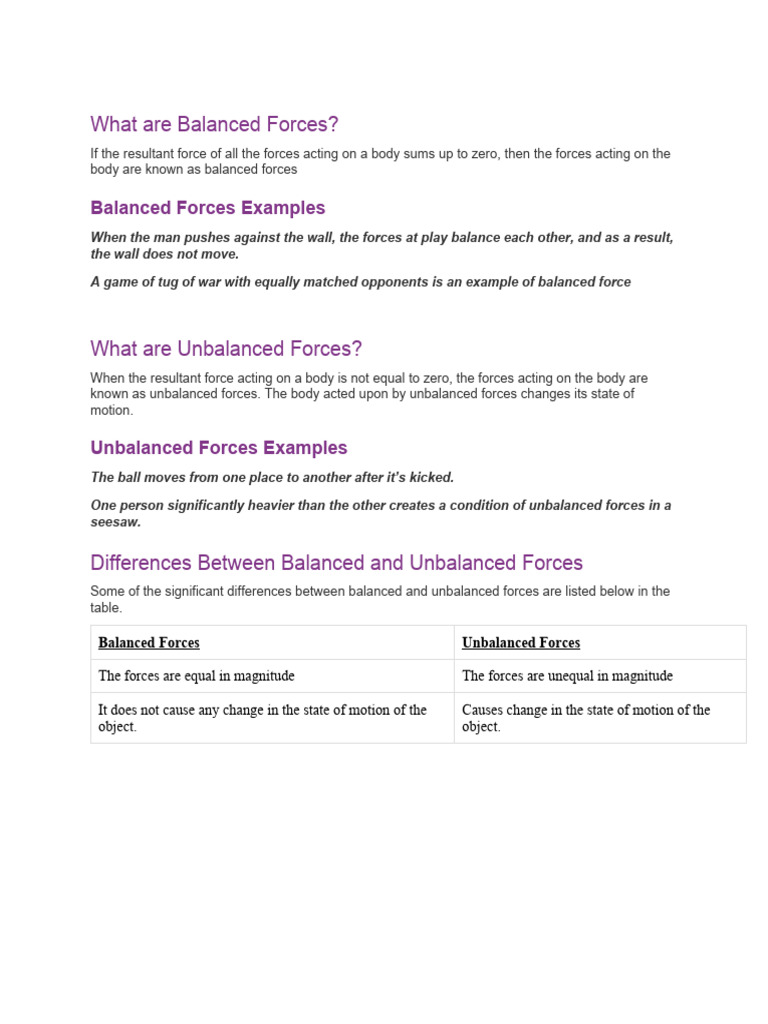
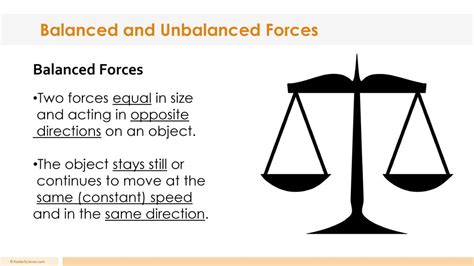
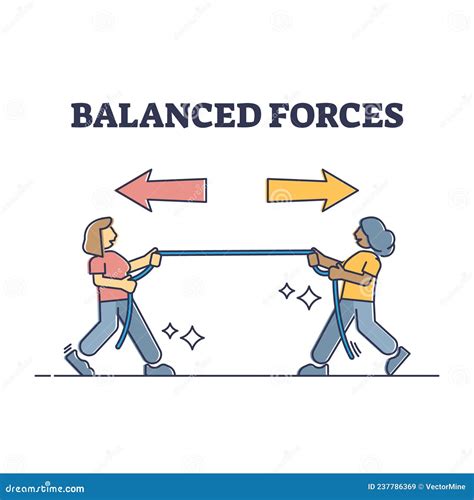
The concept of a balanced force is a fundamental principle in physics that describes the state where the net force acting on an object is zero. This occurs when the forces acting on the object are equal in magnitude and opposite in direction, resulting in no change in the object's motion. To understand this concept, it's essential to delve into the world of forces and Newton's laws of motion. The definition of a balanced force is rooted in the idea that forces are vectors, which means they have both magnitude and direction. When the forces acting on an object are balanced, the object is either at rest or moving at a constant velocity, as stated by Newton's first law of motion, also known as the law of inertia.
Understanding the Concept of Forces
Forces are interactions between objects that can cause changes in their motion. They can be classified into different types, such as frictional forces, gravitational forces, and normal forces, each playing a crucial role in determining the motion of an object. The concept of a balanced force is closely related to the idea of equilibrium, where the net force acting on an object is zero, and the object is in a state of balance. This balance can be achieved when the forces acting on the object are equal in magnitude and opposite in direction, resulting in no net force acting on the object.
Types of Forces and Their Role in Balanced Forces
There are several types of forces that can contribute to a balanced force, including frictional forces, which oppose motion between two surfaces in contact, and gravitational forces, which attract objects towards each other. Normal forces, which are perpendicular to the surface of contact between two objects, also play a crucial role in determining the motion of an object. The balance between these forces determines the net force acting on an object and, consequently, its motion. For example, when an object is placed on a horizontal surface, the gravitational force acting on the object is balanced by the normal force exerted by the surface, resulting in no net force acting on the object.
| Force Type | Description |
|---|---|
| Frictional Force | Opposes motion between two surfaces in contact |
| Gravitational Force | Attracts objects towards each other |
| Normal Force | Perpendicular to the surface of contact between two objects |
Key Points
- A balanced force occurs when the net force acting on an object is zero.
- Forces acting on an object can be classified into different types, including frictional forces, gravitational forces, and normal forces.
- The balance between these forces determines the net force acting on an object and, consequently, its motion.
- Understanding the concept of a balanced force is essential in predicting the motion of objects in various fields, including physics, engineering, and astronomy.
- The definition of a balanced force is rooted in Newton's laws of motion, specifically the law of inertia, which states that an object at rest will remain at rest, and an object in motion will continue to move with a constant velocity, unless acted upon by an external force.
Real-World Applications of Balanced Forces
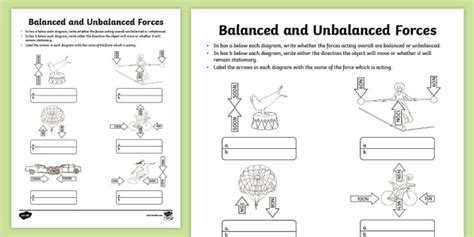
Balanced forces play a crucial role in various real-world applications, including engineering, architecture, and transportation. For example, in the design of bridges, balanced forces are essential in ensuring the structural integrity of the bridge, as the forces acting on the bridge, such as the weight of the bridge itself and the load it carries, must be balanced by the forces exerted by the bridge’s foundation and supports. Similarly, in the field of transportation, balanced forces are critical in ensuring the safety and stability of vehicles, as the forces acting on the vehicle, such as frictional forces and gravitational forces, must be balanced to prevent accidents and maintain control.
Importance of Balanced Forces in Everyday Life
Balanced forces are not only essential in various industries and fields but also play a crucial role in our everyday lives. For example, when we walk or run, the forces acting on our body, such as the gravitational force and the frictional force, must be balanced to maintain our balance and prevent falls. Similarly, when we lift objects, the forces acting on the object, such as the gravitational force and the force exerted by our muscles, must be balanced to prevent accidents and injuries.
What is the definition of a balanced force?
+A balanced force occurs when the net force acting on an object is zero, resulting in no change in the object's motion.
What are the types of forces that can contribute to a balanced force?
+The types of forces that can contribute to a balanced force include frictional forces, gravitational forces, and normal forces.
Why is understanding the concept of a balanced force important?
+Understanding the concept of a balanced force is essential in predicting the motion of objects in various fields, including physics, engineering, and astronomy, and in ensuring the safety and stability of vehicles and structures.
Meta Description: Learn about the concept of a balanced force, its definition, and its importance in understanding the motion of objects. Discover how balanced forces play a crucial role in various real-world applications, including engineering, architecture, and transportation.