The world of American Sign Language (ASL) is rich and complex, offering a unique visual and kinesthetic approach to communication. For those interested in learning ASL, understanding how to construct sentences is crucial. Here are five tips to help you improve your ASL sentence skills, enhancing your ability to communicate effectively and connect with the Deaf community.
Key Points
- Mastering non-manual markers (NMMs) to convey emotions and attitudes
- Understanding the importance of word order in ASL sentences
- Using spatial referencing to identify and discuss locations and objects
- Incorporating facial expressions and body language for nuanced communication
- Practicing storytelling techniques to engage and convey complex ideas
Non-Manual Markers (NMMs) in ASL Sentences
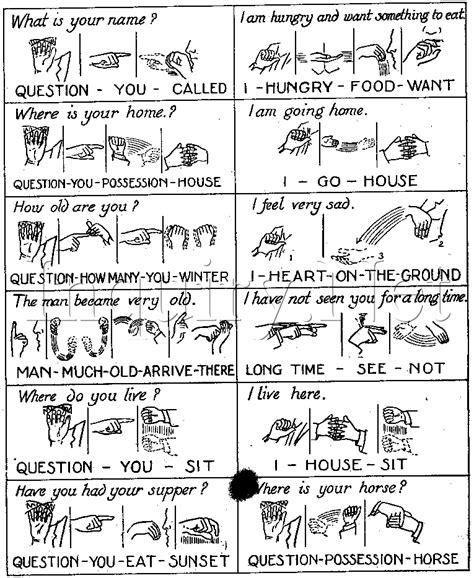
Non-manual markers are facial expressions, head movements, and body language that accompany manual signs to provide additional meaning. They are crucial in ASL for conveying emotions, attitudes, and for distinguishing between questions and statements. For example, raised eyebrows can turn a statement into a question, while a furrowed brow can indicate concentration or concern. Mastering NMMs requires practice and observation of native signers to understand the subtleties of their use.
The Role of Word Order in ASL
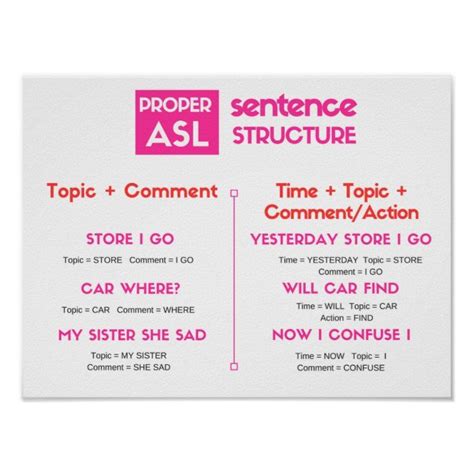
In ASL, the word order can vary significantly from English, often following a subject-verb-object (SVO) structure but with the flexibility to change based on the context and emphasis. Understanding and applying the correct word order is vital for clear communication. For instance, when asking a question, the word order might be adjusted to emphasize the interrogative aspect, such as placing the object at the beginning of the sentence to draw attention to it.
Spatial Referencing in ASL
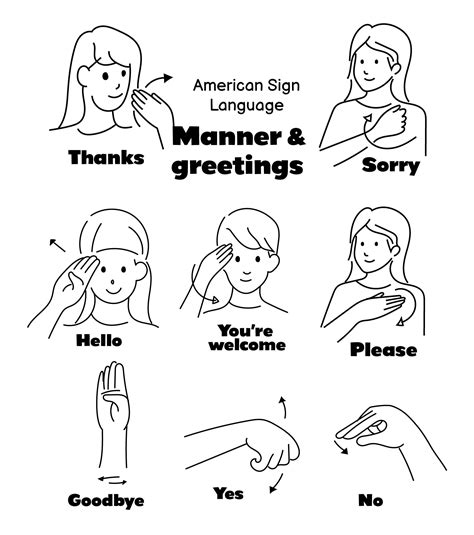
Spatial referencing is a fundamental aspect of ASL, where signs are directed in space to refer to specific locations, people, or objects. This technique allows for the efficient and clear discussion of complex spatial relationships and interactions. Practicing spatial referencing involves setting up a mental map of the signing space and consistently using specific locations to refer to particular entities, ensuring that communication remains precise and unambiguous.
Facial Expressions and Body Language
Facial expressions and body language play a significant role in ASL, providing essential cues about the emotional content and intent behind the message. They can soften or intensify the meaning of signs, convey sarcasm, irony, or humor, and engage the audience in the narrative. Developing an awareness of how facial expressions and body language influence the interpretation of signs is critical for effective communication in ASL.
Storytelling in ASL
Storytelling is an art form in ASL, combining manual signs, non-manual markers, spatial referencing, and nuanced facial expressions to convey intricate narratives. Practicing storytelling techniques involves learning to weave these elements together seamlessly, using the signing space to recreate scenes, and employing role-shifting to differentiate between characters. This skill not only enhances one’s ability to communicate complex ideas but also fosters a deeper connection with the Deaf community and its rich cultural heritage.
How can I improve my ASL sentence structure?
+Improving your ASL sentence structure involves consistent practice, observation of native signers, and a deep understanding of non-manual markers, word order, spatial referencing, and the integration of facial expressions and body language. Watching ASL stories and engaging in conversations with fluent signers can provide valuable insights and help refine your skills.
What role does word order play in ASL sentences?
+Word order in ASL is flexible and can vary based on context and emphasis. While ASL often follows a subject-verb-object structure, it can be adjusted for questioning, emphasizing certain aspects of the sentence, or for stylistic purposes. Understanding these variations is crucial for effective communication.
How do I use spatial referencing in ASL effectively?
+Effective use of spatial referencing involves establishing a consistent mental map of the signing space and using specific locations to refer to entities, people, or objects. Practice signing about different scenarios and interactions to become more comfortable with directing signs in space and using this technique to clarify complex relationships and actions.
Learning ASL is a rewarding journey that not only opens up new avenues of communication but also deepens one's appreciation for the culture and community of Deaf individuals. By focusing on the nuances of sentence structure, including non-manual markers, word order, spatial referencing, facial expressions, and body language, learners can enhance their signing skills and foster more meaningful connections with others.
| ASL Skill | Practice Recommendation |
|---|---|
| Non-Manual Markers | Watch and mimic native signers, focusing on facial expressions and head movements |
| Word Order | Practice signing simple sentences and then adjust the word order to ask questions or emphasize different aspects |
| Spatial Referencing | Set up scenarios in the signing space and practice directing signs to specific locations |
| Facial Expressions and Body Language | Record yourself signing and observe how your facial expressions and body language influence the message |
| Storytelling | Start with simple narratives and gradually incorporate more complex elements like role-shifting and spatial referencing |