Air resistance, also known as drag, is a force that opposes the motion of an object through the air. It is a critical factor in the design and performance of aircraft, vehicles, and other objects that move through the air. Understanding air resistance is essential for predicting the behavior of these objects and optimizing their design for efficiency and safety. In this article, we will explore five air resistance formulas that are commonly used in physics and engineering to calculate the drag force on an object.
Introduction to Air Resistance Formulas
Air resistance formulas are used to calculate the drag force on an object moving through the air. The drag force depends on several factors, including the object’s shape, size, velocity, and the density of the air. There are several different formulas that can be used to calculate air resistance, each with its own set of assumptions and limitations. The choice of formula depends on the specific application and the level of accuracy required.
Key Points
- The drag equation is a fundamental formula for calculating air resistance, which takes into account the object's velocity, cross-sectional area, and drag coefficient.
- The terminal velocity formula is used to calculate the maximum velocity an object can reach as it falls through the air, which is essential for predicting the behavior of objects in free fall.
- The air resistance formula for a sphere is a special case of the drag equation, which is used to calculate the drag force on a spherical object, such as a ball or a balloon.
- The air resistance formula for a rectangular object is used to calculate the drag force on an object with a rectangular cross-section, such as a flat plate or a building.
- The air resistance formula for a falling object is used to calculate the drag force on an object as it falls through the air, taking into account the object's velocity, mass, and drag coefficient.
The Drag Equation
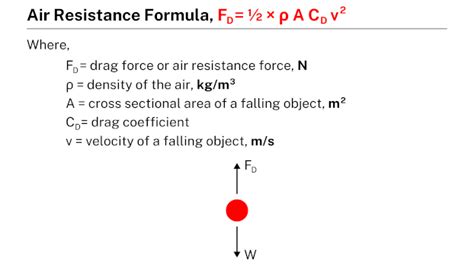
The drag equation is a fundamental formula for calculating air resistance. It is given by the equation:
F_d = ½ ρ v^2 C_d A
where F_d is the drag force, ρ is the air density, v is the object’s velocity, C_d is the drag coefficient, and A is the object’s cross-sectional area. The drag coefficient is a dimensionless quantity that depends on the object’s shape and size.
| Drag Coefficient | Object Shape |
|---|---|
| 0.47 | Sphere |
| 1.28 | Cube |
| 0.82 | Cylinder |
Terminal Velocity Formula
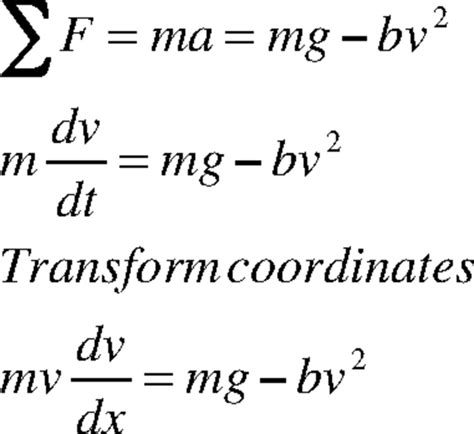
The terminal velocity formula is used to calculate the maximum velocity an object can reach as it falls through the air. It is given by the equation:
v_t = √(2mg / ρAC_d)
where v_t is the terminal velocity, m is the object’s mass, g is the acceleration due to gravity, ρ is the air density, A is the object’s cross-sectional area, and C_d is the drag coefficient.
Air Resistance Formula for a Sphere
The air resistance formula for a sphere is a special case of the drag equation. It is given by the equation:
F_d = ½ ρ v^2 C_d πr^2
where F_d is the drag force, ρ is the air density, v is the object’s velocity, C_d is the drag coefficient, and r is the sphere’s radius.
Air Resistance Formula for a Rectangular Object
The air resistance formula for a rectangular object is used to calculate the drag force on an object with a rectangular cross-section. It is given by the equation:
F_d = ½ ρ v^2 C_d (2lw)
where F_d is the drag force, ρ is the air density, v is the object’s velocity, C_d is the drag coefficient, l is the object’s length, and w is the object’s width.
Air Resistance Formula for a Falling Object
The air resistance formula for a falling object is used to calculate the drag force on an object as it falls through the air. It is given by the equation:
F_d = ½ ρ v^2 C_d A - mg
where F_d is the drag force, ρ is the air density, v is the object’s velocity, C_d is the drag coefficient, A is the object’s cross-sectional area, m is the object’s mass, and g is the acceleration due to gravity.
What is the difference between the drag equation and the terminal velocity formula?
+The drag equation is a general formula for calculating air resistance, while the terminal velocity formula is a special case of the drag equation that is used to calculate the maximum velocity an object can reach as it falls through the air.
How do I choose the right air resistance formula for my application?
+The choice of air resistance formula depends on the specific application and the level of accuracy required. If you are calculating the drag force on an object in general, the drag equation is a good choice. If you are calculating the terminal velocity of an object, the terminal velocity formula is a better choice.
What are some common mistakes to avoid when using air resistance formulas?
+Some common mistakes to avoid when using air resistance formulas include using the wrong formula for the application, neglecting to account for the object's shape and size, and failing to consider the air density and velocity.
In conclusion, air resistance formulas are essential tools for calculating the drag force on an object moving through the air. By understanding the different formulas and how to apply them, you can optimize the design of objects for efficiency and safety. Whether you are designing an aircraft, a vehicle, or a building, air resistance formulas can help you predict and mitigate the effects of air resistance.
Meta description suggestion: “Learn about the five air resistance formulas used to calculate drag force on objects moving through the air, including the drag equation, terminal velocity formula, and more.” (147 characters)