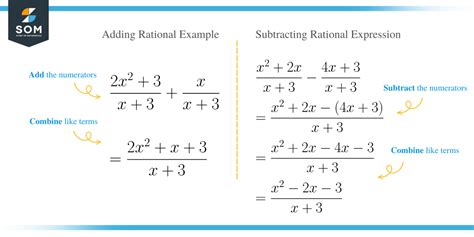
Adding and subtracting rational expressions can seem daunting, especially when dealing with complex fractions and variables. However, with a solid understanding of the underlying principles and a step-by-step approach, these operations can become much more manageable. In this article, we will delve into the world of rational expressions, exploring the concepts and techniques necessary to add and subtract them with ease.
Understanding Rational Expressions
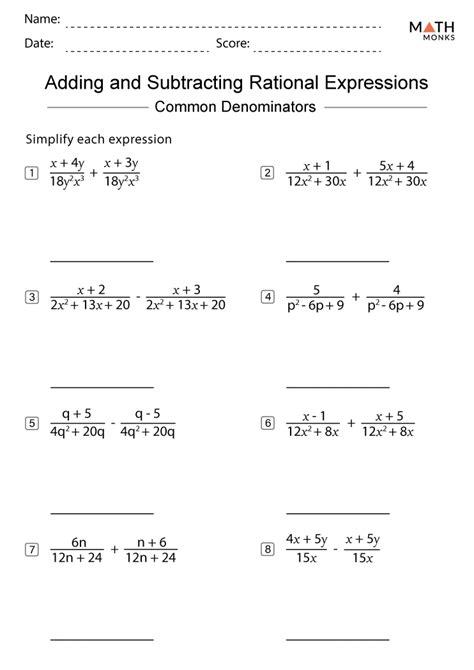
Rational expressions are fractions that contain variables in the numerator, denominator, or both. They can be simple, such as 1/x, or more complex, like (x^2 + 3x + 2)/(x^2 - 4). To add or subtract rational expressions, it is essential to first understand how to simplify and manipulate them. This involves factoring, canceling common factors, and finding common denominators.
Factoring and Simplifying Rational Expressions
Factoring is a critical step in simplifying rational expressions. By breaking down the numerator and denominator into their prime factors, we can identify and cancel common factors, thereby simplifying the expression. For instance, the expression (x^2 + 4x + 4)/(x^2 - 4) can be simplified by factoring the numerator and denominator: ((x + 2)^2)/((x + 2)(x - 2)). Canceling the common factor (x + 2) yields (x + 2)/(x - 2).
Key Points
- Understand the concept of rational expressions and their components.
- Learn how to factor and simplify rational expressions.
- Identify the importance of finding common denominators for addition and subtraction.
- Recognize the role of least common multiple (LCM) in finding common denominators.
- Apply these principles to add and subtract rational expressions with confidence.
Adding Rational Expressions
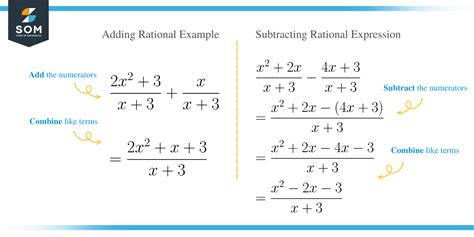
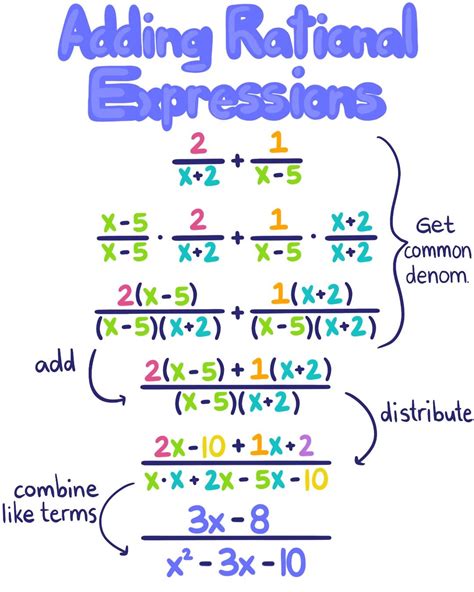
Adding rational expressions involves finding a common denominator and then combining the numerators. The key to success lies in identifying the least common multiple (LCM) of the denominators, which serves as the common denominator. For example, to add (1/x) + (1/(x + 1)), we first find the LCM of x and x + 1, which is x(x + 1). Then, we rewrite each fraction with this common denominator: (x + 1)/[x(x + 1)] + x/[x(x + 1)]. Finally, we combine the numerators: (x + 1 + x)/[x(x + 1)] = (2x + 1)/[x(x + 1)].
Subtracting Rational Expressions
Subtracting rational expressions follows a similar process to addition, with the main difference being the subtraction of the numerators. For instance, to subtract (1/x) - (1/(x + 1)), we again find the common denominator x(x + 1) and rewrite the fractions: (x + 1)/[x(x + 1)] - x/[x(x + 1)]. Then, we subtract the numerators: (x + 1 - x)/[x(x + 1)] = 1/[x(x + 1)].
| Operation | Expression | Common Denominator | Result |
|---|---|---|---|
| Addition | (1/x) + (1/(x + 1)) | x(x + 1) | (2x + 1)/[x(x + 1)] |
| Subtraction | (1/x) - (1/(x + 1)) | x(x + 1) | 1/[x(x + 1)] |
Real-World Applications and Forward-Looking Implications
Rational expressions are not just abstract mathematical constructs; they have numerous real-world applications. In physics, rational expressions are used to describe the motion of objects, the force of gravity, and the behavior of electrical circuits. In economics, they help model population growth, resource allocation, and financial markets. Understanding how to add and subtract rational expressions is essential for these applications, as it allows for the combination of different models and the prediction of outcomes based on varying conditions.
Looking forward, the ability to manipulate rational expressions will become increasingly important as technology advances and mathematical modeling becomes more sophisticated. With the rise of artificial intelligence and machine learning, the need for precise mathematical representations of complex systems will grow. Therefore, mastering the addition and subtraction of rational expressions is not only a fundamental skill for current applications but also a crucial foundation for future advancements in science, technology, engineering, and mathematics (STEM) fields.
What is the first step in adding or subtracting rational expressions?
+The first step is to find a common denominator for the expressions. This involves identifying the least common multiple (LCM) of the denominators.
How do I simplify a rational expression?
+To simplify a rational expression, factor the numerator and denominator, and then cancel any common factors.
What are some real-world applications of rational expressions?
+Rational expressions have applications in physics, economics, and other fields where they are used to model complex systems and predict outcomes.
Meta Description: Learn how to add and subtract rational expressions with ease. Master the techniques of finding common denominators, simplifying expressions, and applying these skills to real-world problems.
By following the principles outlined in this article and practicing with various examples, you will become proficient in adding and subtracting rational expressions. Remember, the key to success lies in understanding the fundamentals, applying them consistently, and always seeking to simplify and clarify the expressions you work with. With time and practice, these operations will become second nature, allowing you to tackle more complex mathematical challenges with confidence.