Mastering the basics of arithmetic operations is essential for anyone looking to build a strong foundation in mathematics. Among these operations, adding and subtracting integers can sometimes seem daunting, especially when dealing with negative numbers. However, with a clear understanding of the concepts and a few simple rules, anyone can become proficient in these operations. In this article, we will delve into the world of integers, exploring how to add and subtract them with ease, and providing insights into the practical applications of these skills.
Key Points
- Understanding the number line and how integers are represented on it.
- Learning the rules for adding and subtracting positive and negative integers.
- Practicing with examples to build confidence and fluency.
- Applying these skills to real-world problems and more complex mathematical concepts.
- Recognizing the importance of integers in various fields, including science, engineering, and finance.
Understanding Integers and the Number Line
Integers are whole numbers, either positive, negative, or zero, without a fractional part. The number line is a visual representation that helps in understanding the relationship between these numbers. It is a line that extends infinitely in two directions, with zero in the middle, positive numbers to the right, and negative numbers to the left. Each number on the line is a unit distance apart, with the distance between two numbers representing their difference. This visual tool is indispensable for grasping the concepts of addition and subtraction of integers.
Adding Integers
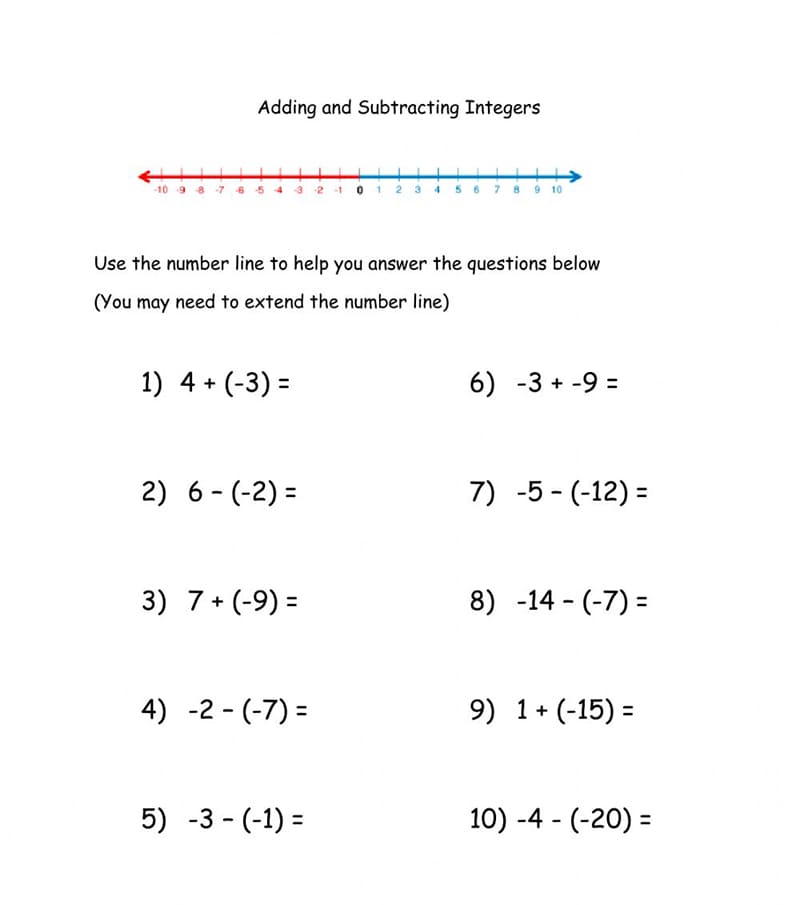
When adding integers, the process can be thought of as moving along the number line. Adding a positive number means moving to the right, while adding a negative number means moving to the left. For example, if you start at zero and add 5, you move 5 units to the right, landing on 5. If you then add -3, you move 3 units to the left, resulting in 2. This can be represented as 0 + 5 - 3 = 2. The rules for adding integers can be summarized as follows:
- Adding two positive integers: Simply add their values. For example, 3 + 4 = 7.
- Adding two negative integers: Add their values and keep the negative sign. For example, -3 + (-4) = -7.
- Adding a positive and a negative integer: Subtract the smaller absolute value from the larger one and keep the sign of the number with the larger absolute value. For example, 5 + (-3) = 2, because 5 is larger than 3, and it’s positive.
Subtracting Integers
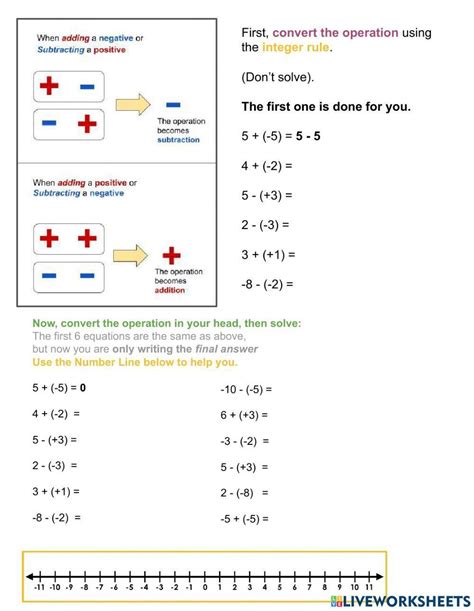
Subtracting integers can be a bit more complex, but it follows a similar logic. Subtracting a number is equivalent to adding its opposite. So, subtracting a positive number is the same as adding a negative number, and vice versa. For instance, subtracting 3 from 5 is the same as adding -3 to 5, which results in 2. The rules for subtracting integers are as follows:
- Subtracting a positive integer from another positive integer: If the first number is larger, subtract the second from the first. If the second number is larger, subtract the first from the second and add a negative sign. For example, 7 - 3 = 4, but 3 - 7 = -4.
- Subtracting a negative integer from a positive integer: This is equivalent to adding the positive value of the negative integer to the positive integer. For example, 5 - (-3) = 5 + 3 = 8.
- Subtracting a positive integer from a negative integer: This involves adding the negative of the positive integer to the negative integer, which results in a more negative number. For example, -3 - 4 = -3 + (-4) = -7.
Practical Applications and Real-World Examples
The ability to add and subtract integers is crucial in various aspects of life and across different disciplines. In science, it’s used for calculating changes in temperature, pressure, or velocity. In finance, it’s essential for managing budgets, calculating profits and losses, and understanding financial trends. Even in everyday life, being able to quickly calculate the total cost of items, the change due after a purchase, or the difference in time between two events can be incredibly useful.
| Scenario | Operation | Example |
|---|---|---|
| Temperature Change | Subtraction | 25°C - 10°C = 15°C |
| Financial Transaction | Addition/Subtraction | $100 + $50 - $20 = $130 |
| Time Difference | Subtraction | 10:00 AM - 7:00 AM = 3 hours |
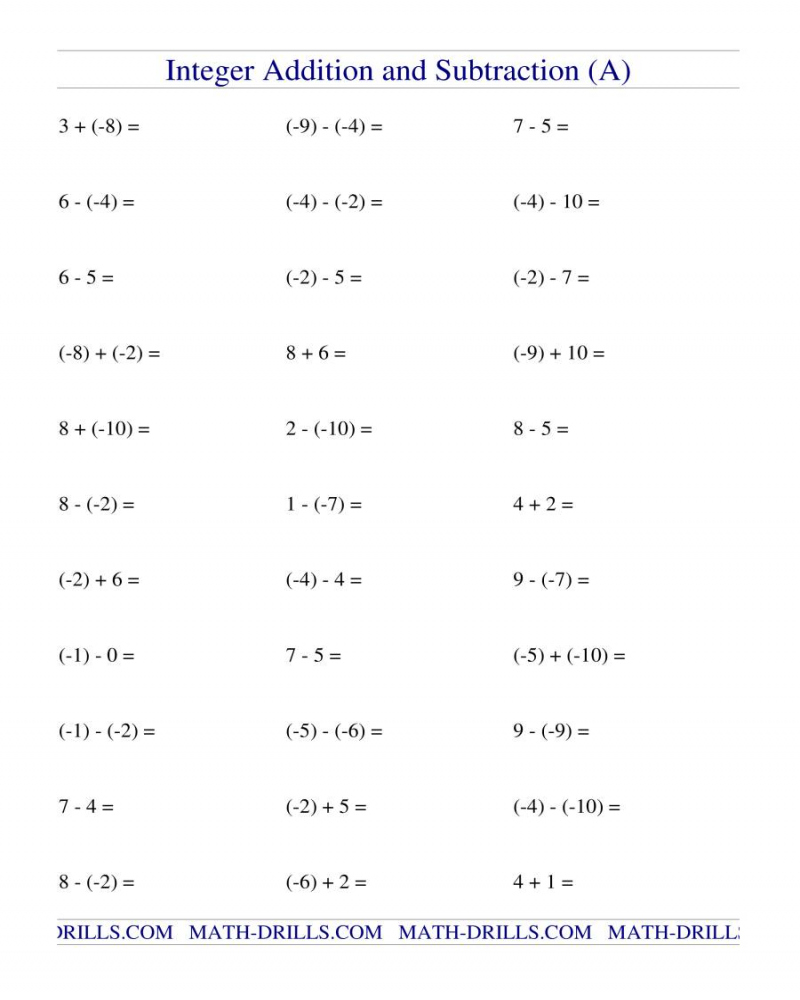
Conclusion and Future Directions
In conclusion, adding and subtracting integers, while it may seem daunting at first, is a skill that can be easily mastered with practice and a clear understanding of the underlying principles. By grasping these concepts, individuals can build a solid foundation in mathematics, enhance their problem-solving skills, and open themselves up to a world of opportunities in science, technology, engineering, and mathematics (STEM) fields, as well as in everyday life. As technology continues to advance and data becomes an increasingly important part of decision-making, the ability to work with integers and other mathematical concepts will only grow in importance.
What is the easiest way to remember the rules for adding and subtracting integers?
+One of the easiest ways to remember is to think of adding and subtracting in terms of movement on the number line. Adding a positive number moves you to the right, adding a negative number moves you to the left, and subtracting a number is the same as adding its opposite.
How do I know when to add or subtract when dealing with negative numbers?
+It’s essential to understand that subtracting a negative number is the same as adding a positive number, and vice versa. So, if you see a subtraction sign followed by a negative number, you can change the subtraction sign to an addition sign and remove the negative sign from the number.
What are some real-world applications of adding and subtracting integers?
+These operations are used in finance for calculating profits and losses, in science for measuring changes in physical quantities like temperature or velocity, and in everyday life for calculating the total cost of items, the change due after a purchase, or the difference in time between two events.