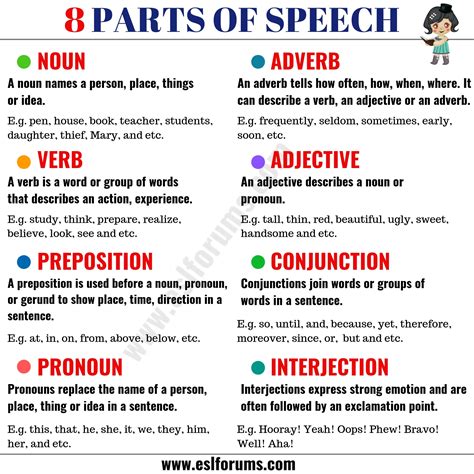
The English language is comprised of eight parts of speech, each serving a unique function in the formation of sentences and the conveyance of meaning. Understanding these parts of speech is essential for effective communication, as they provide the foundation for constructing coherent and grammatically correct sentences. In this article, we will delve into the eight parts of speech, exploring their definitions, functions, and examples to illustrate their usage in context.
Key Points
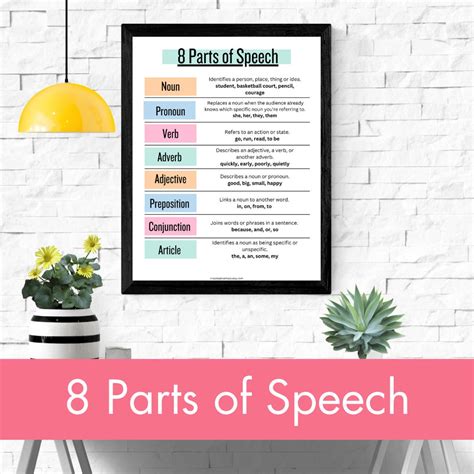
- The eight parts of speech are nouns, pronouns, verbs, adjectives, adverbs, prepositions, conjunctions, and interjections.
- Each part of speech has a distinct function in sentence construction and meaning conveyance.
- Understanding the parts of speech is crucial for effective communication and grammatical correctness.
- The classification of words into parts of speech can sometimes be ambiguous, depending on the context in which they are used.
- Mastery of the parts of speech is essential for writing, speaking, and language comprehension.
Nouns and Pronouns: The Foundations of Sentence Structure
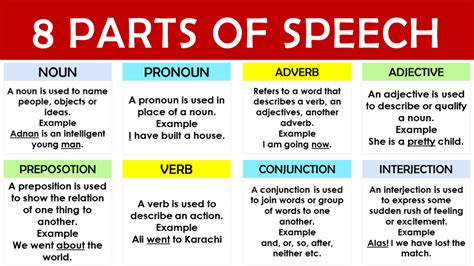
Nouns and pronouns are the building blocks of sentences, serving as the subjects, objects, and complements that provide meaning and context. Nouns are words that refer to people, places, things, and ideas, such as “book,” “city,” and “happiness.” Pronouns, on the other hand, are words that replace nouns in sentences, making language more efficient and concise. Examples of pronouns include “he,” “she,” “it,” and “they.” The distinction between nouns and pronouns is crucial, as it affects the clarity and coherence of sentences.
Verbs: The Action and Linking Elements
Verbs are words that express action, occurrence, or state of being, linking the subject to the rest of the sentence. They can be action verbs, such as “run,” “jump,” and “write,” or linking verbs, such as “be,” “seem,” and “appear.” Verbs are essential for conveying the central idea or action of a sentence, and their correct usage is vital for maintaining grammatical accuracy. The choice of verb can significantly impact the tone, mood, and meaning of a sentence, making it a critical aspect of language expression.
| Part of Speech | Definition | Examples |
|---|---|---|
| Nouns | Words that refer to people, places, things, and ideas | book, city, happiness |
| Pronouns | Words that replace nouns in sentences | he, she, it, they |
| Verbs | Words that express action, occurrence, or state of being | run, jump, write, be, seem, appear |
Adjectives and Adverbs: The Descriptive Elements
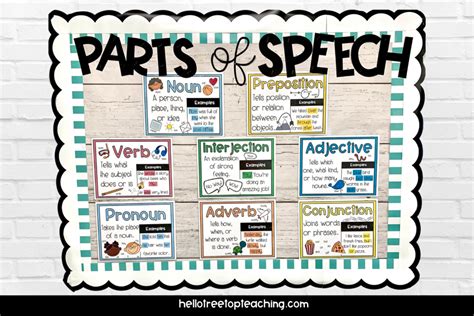
Adjectives and adverbs are words that modify or describe other words or phrases, providing additional information about their characteristics, qualities, or quantities. Adjectives modify nouns or pronouns, such as “happy,” “blue,” and “big,” while adverbs modify verbs, adjectives, or other adverbs, such as “quickly,” “very,” and “well.” The correct usage of adjectives and adverbs is essential for creating vivid and engaging descriptions, as well as for conveying nuanced shades of meaning in language.
Prepositions and Conjunctions: The Connective Elements
Prepositions and conjunctions are words that connect words, phrases, or clauses, establishing relationships between them. Prepositions show the relationship between a noun or pronoun and other words in the sentence, such as “in,” “on,” and “under.” Conjunctions, on the other hand, connect words, phrases, or clauses, such as “and,” “but,” and “or.” The effective use of prepositions and conjunctions is vital for creating clear and logical sentence structures, as well as for conveying complex ideas and relationships between concepts.
Interjections: The Expressive Elements
Interjections are words that express emotion or feeling, often used to convey strong emotions or reactions, such as “oh,” “ouch,” and “wow.” They can be used to add emphasis or create a specific tone in writing or speech. Interjections are an essential part of language, as they provide a means of expressing emotions and attitudes in a way that is both concise and impactful.
In conclusion, the eight parts of speech are the fundamental components of language, each serving a unique function in the formation of sentences and the conveyance of meaning. By understanding and mastering the parts of speech, individuals can improve their communication skills, enhance their writing and speaking abilities, and develop a deeper appreciation for the complexities and nuances of language.
What are the eight parts of speech in the English language?
+The eight parts of speech are nouns, pronouns, verbs, adjectives, adverbs, prepositions, conjunctions, and interjections.
How do nouns and pronouns differ in their functions?
+Nouns refer to people, places, things, and ideas, while pronouns replace nouns in sentences, making language more efficient and concise.
What is the purpose of adjectives and adverbs in sentence construction?
+Adjectives and adverbs modify or describe other words or phrases, providing additional information about their characteristics, qualities, or quantities.
How do prepositions and conjunctions contribute to sentence structure and meaning?
+Prepositions show the relationship between a noun or pronoun and other words in the sentence, while conjunctions connect words, phrases, or clauses, establishing relationships between them.
What is the function of interjections in language expression?
+Interjections express emotion or feeling, often used to convey strong emotions or reactions, and can add emphasis or create a specific tone in writing or speech.
Meta Description: Learn about the eight parts of speech, including nouns, pronouns, verbs, adjectives, adverbs, prepositions, conjunctions, and interjections, and discover how they function together to convey meaning and create effective language expression. (148 characters)