Converting temperature from Fahrenheit to Celsius is a common task in various fields, including science, engineering, and everyday life. The need to accurately convert between these two temperature scales arises from the fact that different countries and industries use different scales for measuring temperature. For instance, the United States predominantly uses Fahrenheit, while most other countries use Celsius. Understanding how to perform this conversion is essential for ensuring accuracy in measurements and calculations. In this article, we will delve into the details of the Fahrenheit to Celsius conversion process, providing a comprehensive guide on how to convert temperature from Fahrenheit to Celsius.
Understanding the Fahrenheit and Celsius Scales
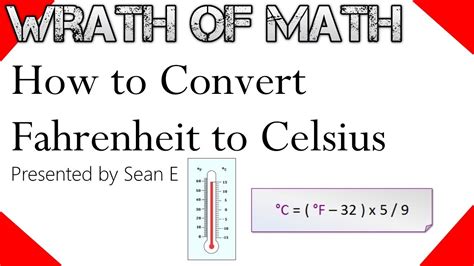
The Fahrenheit scale and the Celsius scale are two different temperature scales. The Fahrenheit scale was introduced by Gabriel Fahrenheit in 1724, while the Celsius scale, formerly known as the centigrade scale, was introduced by Anders Celsius in 1742. The key difference between the two scales lies in their reference points and the size of their degrees. On the Fahrenheit scale, water freezes at 32°F and boils at 212°F. In contrast, on the Celsius scale, water freezes at 0°C and boils at 100°C. This difference in reference points necessitates a conversion formula to translate temperatures from one scale to the other.
The Conversion Formula
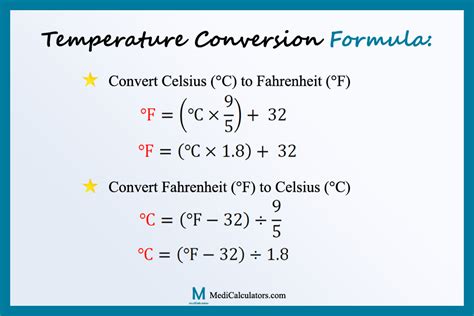
The formula to convert temperature from Fahrenheit (°F) to Celsius (°C) is given by: °C = (°F - 32) × 5⁄9. This formula is derived from the difference in the freezing and boiling points of water between the two scales. By subtracting 32 from the Fahrenheit temperature, we adjust for the difference in the zero points of the two scales. Then, by multiplying by 5⁄9, we adjust for the difference in the size of the degrees between the two scales.
| Temperature Scale | Freezing Point of Water | Boiling Point of Water |
|---|---|---|
| Fahrenheit | 32°F | 212°F |
| Celsius | 0°C | 100°C |
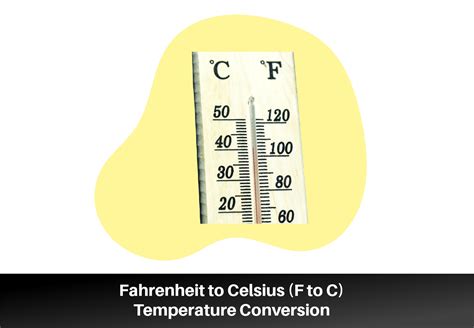
Practical Applications of Fahrenheit to Celsius Conversion
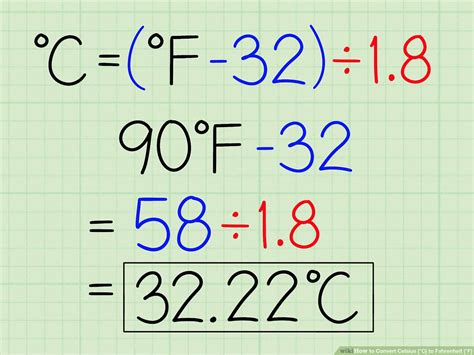
The ability to convert temperature from Fahrenheit to Celsius has numerous practical applications across various fields. In science and engineering, accurate temperature measurements are critical for conducting experiments, designing systems, and ensuring the safety and efficiency of operations. For instance, in the field of chemistry, understanding the melting and boiling points of substances in both Fahrenheit and Celsius is essential for conducting experiments and predicting the behavior of materials under different conditions.
Case Study: Temperature Conversion in Weather Forecasting
In weather forecasting, temperature plays a crucial role in predicting weather patterns and storms. Meteorologists often need to convert temperature from Fahrenheit to Celsius when analyzing global weather data, as different countries may report temperature in different scales. Accurate conversion is essential for making precise weather forecasts and warnings, which can have significant implications for public safety and economic activities.
Key Points
- The Fahrenheit to Celsius conversion formula is °C = (°F - 32) × 5/9.
- Understanding the difference in reference points and degree sizes between the two scales is crucial for accurate conversion.
- Temperature conversion has practical applications in science, engineering, and everyday life.
- Accurate temperature measurements are critical for ensuring safety, efficiency, and precision in various fields.
- Temperature conversion is essential in weather forecasting for making precise predictions and warnings.
Challenges and Considerations in Temperature Conversion
While converting temperature from Fahrenheit to Celsius is a straightforward process using the conversion formula, there are challenges and considerations that need to be addressed. One of the main challenges is ensuring accuracy, especially when dealing with very high or very low temperatures. Small errors in calculation can result in significant discrepancies in the final result. Additionally, the choice of temperature scale can affect the perceived severity of temperature extremes, with Celsius often providing a more intuitive sense of how hot or cold it is compared to Fahrenheit.
Best Practices for Accurate Temperature Conversion
To ensure accurate temperature conversion, it is essential to follow best practices. These include using the correct conversion formula, double-checking calculations, especially for critical applications, and being mindful of the context in which the temperature is being measured and reported. Furthermore, understanding the limitations and potential biases of the measurement tools and the scales themselves can help in making more informed decisions based on temperature data.
What is the formula to convert Fahrenheit to Celsius?
+The formula to convert temperature from Fahrenheit (°F) to Celsius (°C) is °C = (°F - 32) × 5/9.
Why is it important to convert temperature from Fahrenheit to Celsius?
+Converting temperature from Fahrenheit to Celsius is important for ensuring accuracy in measurements and calculations, especially in fields where precise temperature control is critical, such as science, engineering, and weather forecasting.
What are some practical applications of Fahrenheit to Celsius conversion?
+Practical applications include scientific research, industrial processes, weather forecasting, and everyday life, where accurate temperature measurements are necessary for safety, efficiency, and precision.
In conclusion, converting temperature from Fahrenheit to Celsius is a fundamental process that requires understanding the differences between the two temperature scales and applying the correct conversion formula. With its wide range of applications and the need for precision, mastering the art of temperature conversion is essential for both professionals and individuals seeking to understand and work with temperature data accurately.