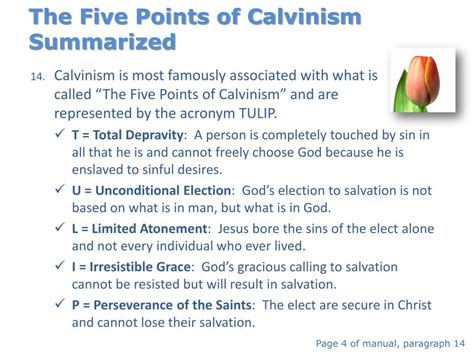
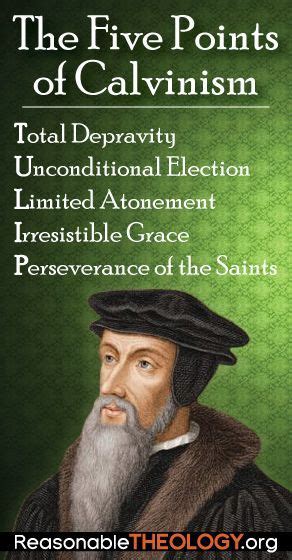
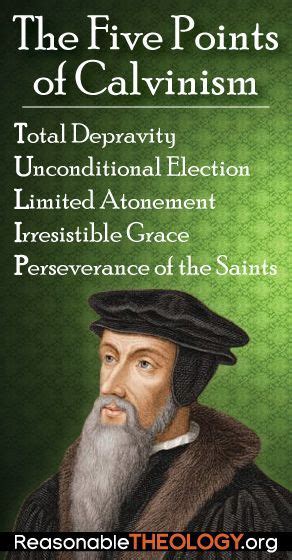
The 5 Points of Calvinism, also known as the Doctrines of Grace, are a foundational aspect of Reformed theology. These points were formulated as a response to the Arminian Remonstrance, a theological statement that countered the Calvinistic views on salvation. The 5 Points of Calvinism are typically remembered using the acronym TULIP, which stands for Total Depravity, Unconditional Election, Limited Atonement, Irresistible Grace, and Perseverance of the Saints.
Introduction to the 5 Points
The development of the 5 Points of Calvinism was a result of the Synod of Dort, which convened in 1618-1619 in the Netherlands. This synod was called to address the theological disagreements between the Calvinists and the Arminians. The Calvinistic delegates to the synod formulated these five points as a response to the Arminian Remonstrance, providing a clear and systematic presentation of their views on salvation. The 5 Points of Calvinism have since become a cornerstone of Reformed theology, influencing numerous Christian denominations and traditions.
Key Points
- Total Depravity: The doctrine that humanity is completely fallen and unable to save itself.
- Unconditional Election: The belief that God chooses those who will be saved based on His sovereign will, not on human merit or foreseen faith.
- Limited Atonement: The teaching that Jesus' death on the cross was specifically intended to atone for the sins of the elect, not for every individual.
- Irresistible Grace: The concept that the Holy Spirit's call to salvation is effectual and cannot be resisted by those whom God has chosen.
- Perseverance of the Saints: The doctrine that those who are truly saved will persevere in their faith until the end, being kept by God's power.
Total Depravity
Total Depravity, the first point of Calvinism, asserts that humanity is completely fallen and unable to save itself. This doctrine is based on the biblical teaching that humanity’s rebellion against God has resulted in a comprehensive corruption of human nature, affecting every aspect of human existence. According to Romans 3:10-18, humanity is described as being under the power of sin, with no one seeking God or being able to come to Him on their own. This understanding of human nature emphasizes the need for divine intervention in salvation, highlighting the absolute dependence on God’s grace for redemption.
Unconditional Election
Unconditional Election, the second point, posits that God chooses those who will be saved based on His sovereign will, not on human merit or foreseen faith. This doctrine is rooted in the biblical concept of God’s sovereignty and His right to choose whom He wills for salvation. Ephesians 1:4-5 illustrates this point, stating that God chose believers in Christ before the foundation of the world, according to the purpose of His will. The emphasis here is on God’s initiative and grace in salvation, rather than on human decision or works.
| Calvinistic Doctrine | Biblical Reference |
|---|---|
| Total Depravity | Romans 3:10-18 |
| Unconditional Election | Ephesians 1:4-5 |
| Limited Atonement | John 10:11, 26 |
| Irresistible Grace | John 6:44, 65 |
| Perseverance of the Saints | John 10:28-29, Romans 8:35-39 |
Limited Atonement
Limited Atonement, the third point of Calvinism, teaches that Jesus’ death on the cross was specifically intended to atone for the sins of the elect, not for every individual. This doctrine is often the most controversial of the 5 Points, as it seems to limit the scope of Christ’s atonement. However, proponents argue that the Bible teaches that Christ’s death was definitively for His people, as seen in John 10:11, 26, where Jesus says, “I lay down my life for the sheep.” The emphasis is on the effectiveness of Christ’s atonement for those whom God has chosen, rather than on its potential or universal application.
Irresistible Grace
Irresistible Grace, the fourth point, posits that the Holy Spirit’s call to salvation is effectual and cannot be resisted by those whom God has chosen. This doctrine highlights the power and efficacy of God’s grace in salvation, emphasizing that it is not merely an offer that can be accepted or rejected, but a sovereign work of God that brings about the desired response. According to John 6:44, 65, no one can come to Jesus unless the Father draws him, and it is the Father’s will that those who are drawn will indeed come to Jesus.
Perseverance of the Saints
Perseverance of the Saints, the fifth and final point, asserts that those who are truly saved will persevere in their faith until the end, being kept by God’s power. This doctrine provides assurance and comfort to believers, emphasizing that their salvation is secure in God’s hands. John 10:28-29 and Romans 8:35-39 provide biblical support for this point, teaching that believers are kept by God’s power and that nothing can separate them from the love of Christ.
In conclusion, the 5 Points of Calvinism offer a comprehensive and cohesive understanding of salvation, emphasizing God's sovereignty, grace, and initiative in redeeming humanity. While these doctrines may be subject to various interpretations and debates, they remain a significant part of Reformed theology, shaping the beliefs and practices of numerous Christian denominations and traditions.
What is the primary focus of the 5 Points of Calvinism?
+The primary focus of the 5 Points of Calvinism is to emphasize God’s sovereignty and grace in salvation, highlighting His initiative and work in redeeming humanity.
How do the 5 Points of Calvinism relate to the concept of free will?
+The 5 Points of Calvinism suggest that human free will is limited by sin and that true freedom to choose God comes through the gracious work of the Holy Spirit, which is effectual and irresistible for those whom God has chosen.
What is the significance of the acronym TULIP in relation to the 5 Points of Calvinism?
+The acronym TULIP stands for Total Depravity, Unconditional Election, Limited Atonement, Irresistible Grace, and Perseverance of the Saints, providing a memorable way to recall the five key doctrines of Calvinism.